A Risk-Based Framework for Trusting AI-Generated Code
- AI Generated Code
- Code Review
- Software Engineering
- Risk Management
The Problem With All-Or-Nothing AI Coding Policies
Most engineering organisations are still deciding between two extremes when it comes to AI-generated code: let it into everything, or keep it out of everything. Neither position holds up under scrutiny. Some major open source infrastructure projects have already worked through this question in public, and their conclusions point toward a more useful answer: the right level of trust in AI-generated code depends on what the code actually does, not on where it came from.
Several widely used projects now separate private AI use, understanding a codebase, debugging, drafting documentation, from the act of contributing AI-generated output back into a shared codebase. Private use is broadly accepted. Direct contribution is where policies diverge, and the deciding factor is almost always the cost of a mistake. Reviewer workload, safety and security exposure, and intellectual property risk are the reasons cited most often for restricting AI contributions in critical infrastructure such as language runtimes and compilers, where a subtle defect can propagate into everything built on top of it.
That split maps cleanly onto three tiers that any product team can apply. Low-stakes internal tools and early prototypes can absorb a high volume of AI-generated code because the cost of a mistake is low. Ordinary customer-facing features sit in the middle: AI can write a large share of the code, but strong typing, automated tests, monitoring and a real review step still matter. High-leverage systems, anything touching payments, authentication, data integrity or infrastructure, deserve the same handcrafted rigour they always have, whatever tooling produced the first draft.
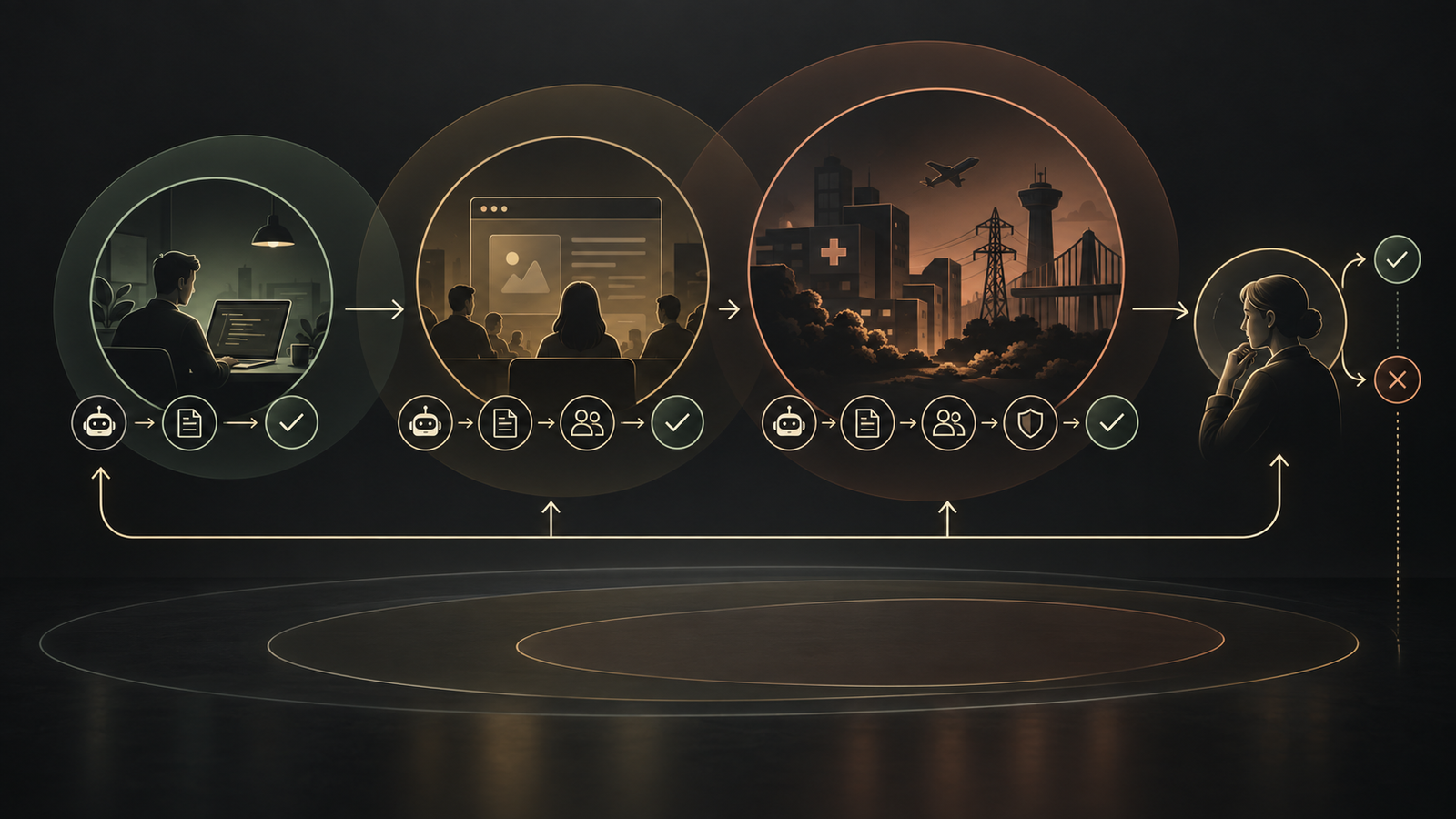
Review Capacity Is the Actual Bottleneck
Generating code faster does not help a team that cannot review it fast enough. That is the pattern showing up across the projects tightening their AI policies: a flood of plausible-looking contributions that still require a human to read, understand and take responsibility for every line. The fix is not to slow down code generation. It is to treat review as infrastructure in its own right.
That means combining static analysis, dynamic analysis and rule-based checks with AI-assisted review tools, then measuring the combination against concrete signals: defect rates, review turnaround time and how many real vulnerabilities get caught before release. It also means writing down coding standards in a form both people and AI tools can reference consistently, rather than leaving conventions to tribal knowledge that varies reviewer to reviewer.
Scoping Tasks to Limit the Blast Radius
The other lever is upstream of review entirely: how AI tasks get scoped in the first place. A vague instruction produces a large, internally consistent block of code built on one early wrong assumption, and that assumption compounds through every decision after it. A narrow, explicit task, described down to edge cases and paired with a test written first, gives a much smaller surface for that kind of error to hide in. Persistent project context, a maintained record of architecture, conventions and previously rejected approaches, keeps that discipline from resetting with every new session.
None of this is really new advice. It is the same discipline that has always separated maintainable web applications from fragile ones: know what you are building before you build it, keep review proportional to risk and never let a fast first draft substitute for a system someone actually understands. AI changes how quickly the first draft appears. It should not change who is accountable for what ships.
Frequently asked questions
How much AI-generated code should a software team allow in production?
The right amount depends on the risk of the system being built: low-stakes internal tools can use AI-generated code heavily, while payments, authentication and other high-leverage systems need the same rigorous, human-led development they always required. Ordinary customer-facing features sit in between, where AI can write much of the code as long as strong typing, automated tests, monitoring and a real review step remain in place.
Why do some engineering teams restrict AI-generated code in critical systems?
Teams restrict AI-generated code in critical systems mainly because of reviewer workload, security exposure and the cost of a subtle defect propagating through infrastructure that everything else depends on. Private use of AI for understanding or debugging code is usually still allowed, only direct contribution of AI-generated output is restricted.
What is blast radius in AI-assisted coding?
Blast radius describes how far a wrong assumption in an AI-generated task can spread before anyone notices it. Scoping AI tasks narrowly, describing edge cases explicitly and pairing them with a test written first keeps that blast radius small and easier to review.
How can teams make AI code review more effective?
Teams make AI code review more effective by combining static analysis, dynamic analysis and rule-based checks with AI-assisted tools, then tracking concrete signals such as defect rates, review turnaround time and vulnerabilities caught before release. Written, shared coding standards also help AI review tools give consistent, relevant feedback instead of generic suggestions.
Does using AI to write code reduce the need for code review?
No, using AI to write code increases the need for structured code review rather than reducing it, since a higher volume of plausible-looking code still needs a human to read, understand and take responsibility for it. Review should be treated as infrastructure, not an afterthought, especially as AI generates a larger share of the first draft.
Put this into practice
Explore the services related to this article.
A short note about the product, the timeline and who it is for is enough to start. You will hear back from the engineer who would do the work, not a sales team.
Start a partnership