Code Review Is the Real Bottleneck in AI Assisted Development
- Code Review
- AI Assisted Development
- Software Quality
- Engineering Process
Teams that adopted AI coding agents expected the old constraint to loosen. It did, just not where most people expected. Generating code got radically faster. Reviewing it did not. Once an agent can produce in minutes what used to take a developer half a day, the queue backs up somewhere else: in front of whoever has to decide if that code is actually safe to ship.
This shift changes what a competent engineering process looks like. A review step designed around a person writing a modest amount of code per day cannot absorb a much larger volume without either rubber stamping changes or burning out the engineers stuck approving them. Some teams have responded by tightening the rules specifically for the riskiest code, requiring a senior engineer to sign off before anything touching a critical system merges, while lower stakes changes move through faster. Others have tried to automate review end to end. Neither works alone. Volume needs automation. Judgment still needs a person.
Code Review Cannot Stay a Single Gate at AI Speed
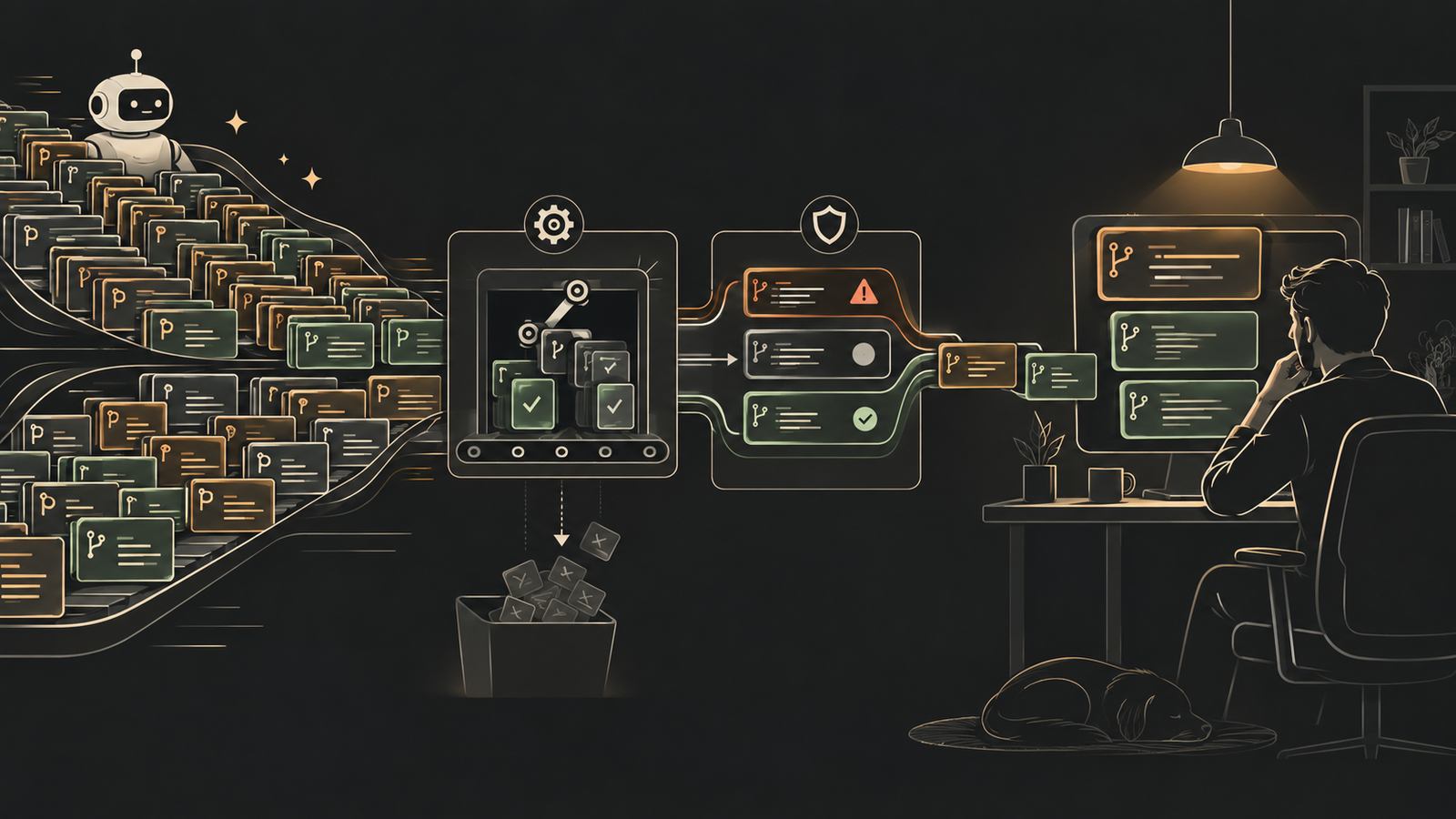
Treating review as one checkpoint at the end of a pull request is what breaks first once AI generated volume goes up. A more durable structure runs checks at several points, each catching a different class of problem before it reaches the next.
The first layer is deterministic and cheap: formatters, linters, type checks and security scanners running automatically the moment an agent finishes a task, with the results fed straight back so the agent can correct itself before a human ever looks at the change. The second layer uses a separate AI pass to evaluate the first agent's output against explicit criteria: correctness, security, whether the logic is simpler than it needs to be, and how it behaves under load or concurrency. A short, project specific brief describing known conventions and trouble spots makes that pass far more useful than a generic prompt would. The third layer runs automatically the moment a pull request opens, independent of anything done locally, as a safety net for whatever slipped through. Only then does a human reviewer step in, and their attention goes where it earns the most: migrations, infrastructure changes, anything touching a system that is expensive to get wrong.
Findings from an automated pass are only useful once triaged. A flat list of dozens of flagged issues gets skimmed and ignored. Separating must fix problems from minor suggestions keeps the signal visible.
Guardrails and Architecture Reduce What Needs Reviewing
The most effective teams are not only running more review passes, they are shaping the environment an agent works in so fewer problems get generated in the first place. That means encoding a team's actual preferences (no default values buried in function signatures, no swallowed errors, no direct calls from a UI layer into a database) as automated rules instead of repeating the same comment on every pull request. It also means deciding architecture deliberately before generation starts, with module boundaries and interfaces defined up front, since a codebase that stays modular is far easier to keep trustworthy no matter how much of it was machine written.
The choice of tooling around an agent, not only the underlying model, has an outsized effect here. The harness determines what context an agent has, what feedback it receives and how automatically it can correct course, which is why two teams using the same model can end up with very different quality outcomes.
None of this replaces judgment, it just moves judgment to where it has the most leverage: deciding what should be built, how a system should be shaped, and which changes are risky enough to deserve a senior engineer's full attention before they reach production. For a founder evaluating how a build partner actually works, that is the question worth asking. Not whether AI touches the code, but what stands between an agent's output and the systems a real product depends on.
Frequently asked questions
Why does AI generated code need more review, not less?
Because AI coding agents produce code far faster than a person can, which shifts the constraint in software delivery from writing code to reviewing it safely.
What is a layered code review process?
A layered process runs checks at several points: automated formatting and security scans right after code is generated, a separate AI review pass against explicit criteria, an automated check when a pull request opens, and human review reserved for the highest risk changes.
Should AI generated code always be reviewed by a human?
Not every change needs the same level of scrutiny. Most teams reserve full human review for higher risk work like migrations and infrastructure changes, while lighter automated checks handle routine code.
How can teams reduce the number of issues AI generated code introduces?
Encoding a team's coding preferences as automated rules and deciding module boundaries and architecture deliberately before generation starts both reduce how much needs to be caught later in review.
Does the AI coding tool or harness matter as much as the model?
Yes. The harness determines what context an agent has, what feedback it receives, and how automatically it can correct itself, so two teams using the same underlying model can get very different quality outcomes.
Put this into practice
Explore the services related to this article.
A short note about the product, the timeline and who it is for is enough to start. You will hear back from the engineer who would do the work, not a sales team.
Start a partnership