Securing AI Agents in Web Products: Least Privilege First
- AI Agents
- Security
- Least Privilege
- Web Development
Adding an AI agent to a web product feels like adding a feature. It is closer to hiring a new operator who never sleeps, works at machine speed, and follows instructions from anyone who can get text in front of it. When that operator can call tools, read data and change records, the security model of the whole product changes.
Why agents change the security model
Traditional application logic is deterministic: the same input produces the same output, so tests can pin behaviour down. An agent is probabilistic. The same request may resolve differently on two runs, and its behaviour can shift with feedback over time. That means the first question moves from 'did we implement it correctly?' to 'are the outcomes we measure moving toward the goal, safely?'. Evaluation comes first, code second.
The attack surface grows in several places at once:
- The model itself, which can be prompt injected. This is the leading attack type against language models: hostile text convinces the agent to take commands from an attacker.
- The protocol that connects an agent to tools and services, which is one more channel to abuse.
- Excessive agency, where the agent holds more access than its job needs, or is able to raise its own privileges.
- Data leakage through tool calls.
- Amplification: a compromised agent acts autonomously, so it does harm much faster than a person could.
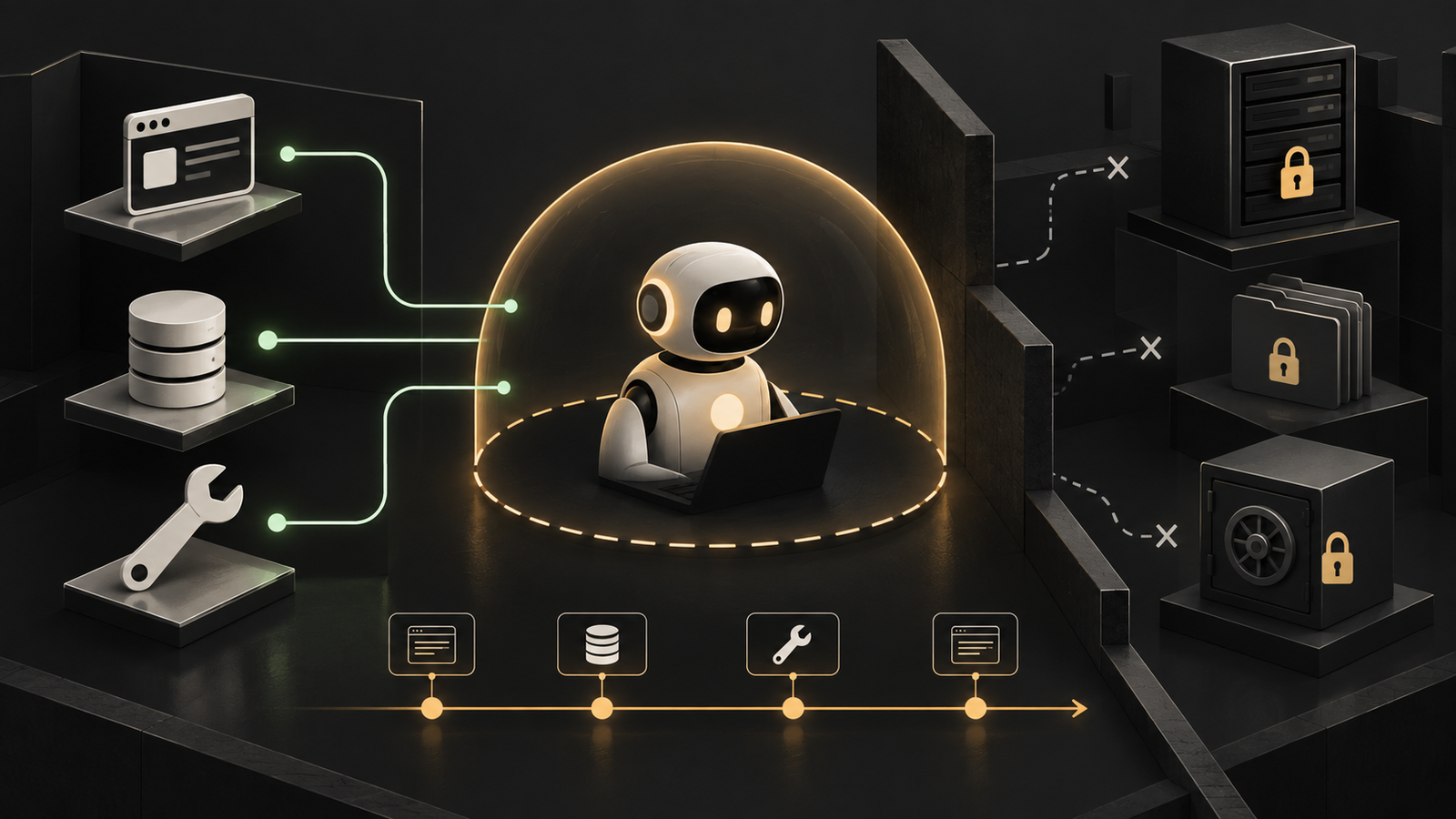
Controls that keep an agent inside its boundaries
Most of the answer is old security discipline applied to a new kind of actor.
Give every agent its own identity. Agents should not share credentials. Unique identities make it possible to trace a misbehaving agent, revoke it alone, and audit what it did.
Grant the minimum, for the minimum time. Least privilege means an agent can reach only what its task requires. Just-in-time access goes further: permissions are issued for the task and expire after minutes, hours or a day. Role-based assignment keeps this manageable, and it helps to think of roles in terms of risk, so higher-risk actions need stronger justification.
Sandbox the runtime. If an agent misbehaves, the damage should stay inside a contained environment.
Put a gateway in front. Rather than letting user input reach the model directly, route it through a policy layer that screens for injection attempts. The same idea applies to the calls an agent makes to tools: inspecting outbound data on that path is where data loss prevention belongs.
Keep a human in the loop. For consequential actions, oversight is a design requirement, not a nice extra.
Observability and lifecycle
Controls are not enough without visibility. Teams need traces of the decisions an agent makes and the actions it takes, plus monitoring that flags abnormal behaviour: too much access, too much data pulled, changes it should not make. Configuration drift matters too, especially when an agent can alter its own parameters. Proactive threat hunting, where the team imagines how the agent could be abused and then checks, complements reactive alarms.
Security also has to span the whole lifecycle: plan, code, test, deploy, monitor, then plan again. Bolting it on after launch is the expensive way to do it.
What this means for web teams
For founders and product teams, the practical takeaway is to decide what an agent is allowed to do before deciding what it can do. Write down acceptable agency, list every tool it will touch, give it a scoped identity, and make sure someone can see and stop its actions. An agent that is easy to constrain is also easier to test, review and trust. The teams that treat these boundaries as part of the product, not a later hardening task, will be the ones able to ship agents with confidence.
Frequently asked questions
How do you secure an AI agent in a web application?
Constrain what the agent can reach before it ships. Give it a unique identity, grant only the permissions its task needs, run it in a sandbox, screen inputs through a policy gateway, and keep human oversight for consequential actions.
What is prompt injection in AI agents?
Prompt injection is an attack where hostile text convinces a language model to follow an attacker's commands. It is the leading attack type against language models, and it is riskier for agents because they can act through tools.
What does least privilege mean for AI agents?
Least privilege means an agent can access only what its job requires and nothing more. Just-in-time access strengthens this by issuing permissions for a task and letting them expire.
Why should AI agents not share credentials?
Shared credentials make it impossible to trace which agent misbehaved. Unique identities allow tracing, targeted revocation and auditing of each agent's actions.
What should teams monitor once an AI agent is live?
Monitor the decisions and tool calls the agent makes, abnormal access or data volumes, unexpected changes, and configuration drift over time.
Put this into practice
Explore the services related to this article.
A short note about the product, the timeline and who it is for is enough to start. You will hear back from the engineer who would do the work, not a sales team.
Start a partnership