What Tokens, Context Windows And Hallucinations Mean For Code
- AI Assisted Development
- Code Review
- Application Security
- Software Engineering
Teams adopt AI coding assistants expecting speed, then ship code with security holes and mismatched scope because nobody actually understands how the tool reasons, what it can see, or where it tends to guess wrong. Founders and product teams evaluating an AI-assisted workflow, in-house or run by an engineering partner, need a working vocabulary for what these tools can and cannot be trusted to do alone.
What A Token And A Context Window Actually Are
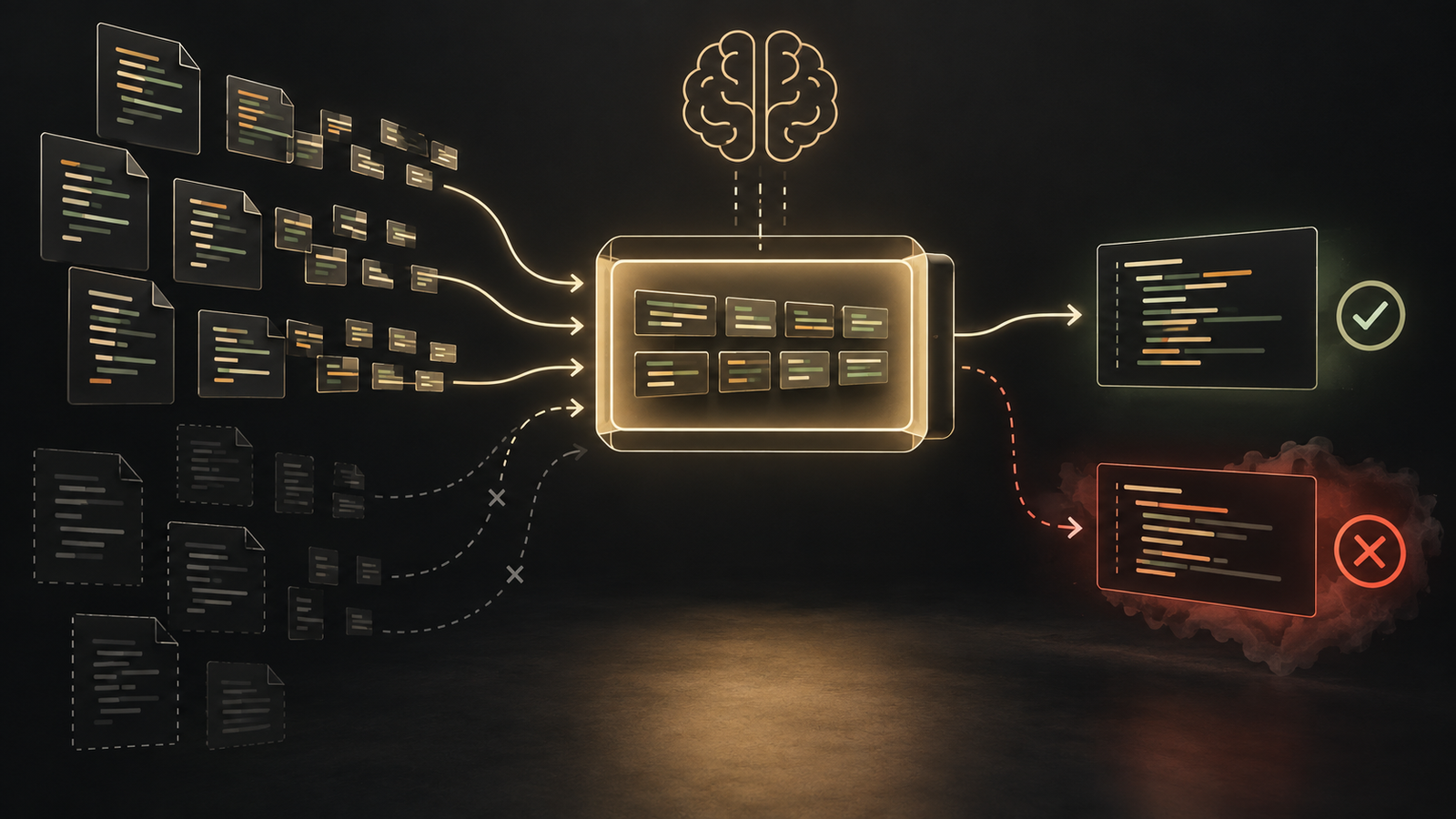
An AI coding model does not read code the way a person does. It breaks every prompt and every file into tokens: word pieces that can be a whole word, part of a word, or a punctuation mark. Everything the model can consider at once, the code already open plus the running conversation, is bounded by its context window, measured in tokens. A small context window means the assistant only sees a handful of files at a time; a large one lets it reason across much more of a project in one pass. The practical consequence: a tool that cannot see the authentication middleware, because it fell outside the context window, will happily generate a new endpoint that skips it entirely.
Why Hallucinated Code Is A Production Risk
A hallucination, in this setting, is a model confidently producing something that does not exist: a function never defined, a library method deprecated years ago, an API parameter invented on the spot. The model has no awareness that it is wrong. It predicts a plausible next token, and plausible is not the same as correct. That is why AI-suggested code needs checking against real documentation before it is trusted, not accepted because it compiles or reads idiomatically.
The costlier version shows up around trust boundaries. A recurring pattern in AI-generated backend code is accepting a value the client sent (a total, a role flag, a price) and using it directly instead of recomputing it server side. Paired with a hard-coded credential left over from a demo, or an admin route that never got an authentication check, these are exactly the issues a fast, unsupervised AI-generated pull request tends to carry, and exactly the kind that only surface under a security-literate review rather than a glance at whether the feature works.
Where Delegation And Review Fit Into The Workflow
None of this argues against using these tools, it argues for using them deliberately. Bounded, well-specified tasks: boilerplate, test scaffolding, refactoring a repetitive pattern, suit direct AI generation. Architecture decisions, security-sensitive logic and anything carrying real business risk are better kept under human ownership, with the assistant doing the typing rather than the deciding.
Splitting work across specialized agents, one on interface work, another on a backend integration, holds up well in practice, provided each change still passes through review before it merges, and any command an agent wants to run against a live system gets a human's explicit approval first. A written set of project conventions, preferred libraries, naming rules, security requirements, generated once and kept current, gives every agent and every reviewer the same baseline to work from.
Building This Into Web Development Practice
Treat token limits, context windows and hallucination risk as operational facts about a tool, not caveats to skim past. A team that understands what its AI assistant can see, and where it is likely to guess, knows which lines deserve a second, human read before anything reaches production. That is a smaller discipline than it sounds, and it is the difference between AI-assisted code that ships fast, and AI-assisted code that ships fast without quietly trusting whatever the client sent.
Frequently asked questions
What is a context window in AI coding tools?
A context window is the amount of code and conversation an AI model can consider at once, measured in tokens; a small context window means the assistant only sees a handful of files, while a large one lets it reason across much more of a project in a single pass.
What does hallucination mean in AI-generated code?
Hallucination is when an AI model confidently produces code that does not exist, such as a function that was never defined, a deprecated library method, or an invented API parameter, without any awareness that it is wrong.
Why is AI-generated code a security risk?
AI-generated code is a security risk because a recurring pattern in AI-written backend code is accepting a client-supplied value, such as a total or a role flag, and using it directly instead of recomputing it server side, alongside hard-coded credentials and unauthenticated admin routes.
Should AI agents be allowed to run commands automatically?
No, any command an AI agent wants to run against a live system should get a human's explicit approval first, the same way any code change should pass through review before it merges.
What kind of coding tasks are safe to hand to AI?
Bounded, well-specified tasks such as boilerplate, test scaffolding and refactoring a repetitive pattern suit direct AI generation, while architecture decisions and security-sensitive logic are better kept under human ownership.
How can teams keep multiple AI agents consistent on a project?
A written set of project conventions, covering preferred libraries, naming rules and security requirements, generated once and kept current, gives every agent and every reviewer the same baseline to work from.
Put this into practice
Explore the services related to this article.
A short note about the product, the timeline and who it is for is enough to start. You will hear back from the engineer who would do the work, not a sales team.
Start a partnership