Why AI-Generated Code Needs Outcome-Based Review
- Code Review
- AI Assisted Development
- Software Engineering
- Vibe Coding
- Web Development
A team can now go from an idea to a working demo in an afternoon. That speed creates a new problem: what does reviewing the result even mean when a model wrote most of it. Checking that the code compiles and looks tidy is no longer the hard part. Knowing whether it does the right thing, safely, under real conditions, is.
From syntax checks to outcome validation
Code review has moved through several distinct models over the decades. It started as a formal, line by line inspection done by a full team in a room. As delivery sped up, review became something two people did on the fly while pairing, still focused almost entirely on implementation: was the syntax correct, did the code match the docs, were obvious bugs caught early.
As codebases and teams grew, review moved into a pull request model built around version control: changes were submitted as diffs, and a merge required consensus from reviewers looking at what had changed and why. Continuous integration pipelines then added an automation layer on top: automated checks for code quality, security vulnerabilities and compliance running alongside the human reviewers.
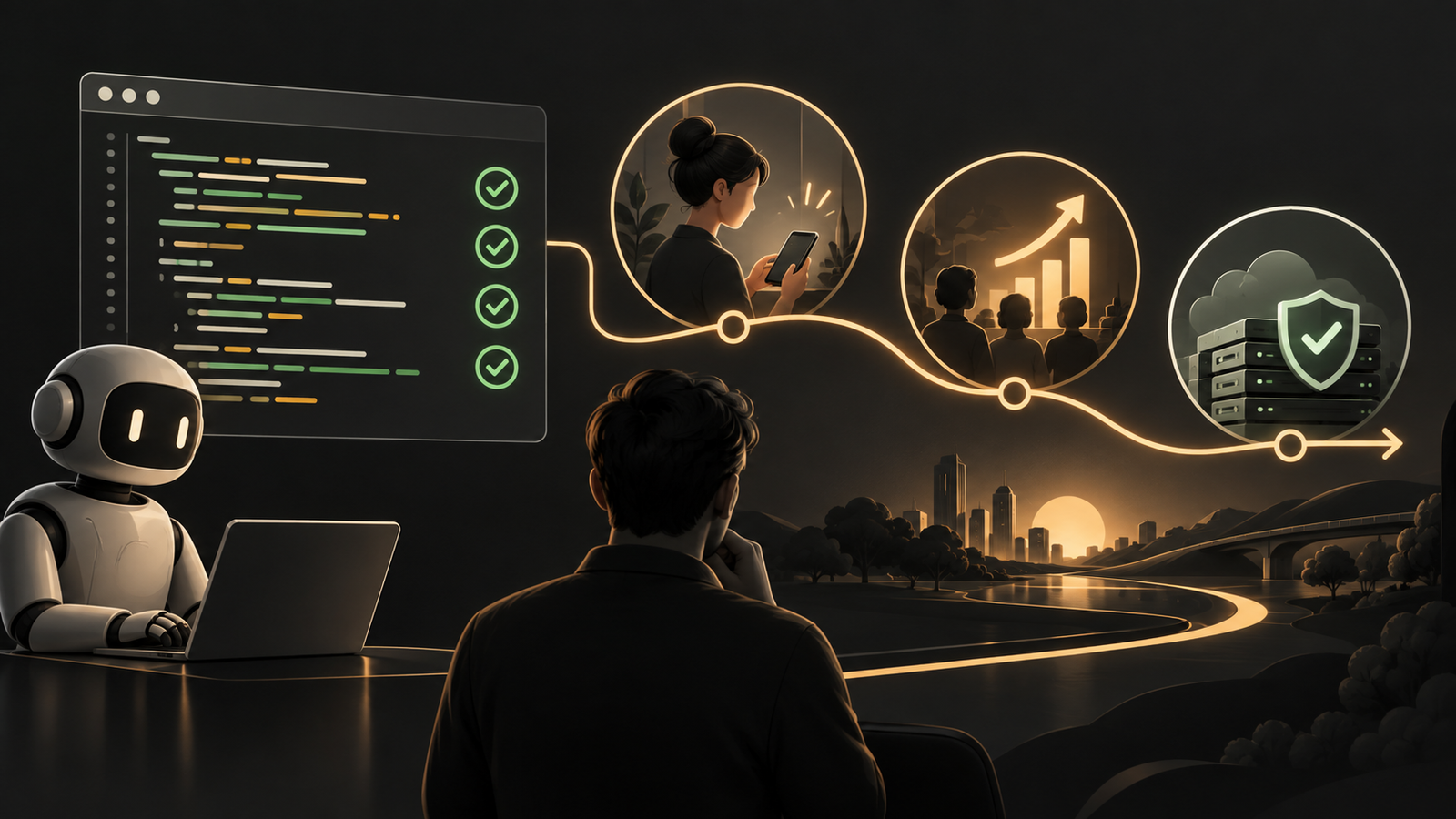
What AI changes is the center of gravity. When a model can produce the implementation, docs and even a first pass at architecture, the useful human contribution stops being 'is this syntax correct' and becomes 'is this what we actually needed'. Review is shifting from checking how something was built to validating whether it fulfils the requirement and produces the intended business outcome. That is a harder, more senior skill than reading a diff line by line, not an easier one.
Speed to a demo is not the same as speed to production
There is a useful signal in how the market treats experienced engineering judgment even as AI tools get better at producing code quickly: it has not gotten cheaper. That is consistent with what shows up whenever someone without a development background tries to direct an AI tool on a real project. The tool will happily produce a database schema, a set of pages and some working buttons. What it will not do reliably is tell you when the data model is wrong, when an edge case has been missed, or when the logic looks plausible but does not match how the business actually operates. Recognising that gap requires having built the wrong version of something before and knowing what wrong looks like.
That is the actual shift happening in software delivery. Typing code was never the scarce skill. Knowing what to build, judging whether an AI-produced solution is safe to ship, and debugging the parts it confidently gets wrong are the skills that are becoming more valuable, not less, as implementation itself gets commoditised.
What this means for a review pipeline
For a team shipping real products, this points to a concrete change in how review pipelines should be structured. Automated checks still matter: security scanning, code quality gates and compliance rules belong in the pipeline regardless of who or what wrote the code. But the human review step on top of that needs to be explicitly aimed at outcomes: does this change match the requirement, does it hold up under the load and edge cases the product will actually see, and is there runtime evidence backing that up, not just a clean looking diff.
That is a different bar than 'did a senior engineer read every line', though it does not remove the need for one. It means the senior engineer is reviewing for intent and consequence as much as for correctness. For web development specifically, where AI tools can now generate entire routes, components and database layers in minutes, that outcome-based check is what turns a fast demo into something a team can safely put in front of real users.
Frequently asked questions
How is code review changing because of AI coding tools?
Review is shifting away from checking syntax and implementation details toward validating that the generated code actually fulfils the business requirement and produces the intended outcome, since AI tools can now handle much of the implementation itself.
Can AI generated code be trusted without human review?
No, AI generated code still needs human review because AI tools can produce a plausible looking result, such as a working database schema or a set of pages, without correctly matching how the business actually needs the logic to behave.
Why does experience matter more, not less, when using AI coding tools?
Experience matters more because directing an AI tool well requires knowing what a correct result looks like, catching edge cases the model missed, and judging whether the output is safe to ship, none of which the tool itself can verify.
What should a modern code review pipeline include when AI writes most of the code?
A modern pipeline should keep automated checks for security, code quality and compliance, and add a human review step focused specifically on outcomes: whether the change matches the requirement and holds up under real usage, not just whether the diff looks clean.
Put this into practice
Explore the services related to this article.
A short note about the product, the timeline and who it is for is enough to start. You will hear back from the engineer who would do the work, not a sales team.
Start a partnership