Cloudflare Clef: design a reviewable AI document and image intake
- AI integration
- Document classification
- Product development

An AI feature does not always need to write an answer. Sometimes it needs to sort a document, identify an image category or recommend a queue for a request. The product still needs to decide what happens when an input is incomplete or a recommendation is wrong.
Cloudflare’s October 1, 2026 Clef announcement introduces Clef and Clef-flash: decision models returning typed answers and probabilities for predefined questions. For client products, the opportunity is a narrow intake step that software can validate and a person can review.
We separate announced capabilities from Curiosive’s recommended architecture below. We have not tested Clef against client documents, reproduced Cloudflare’s benchmarks or established a probability threshold for a customer workflow.
What Clef changes about AI classification
Cloudflare describes decision models as producing bounded outputs for application-defined questions. Its examples include support routing and domain classification. The launch introduces two hosted models and makes their weights available under Apache 2.0.
The Clef documentation describes a 27B multimodal model evaluating state and a schema of typed questions. Question types include a yes/no-like probability, a choice among described options and an ordinal score. Application code receives a defined output shape instead of a paragraph to interpret.
A valid shape is not a correctness guarantee. A result can match the schema while selecting the wrong category. Returned probabilities also need validation against your inputs before supporting a business action.
Cloudflare publishes benchmark scores and latency comparisons. These are vendor-reported results under evaluated conditions, not promised performance for your intake queue. The Hacker News discussion includes skepticism about benchmark generalization and discussion of existing classifiers. It raises evaluation questions without resolving which model fits a client workload.
A client use case: document and image intake
Consider an illustrative supplier portal receiving descriptions, packaging photos and supporting documents. Staff need to identify submissions, route them and flag missing information. A general chatbot is not necessarily the right interface.
A bounded step could suggest “product image,” “specification document” or “unrecognized submission,” using categories defined by the application. Separate questions could ask whether a required view is present or information appears incomplete. These are proposed uses, not measured Clef capabilities on supplier files.
Keep labels explainable. “Ready for publication” combines several judgments. Split it into inspectable questions: whether the file is readable, whether an identifier is present and which category applies. Final publication remains a separate decision with its own checks.
For teams exploring AI integration, this offers a focused starting point: one queue, a defined label set and a review screen showing the source beside the recommendation.
Define the questions before connecting the model
The label schema is part of product design. Each option needs a meaning reviewers can apply consistently. Overlapping categories invite disagreement regardless of the model.
Include an unknown or unsuitable route where the question format permits it. If every input must be either “invoice” or “product sheet,” an unrelated image can still receive a decisive-looking answer. A forced choice should not become evidence that the file belongs in the workflow.
Distinguish properties from presentation. A document resembling a specification sheet may lack the required identifier. Ask those questions separately. Version the schema and attach decisions to the version that produced them.
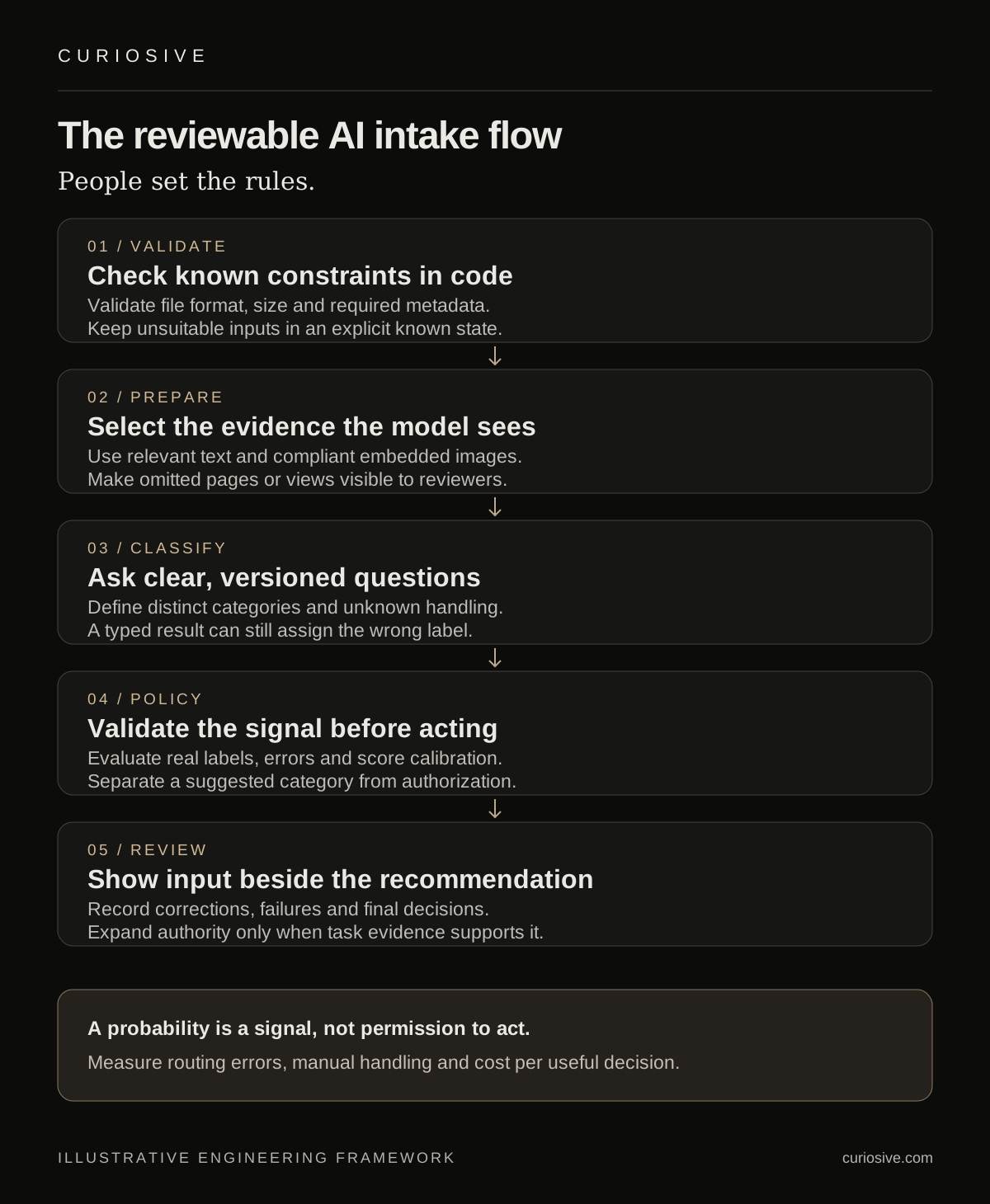
Ordinary validation comes first. Check supported formats, sizes and required metadata in code. A model is unnecessary to determine whether a request exceeds a known byte limit. Use AI where interpretation is needed.
API limits affect the upload interface
The reviewed hosted Clef documentation accepts between 1 and 64 typed questions. Its image extension permits up to four embedded PNG, JPEG or WebP images. Remote image URLs are not accepted by this interface.
Each image may be at most 4 MiB and 16 megapixels, with 8 MiB total decoded image data and a maximum request body of 13 MiB. These are API constraints, not recommended upload defaults. A product may need lower limits for usability and processing cost.
The docs also state that long text state is truncated to fit the token limit. Relevant details at the end of a large record may be absent. Sending an entire case file does not guarantee every part is considered.
Design the adapter explicitly: select relevant views, prepare compliant embedded images and assemble text needed for the questions. If a PDF needs page extraction, implement and test that preprocessing. Image support does not establish an end-to-end PDF workflow.
Show reviewers what reached the model. Make selected pages and omitted views visible. If processing would lose important information, route the submission for review rather than silently accepting an incomplete representation.
A probability is a signal, not permission
A high category probability does not establish correctness at that rate on your submissions. Ambiguous labels, poor scans, new languages and different supplier formats can change the relationship between scores and outcomes.
Begin in suggestion mode. Staff see the source and proposed category, then accept or correct it. Use reviewed examples to evaluate the model and label design together.
Measure errors relevant to the queue. Sending a submission to the wrong team differs from holding an unreadable file for review. Track per-category precision and recall, disagreements and manual-handling share. Aggregate accuracy can hide an important weak category.
Choose automation thresholds using representative labeled inputs and the consequences of mistakes. Include difficult examples and inputs outside expected categories. Validate calibration when probabilities drive policy; do not borrow a demo threshold or automatically authorize the top option.
Separate classification from action policy
The model recommends a route. Application policy determines the action. A classification might add a suggested queue to a review record; approving public content or changing payment details requires separate authorization and validation.
Store the input reference, schema version, model identifier, result and final reviewer decision. Scope access to staff who need the information. Avoid complete private documents in broad operational logs merely to simplify debugging.
Define failure behavior before rollout. A timeout should leave a known state, such as awaiting classification or manual review. Retries should not duplicate entries. Reprocessing with a new schema should create a traceable decision rather than silently replacing history.
Bound payloads, question counts and retries. Reuse results when the same input and schema were already evaluated. Measure cost per correctly routed or reviewed submission, including preprocessing and corrections. Unit model pricing alone does not describe feature cost.
Our production AI architecture guide covers surrounding reliability and evaluation decisions. Structured outputs still need those controls.
Read fine-tuning availability precisely
Cloudflare’s launch offers hands-on fine-tuning services through its forward-deployed engineering team. It describes a later self-service platform and identifies work-in-progress components.
Do not schedule delivery around self-service fine-tuning as though it were generally available. First evaluate whether the base model, clearer questions or better input selection can support the task.
If training is considered, examples should reflect the actual label policy. Keep closely related submissions from leaking across training and evaluation sets. Maintain an independent review set and inspect changed categories. Open weights make experimentation possible but do not establish accuracy or remove operating responsibilities.
Start with a reviewable suggestion
A focused first release validates a file, prepares relevant evidence, asks a small set of questions and shows a recommendation staff can correct. Record enough evidence to determine whether it helps before extending authority.
This supports AI-accelerated development by giving engineers and reviewers a clear typed contract. The potential benefit is a simpler route from incoming material to the next step. Any reduction in handling effort must be measured in the real workflow.
If your product has a document or image queue needing clearer routing, bring the intake process to Curiosive. We can discuss its label policy, review interface and AI integration. See our approach for how we frame delivery.
Sources and scope
Reviewed October 3, 2026: Cloudflare’s Clef launch, October 1, hosted model documentation and Hacker News discussion. Capabilities, limits and availability statements come from Cloudflare. The supplier portal is illustrative; intake, evaluation and policy design are Curiosive recommendations. No independent benchmark, client case study or automation outcome is claimed.
Frequently asked questions
Can the hosted Clef API accept remote image URLs?
The reviewed documentation accepts up to four embedded PNG, JPEG or WebP images and does not accept remote image URLs. Per-image and request limits also apply.
Is Clef self-service fine-tuning available?
The launch offers hands-on fine-tuning assistance and describes a later self-service platform, rather than general availability of self-service fine-tuning.
Does a high probability guarantee the correct category?
No. Validate scores against reviewed labels on representative inputs before using probabilities to drive workflow policy.
Put this into practice
Explore the services related to this article.
A short note about the product, the timeline and who it is for is enough to start. You will hear back from the engineer who would do the work, not a sales team.
Start a partnership