Decision Quality Is the New Code Quality in AI-Assisted Builds
- AI-Assisted Development
- Code Quality
- Software Architecture
- Testing
- Code Review
A feature request arrives: build a notification system. An AI coding assistant can produce an endpoint, a database schema, a queue consumer and a front-end hook in minutes, and the result often looks tidy. The trouble is that none of it answers the questions that decide whether the feature survives contact with real users. Should delivery be synchronous or asynchronous? What happens when a downstream service is down? How do retries behave under load? What changes when usage grows a hundredfold?
For founders and product teams choosing how to build, this is the shift worth understanding. Implementation quality is getting easier to buy. Decision quality is becoming the differentiator.
Why clean code is no longer the hard part
Readability, maintainability and testability still matter. But a well-formed function is now cheap, so it says little about whether the product is right. AI tools are strong when handed a well-defined problem. They are weaker at comparing competing architectures, weighing long-term business context, or recognising that the simplest approach is not always the best one.
That moves the engineer's role up the stack. The work is less about typing code and more about owning trade-offs: speed against cost, reliability against user experience, and how success will be measured. Someone still has to be accountable for security, governance and maintainability. In our practice, that is why senior engineers review every change rather than trusting fluent output.
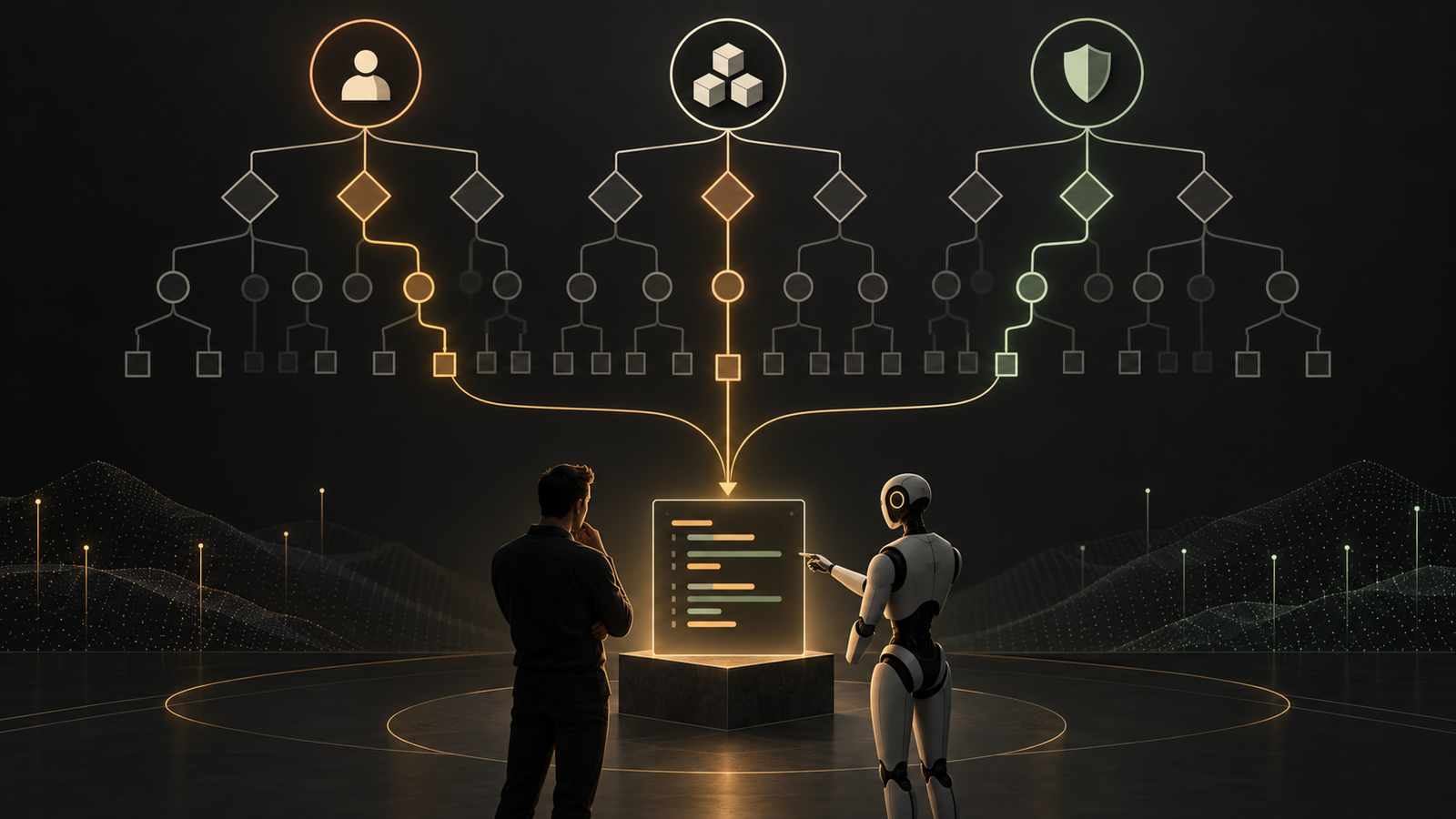
Review the system, not just the file
Pull requests have traditionally been reviewed one file at a time. Modern products do not live inside files. A single change can touch APIs, data contracts, infrastructure, monitoring and the services downstream of them.
Reviewing for AI-assisted work therefore has to ask a wider question. Instead of 'is this function correct?', the reviewer asks what this change does to the whole platform. Large AI-generated diffs with confident comments can hide exactly the cross-cutting effects that cause production problems later.
Make tests and guardrails do the trusting
If code is no longer trusted because a person wrote it, something else has to earn that trust. Evidence is the answer: unit, integration and contract tests, security checks, performance testing, and runtime monitoring. Behaviour is validated, and confidence comes from that validation rather than from authorship.
The same applies to standards. A coding guideline sitting in a wiki goes stale quickly. In an AI-assisted workflow, standards belong inside the process itself:
- Security requirements enforced automatically
- Architectural guardrails encoded in templates and tooling
- Testing expectations attached to every pull request
- Static analysis running continuously
The aim is to make the correct path the easiest path. Agents also perform better inside explicit boundaries than when they must guess at unwritten team habits.
What this means for web development practice
Quality is not a final checkpoint before release. Teams that ship continuously need validation on every commit, automated tests on every pull request, and observable signals from every deployment, feeding what is learned back into planning.
For a web product, that means agreeing the trade-offs early, encoding the rules in the pipeline, and reserving human attention for judgement. AI accelerates the writing. Engineering still decides whether it was worth writing at all.
Frequently asked questions
Does code quality still matter when AI writes the code?
Yes, code quality still matters, but it is no longer the main differentiator. Readable, testable, maintainable code is cheap to generate now, so the harder question is whether the solution and its trade-offs are right for the business.
How should AI-generated pull requests be reviewed?
They should be reviewed at system level rather than file by file. A single change can affect APIs, data contracts, infrastructure and downstream services, so reviewers ask what the change does to the whole platform.
How do you trust code that an AI wrote?
You trust it by validating its behaviour rather than its authorship. Unit, integration and contract tests, security checks, performance testing and runtime monitoring provide the evidence that the software works.
Where should engineering standards live in an AI-assisted workflow?
They should live inside the development process, not in a document. Security rules, architectural guardrails, testing expectations and static analysis should be enforced automatically so the correct path is the easiest one.
When should code quality be checked in continuous delivery?
Quality should be checked continuously, not just before release. Every commit and pull request triggers validation, and every deployment produces observable signals that inform the next iteration.
Put this into practice
Explore the services related to this article.
A short note about the product, the timeline and who it is for is enough to start. You will hear back from the engineer who would do the work, not a sales team.
Start a partnership