Designing an AI-Assisted Delivery Pipeline for Web Products
- AI Coding Agents
- Software Delivery
- Code Review
- Spec-Driven Development
Most teams adopt AI coding agents one prompt at a time. A developer asks for a change, reads the diff, and moves on. That works for a single person, but it stops scaling when several agents run in parallel and the real bottleneck shifts from writing code to deciding what gets built, checked and shipped.
The teams getting durable value tend to treat the whole software development life cycle as a pipeline, then decide deliberately where people step in. This is less about tools than about process design.
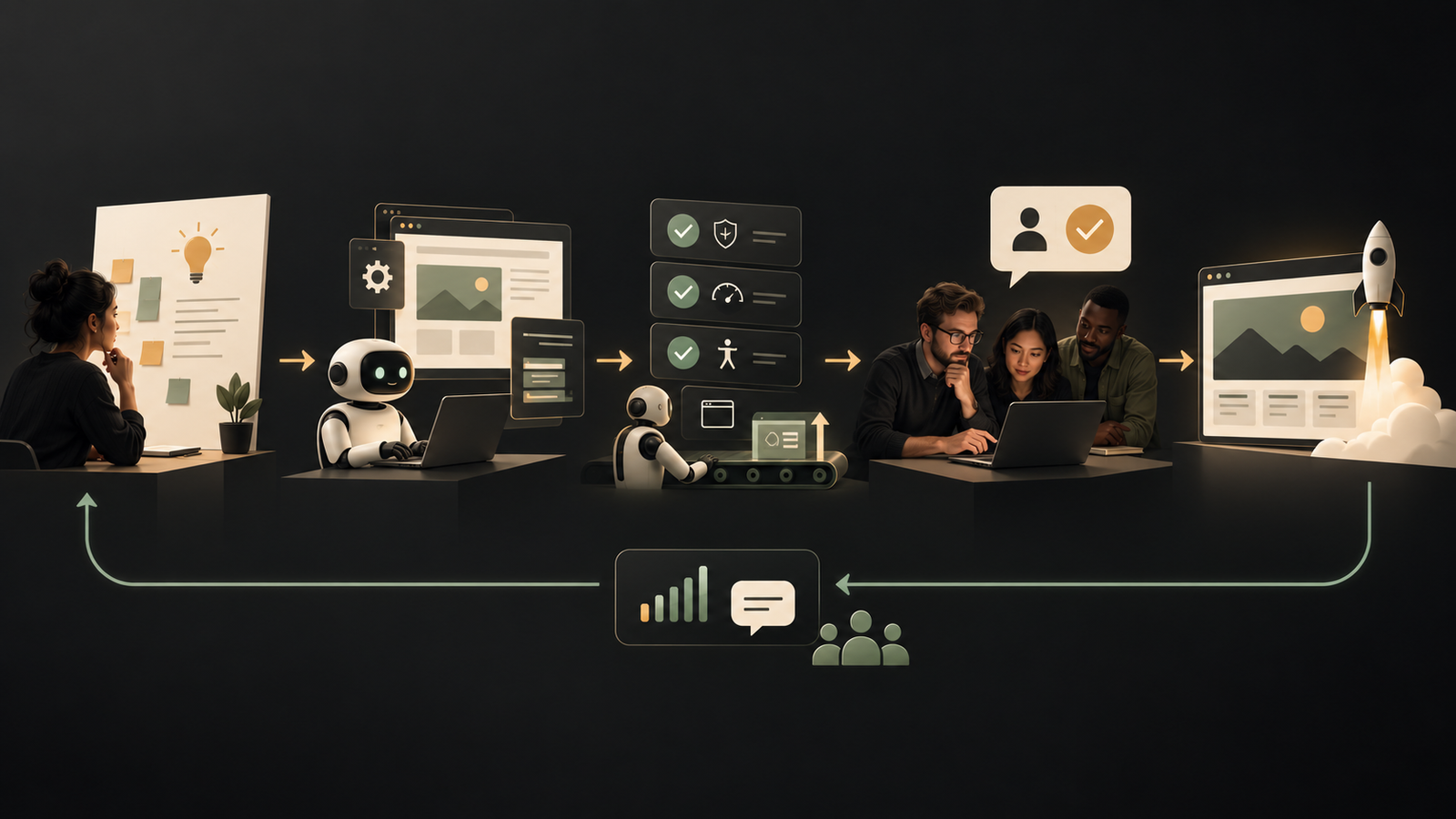
The stages of an AI-assisted delivery loop
A useful pipeline is a loop rather than a line. Ideas arrive from users, the team, and monitoring. Each one passes through the same stages:
- Triage. An agent reads incoming work. Small, unambiguous items can go straight to implementation. Anything complex is escalated.
- Specification. For harder work, an agent drafts a product spec (the behaviour that must hold) and a technical spec (the shape of the code). A person reviews both before any code is written.
- Implementation. A coding agent produces a change in an isolated environment, so a bad run cannot touch anything important.
- Review. An agent reviews first. Humans then join based on risk, which turns review into a risk-management exercise rather than a wall of diffs.
- Verification. The change is exercised as a user would exercise it, with the usual CI checks alongside.
- Monitoring. Shipped work stays under observation, and what monitoring finds feeds back into triage.
For a web product, this maps cleanly onto familiar practice: issue tracker, design notes, pull request, preview deployment, error tracking.
Where humans belong in the loop
Removing people from every stage is the wrong goal. Human attention is the scarce resource, so it should sit at the points where judgement cannot be automated: approving a spec, reviewing high-risk changes, and judging the finished product. Taste and product sense still decide whether the output is useful, and a pipeline that produces work nobody wants is only efficient at waste.
Specs deserve particular care. A reviewed specification is far cheaper to correct than a finished implementation, and it gives review agents something concrete to check the code against.
Feedback loops that improve the pipeline itself
The most interesting idea is a loop on the loop. If a review agent leaves comments and senior engineers routinely correct them, that correction is data. A second observing agent can study those corrections and refine the review instructions for the next run. Over time the pipeline gets better without anyone rewriting it by hand.
That only works if the team measures something: how much shipped, how much human time it took, and what it cost in compute. Without measurement, a pipeline drifts.
There is also a build-versus-buy question. A simple version, such as triage plus specs plus review, is within reach of most teams. A hardened system with sandboxes, work scheduling and shared memory is a product in itself, and building it can pull attention away from the product a company actually sells.
What this means for web development practice
For founders and product teams, the practical takeaway is to start small. Pick one stage, usually triage or first-pass review, automate it, and place a person at the next checkpoint. Write down what good looks like so an agent can be held to it. Then add stages as trust is earned.
Engineers on such teams write less code by hand and spend more time shaping the process that produces it. The craft moves upward: clear specs, sharp review criteria, honest measurement. Teams that invest there ship faster without lowering the bar, because senior judgement stays exactly where it matters.
Frequently asked questions
What is an AI-assisted software delivery pipeline?
It is a loop that runs the whole development life cycle with agents doing routine work and people at key checkpoints. Stages include triage, specification, implementation, review, verification and monitoring, with monitoring findings feeding back into triage.
Where should humans review AI-generated code?
Humans should review where risk is highest, after an agent has done a first pass. Human attention is scarce, so it belongs on spec approval, high-risk changes and judging the finished product.
Should we build our own AI coding pipeline or buy one?
Most teams can build a simple version, but a scalable one is usually a product in itself. A basic setup with triage, specs and review is within reach, while sandboxes, scheduling and shared memory can distract from the core product.
How do you make AI review agents improve over time?
Use an observing agent that studies how engineers correct review comments and refines the review instructions. This only works when the team also measures output, human time and compute cost.
Why write specs before letting an agent implement a feature?
A reviewed spec is cheaper to correct than a finished implementation. It also gives review agents a concrete standard to check the code against.
Put this into practice
Explore the services related to this article.
A short note about the product, the timeline and who it is for is enough to start. You will hear back from the engineer who would do the work, not a sales team.
Start a partnership