How Web Teams Keep Control When Running Multiple AI Coding Agents
- AI Coding Agents
- Code Review Process
- Engineering Workflow
- Software Delivery
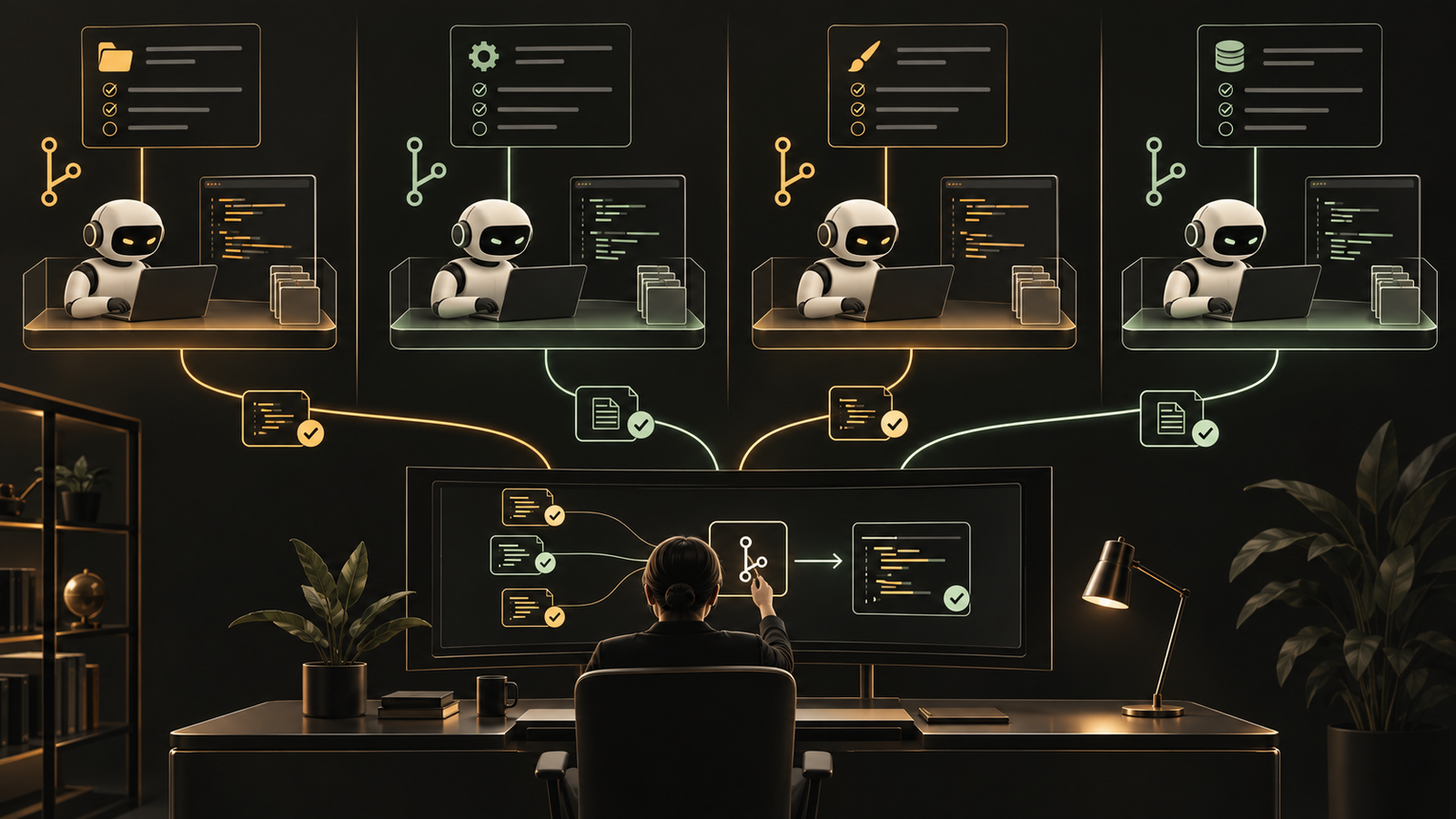
More product teams are no longer running one AI coding session and hoping for the best. They are opening several coding agents at once, pointing each at a different part of a project and expecting a pull request that is actually ready to look at. The gap between that ambition and what lands in the repository is almost always a process gap rather than a model limitation. A single giant prompt with no boundary produces a session that drifts, a diff that touches far more than it should and a reviewer with no idea where to start. A scoped task, a clear boundary and a review gate before merge produce shippable work from the same tools.
Scoping each session to a bounded unit of work
The teams getting reliable output are not asking an agent to build a whole feature in one pass. They start with a short discussion that turns a vague idea into a written specification: the problem, the intended behaviour, the acceptance criteria and how each criterion will be checked. That specification is then broken into smaller tickets, each sized to fit inside one working session. This matters because a coding agent's usefulness declines well before its context window is technically full: as a session fills up, attention to the original intent weakens and mistakes creep in. Clearing the session between tickets, rather than pushing one conversation through an entire feature, keeps output closer to what was actually asked for. It also lets different tasks run at different reasoning effort: a quick exploratory question does not need the same depth as a change to core architecture, and matching effort to task keeps turnaround fast without wasting budget on the simple stuff.
Isolating parallel streams and pinning what they touch
Running several agents against several problems only works if they cannot step on each other. Separate working copies of the repository, rather than one shared checkout, stop concurrent sessions from overwriting the same files while they work. The same discipline applies to what an agent is allowed to choose on its own: left unconstrained, a coding agent will happily pick outdated dependency versions with known vulnerabilities, so the specification should pin the versions a project depends on and dependency and security scanning should run on every change regardless of who or what wrote it.
Making review the actual bottleneck, on purpose
None of this replaces review, it makes review the point. Code should be checked by a process that did not write it: an automated pass in a fresh session catches issues that the session which generated the code tends to wave through, and a human still needs to sign off before anything merges. That review step is usually where the real value shows up, not in the generation itself: it is where missing edge cases, unhandled states and undocumented behaviour changes surface. Large changes slow this down disproportionately, since an independent reviewer, human or automated, takes much longer to check a sprawling diff than a small one, so splitting work into smaller pull requests keeps the whole loop fast. Teams running this kind of workflow report realistic, moderate gains, commonly in the range of thirty to sixty percent, rather than the multiples sometimes claimed online, and that gap between hype and outcome is usually explained by whether review stayed rigorous or got skipped to keep up with generation speed.
None of this is really about the tools. Writing a specification before building, testing before trusting, isolating concurrent work and reviewing independently before merge are practices that predate AI coding agents by decades. What has changed is the speed at which unmanaged shortcuts now produce damage, and the speed at which a disciplined team can turn a scoped ticket into production code. For a studio shipping web products for other people, that discipline is the difference between AI coding as a demo and AI coding as an engineering practice.
Frequently asked questions
How many AI coding agents can one developer realistically run at once?
In practice, most developers find four parallel coding sessions is about the limit before oversight breaks down, since each session still needs a task and a check before it gets merged. Beyond that a person spends more time coordinating than reviewing.
Why does an AI coding agent's output get worse the longer a session runs?
As a session's context window fills, the agent's attention to the original task weakens and it starts drifting from what was actually asked, which is why clearing or resetting the session between scoped tickets keeps results closer to the request.
Should AI generated code be reviewed by the same agent that wrote it?
No, review works better in a fresh session or process that did not write the code, because an agent that just generated a change tends to approve its own work rather than catch what is missing.
What productivity gains should a team expect from AI coding agents?
Teams that keep review rigorous tend to report moderate, realistic gains in the range of thirty to sixty percent rather than the larger multiples sometimes claimed, and that gap usually comes down to whether review was kept in place or skipped.
Why should AI generated pull requests be kept small?
Small pull requests are faster for an independent reviewer, human or automated, to check thoroughly, while a large sprawling diff slows review down disproportionately and increases the chance that something gets missed.
Put this into practice
Explore the services related to this article.
A short note about the product, the timeline and who it is for is enough to start. You will hear back from the engineer who would do the work, not a sales team.
Start a partnership