Interview First, Build Second: Requirements for AI Coding Agents
- AI Coding Agents
- Requirements
- Software Planning
- Web Development
Most AI-assisted builds go wrong before a single line of code exists. A loose brief goes in, the agent fills every gap with a confident guess, and features nobody asked for appear. Worse, a decision that deserved a minute of thought ends up baked into the database schema. The fix is rarely a better model. It is a better conversation before the build starts.
Interview the requirements before the agent builds anything
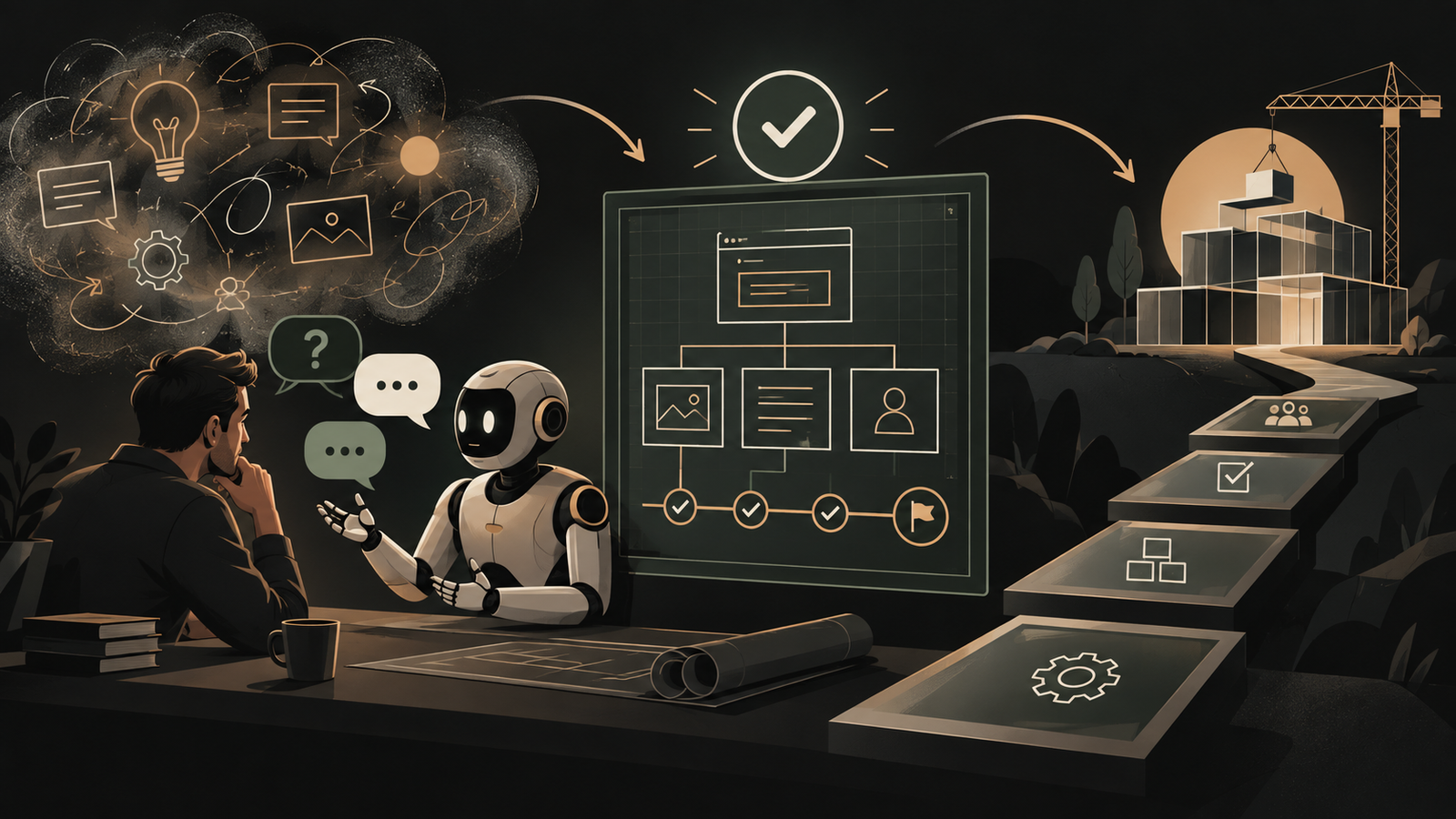
Instead of handing an agent a rough idea, ask it to question you first. Ending a brief with a request for clarifying questions makes the agent surface the edge cases a rushed plan would miss: what happens to a record when its last child is deleted, whether a flow really needs two steps or one, which states are permanent once reached.
Two habits make this interview far more useful:
- Explain why, not only what. An agent that knows the goal can suggest alternatives. One that only has instructions can only obey them.
- Let the agent read the code first. If a question can be answered by inspecting the codebase, the agent should look before it asks a person. Delegating that exploration to a sub-agent also keeps the main context small, because only a summary returns.
The time spent here pays back later. The more the interview settles, the less guidance the build itself needs.
Agree a shared vocabulary with your agent
Teams lose hours when one word means two things. If a project calls something a draft in one place and a preview in another, an agent will treat them as separate concepts. A short glossary file, placed where the agent finds it whenever it searches for a term, removes that ambiguity. Domain-driven design calls this a ubiquitous language, and it works just as well between a product owner and an AI collaborator as between people. Instructions become shorter, and the resulting plan becomes more precise.
Plan in milestones and fix the big decisions early
For a new product, start in a planning mode rather than a building mode. Write down the objective, the audience and what finished looks like. Ask for a plan broken into milestones that can be built and verified one at a time, and state the scope explicitly, including features to leave out. Then read the plan before any code is generated. A wrong direction is cheapest to catch at this stage.
A few decisions belong in the brief rather than being left to the agent:
- The framework and backend platform, for example Next.js with a hosted backend.
- Third-party services, such as a media or payments provider.
- The design system. Ask for a style guide page first, review it, and only then apply it across the product, rather than letting styling drift page by page.
Many frameworks and platforms now publish agent skills or MCP servers. Installing the relevant ones before building gives the agent accurate, current knowledge of those tools instead of guesses from memory.
When something breaks, describe it precisely: what was done, what was expected, and what happened instead. Vague bug reports produce vague fixes. It also helps enormously when the surrounding code is well tested, because a small change then stays a small build.
What this means for web development practice
None of this is new. Clear requirements, shared language, small verifiable steps and early technical decisions have always separated calm projects from chaotic ones. AI agents simply make the cost of skipping them arrive faster. For founders and product teams, the takeaway is practical: judge a build partner by how well they question the brief, not only by how quickly they ship the first screen. At Curiosive, senior engineers own that conversation and review what the agents produce.
Frequently asked questions
How do you write a good brief for an AI coding agent?
A good brief states the goal, the reason behind it and the scope, then asks the agent to raise clarifying questions. The article recommends explaining why a feature exists so the agent can suggest alternatives, and listing features to leave out.
Why should I keep a glossary for AI coding agents?
A glossary removes ambiguity when one term could mean two things. Placed where the agent finds it while searching, it makes instructions shorter and plans more precise.
What is plan mode for AI coding tools?
Plan mode is a setup where the agent thinks through the problem and produces a written plan instead of writing code. The plan should be broken into milestones that can be built and verified one at a time.
Should I choose the tech stack myself when using AI to build an app?
Yes, the main decisions belong in the brief. Framework, backend platform, third-party services and design system should be set up front, or the agent will choose them for you.
How do I report a bug to an AI coding agent?
Describe what you did, what you expected and what actually happened. Precise reports lead to precise fixes, while vague ones lead to guesses.
Put this into practice
Explore the services related to this article.
A short note about the product, the timeline and who it is for is enough to start. You will hear back from the engineer who would do the work, not a sales team.
Start a partnership