Keeping Your Team Fluent in Code That AI Writes
- AI Assisted Development
- Software Engineering
- Code Review
- Team Practices
When AI agents write the first draft of most features, typing code stops being the slow part. The slow part becomes deciding what to build, checking what comes back, and understanding the system well enough to fix it when it breaks. Teams that notice this late end up with senior engineers buried in review while nobody can say with confidence how the product actually works.
Move engineering rigour upstream, before the code exists
Quality does not disappear when an agent writes the code. It moves earlier. A request such as 'let users upload a photo' leans on shared context that a human colleague fills in without thinking: which formats, what feedback during upload, what size limits. An agent has none of that context, so it does exactly what was asked and nothing more. A notification feature with no stated rate limit has no reason to hold back.
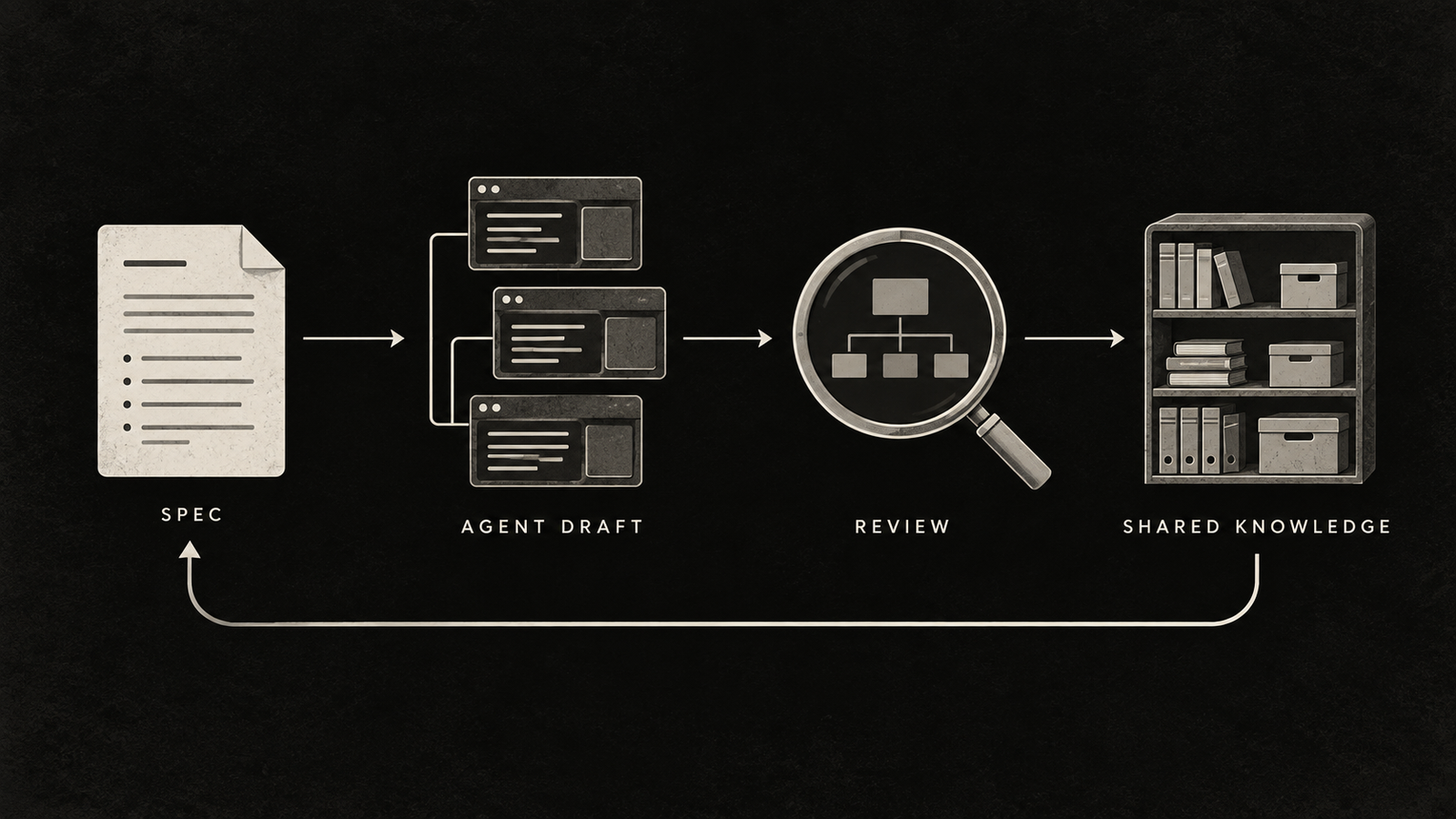
This is why older techniques are returning: structured requirements, decision tables and state machines. When an agent is handed a state machine that lists every state the application can be in, there is very little room left to improvise. The specification becomes the durable asset, and the code becomes easier to replace.
Tests play the same role. A strong suite pins behaviour down, so an implementation can be regenerated or rewritten while the contract stays fixed. One caution: agents can produce faulty code and then write tests that approve it. The tests need independent human attention, not just a green tick.
Treat supervision as a skill of its own
Between writing code and shipping it sits a layer of work that rarely has a job title. It includes breaking a problem into agent-sized pieces, knowing when to let an agent run and when to step in, and fixing poor output by improving the brief instead of hand-patching the result.
For hiring and team design, this changes what to look for. Fast typing matters less. More useful signals are architectural thinking, the ability to write a specification that cannot be read two ways, and the ability to debug a system the person did not write. It also changes workload: when generation gets cheap, review becomes the queue, and the most experienced people risk becoming traffic controllers instead of builders. Spreading review load deliberately is part of the plan, not an afterthought.
Write down what only senior engineers know
An agent that reads an error message and the documentation will suggest the textbook response. In an outage, that can mean repeating the same restart while the real cause sits elsewhere, such as a shared resource being exhausted by a background job that no document mentions. That knowledge lives in people's heads.
The practical answer is to capture it. After each incident, record what happened, how it was fixed, and what an experienced engineer would have checked first. That record is context an agent can actually use. Be sceptical of 'self-healing' claims until that context exists. Agents also tend to agree with whoever is prompting them, so for diagnosis it helps to set up a second agent whose job is to challenge the working theory.
Stay close to the code you ship
Code review was never only about catching bugs. It was how people learned the system. If agents write everything and nobody reads it, the team become strangers in their own codebase.
One workable habit is to have the agent lay out its architectural decisions before it writes anything, then review those decisions with a senior engineer. Understanding has to be scheduled, because it no longer happens by accident.
What this means for web product teams
For anyone commissioning or running a web product, the lesson is consistent. Invest in clear specs, a trustworthy test suite, written institutional knowledge and deliberate review of design decisions. Those are the parts that keep AI-assisted delivery fast without leaving the team unable to explain, or fix, what they have shipped.
Frequently asked questions
How does AI coding change what developers spend time on?
It moves effort from typing code to specifying, supervising and verifying. Engineering rigour shifts upstream into requirements, state machines and test suites, while review becomes the main queue.
Why do AI coding agents need detailed specifications?
Agents lack the shared context humans use to fill gaps, so they do exactly what is written. Without a stated limit, such as a rate limit on notifications, nothing stops them from ignoring it.
Can AI agents fix production outages on their own?
Not reliably without the right context. An agent tends to suggest the textbook fix, and undocumented knowledge held by senior engineers is missing, so recording incidents and using a second agent to challenge the diagnosis helps.
How can teams avoid losing understanding of AI-generated code?
Have the agent lay out its architectural decisions before it writes code, and review those decisions with senior engineers. Understanding of the system needs to be scheduled deliberately.
Put this into practice
Explore the services related to this article.
A short note about the product, the timeline and who it is for is enough to start. You will hear back from the engineer who would do the work, not a sales team.
Start a partnership