Local LLM deployment: hardware fit, data boundaries and operating cost
- AI integration
- Local LLMs
- Infrastructure

Running an LLM on hardware you control changes where inference happens. It also changes who owns capacity, retained conversations, upgrades and failures. For a product team considering local AI, the useful first question is whether one specific workload benefits enough to justify operating the system.
The DwarfStar discussion on Hacker News brings that decision into focus. Local inference is becoming a concrete engineering option for some high-memory machines. It is still a deployment choice that needs a workload, a data boundary and a person responsible for keeping it useful.
What DwarfStar makes worth examining
The Hacker News submission about ds4 links to a community resource site. The primary technical source is the DwarfStar repository maintained by antirez. Its README describes a specialized inference engine for selected model families, with Metal, CUDA and ROCm support. It requires the project’s supported model files rather than treating every GGUF file as interchangeable, and describes the software as beta quality and fast-changing.
The HN thread is small. Comments raise quantization quality and alternative hardware implementations, but do not establish a consensus or a reproducible comparison. We have not run DwarfStar benchmarks, and we do not treat its published performance examples as results for a client product.
For buyers, the significant idea is narrower than “replace all hosted AI.” A capable local workload may be feasible on appropriate hardware. The next step is to test whether the complete workflow fits, including the input length, output quality, number of users and data it leaves behind. The guidance below is Curiosive’s analysis of that decision.
Choose a bounded workload before choosing a machine
A private document extraction job, a developer workstation assistant and a multi-user customer feature impose different requirements. A batch job can often tolerate a queue. An interactive tool needs an acceptable response time while other work is running. A customer-facing endpoint adds availability and support expectations that a personal laptop does not naturally satisfy.
Write down the intended input, result and operating hours. Include the maximum document size, expected concurrency, whether tools can access external services and what happens when the machine is unavailable. “Runs locally” is a description of execution location; it does not specify any of those product behaviors.
For an illustrative internal extraction workflow, the useful pilot could be a controlled queue that processes approved documents into a reviewable schema. That gives the team a finite task and a measurable result. It is easier to evaluate than starting with a general autonomous assistant that can read every file and call every tool.
Keep the scope narrow enough that a manual fallback exists. If the job cannot finish, preserve the input and let an authorized person complete it. Local deployment becomes easier to assess when the product does not depend on the machine behaving like an unlimited shared service.
Hardware fit includes context and concurrency
Do not size a machine using the model file alone. The inference runtime also needs space for working buffers and the state of active conversations. Longer context and additional sessions can materially change the memory requirement. Storage, available bandwidth and other applications on the same machine affect the operating envelope too.
DwarfStar’s Metal guide gives model-specific starting points and warns that they are not guarantees for every context or session count. It also distinguishes resident execution from SSD streaming. Treat those instructions as a starting configuration to test, not an assurance that an existing employee laptop will meet a production workload.
Create a test matrix with the smallest, typical and largest expected inputs. Run it with the required concurrent work and other normal machine activity. Record time to first useful output, total completion time, peak memory, queue time and failures. Repeat after a cold start. A warm demonstration with a short prompt can miss the delay that users experience with a large uncached document.
SSD streaming can make a configuration possible without making it appropriate for the target experience. Measure it with the actual storage and workload. If throughput is inadequate, reducing scope, scheduling work or retaining a hosted path may be more sensible than treating a larger purchase as the automatic answer.
Quantization belongs in the quality test
Quantization changes how model weights are represented to reduce resource requirements. The practical question is whether the specific model and representation preserve the capabilities your workflow needs. A readable answer is not enough if extraction drops a field or a code suggestion changes behavior.
Compare candidate configurations on the same representative examples. Include ambiguous inputs, unusual terminology and cases where the correct response is to decline or request missing information. Record invalid structured output and the amount of human correction needed. Keep the evaluation tied to the exact model artifact and runtime configuration.
Use task checks that can identify meaningful failures: required fields, valid references, calculations, repository checks or a documented review rubric. If a larger representation improves the result but no longer fits your machine, that is a deployment constraint to resolve. It is not evidence that every smaller representation is bad, or that one model family will suit all tasks.
Keep a held-out set for upgrade decisions. Local ownership lets you choose when to update, but a changed model, prompt template or runtime can still change behavior. A previously useful configuration should remain available while you evaluate its replacement.
Local inference is one part of the data boundary
Processing prompts locally can avoid sending those prompts to a remote inference endpoint, provided the application actually uses the local path. It does not automatically keep every part of a workflow offline. Search tools, remote document stores, telemetry and external actions may still transmit information.
Map the whole path from source document to result. Check the client, inference server, tools, caches, logs and backups. If the deployment is intended to work without outbound traffic, test that condition rather than inferring it from the model location. The same application can use a local model while a connected tool sends retrieved material elsewhere.
DwarfStar’s server documentation is explicit that disk cache files contain prompt text and model state, and that traces can contain sensitive content. Our recommendation is to treat those files as part of the application’s data inventory: control access, decide retention and include them in deletion and backup procedures.
The machine itself also matters. A shared workstation, an unlocked account or an unrestricted backup can undermine an otherwise careful local design. Keep access proportional to the workload, avoid logging raw inputs by default and give operators enough diagnostic information without duplicating every conversation into support systems.
A local API still needs an integration contract
DwarfStar exposes familiar API styles, but compatibility should be tested at the behaviors the application depends on. Check streaming, tool-call structure, cancellation, response parsing and context limits with the actual client. Matching a URL shape does not establish that every client feature behaves identically.
One specific detail in the ds4 serving guide is particularly useful: accepted model names can be compatibility aliases, while the model file selected at server startup determines what is loaded. Log and inspect the actual loaded artifact. A request label alone should not be your evidence of which model produced an answer.
The guide also describes a default localhost listener and advises authentication and TLS for an Internet-facing deployment. CORS headers are not access control. If a personal service becomes a shared endpoint, that is a change in exposure and responsibility; design it deliberately rather than opening a listening address to make a demo reachable.
Define a small application contract around the features you need and test it against every supported deployment. This gives you a way to change runtimes without scattering assumptions about one server through the product. It also makes an unavailable model or unsupported option a visible failure that the application can handle.
Evaluate the total operating cost
The purchase price is one part of local AI cost. Include electricity, storage, maintenance, operator time, replacement capacity and the effect of tying up a machine that people use for other work. Compare those costs with the alternative over a realistic usage period.
Separate capacity from demand. If the workload is bursty, an owned machine may be idle much of the time yet still queue requests during peaks. If the workload is steady and predictable, the same capacity may be more useful. Use measured pilot volume and accepted outcomes to build the comparison; do not claim a break-even point from token price alone.
Ask who handles a failed disk, an operating-system update or a runtime regression. A personal laptop that sleeps, travels or runs other software should not silently become the only dependency for an important team process. Agree on operating hours, support ownership and a fallback before people rely on the service.
The right pilot output is a decision record: workload, data paths, tested configuration, quality limitations, capacity limits and estimated operating cost. It should be understandable to the person funding the work as well as the engineer who will maintain it.
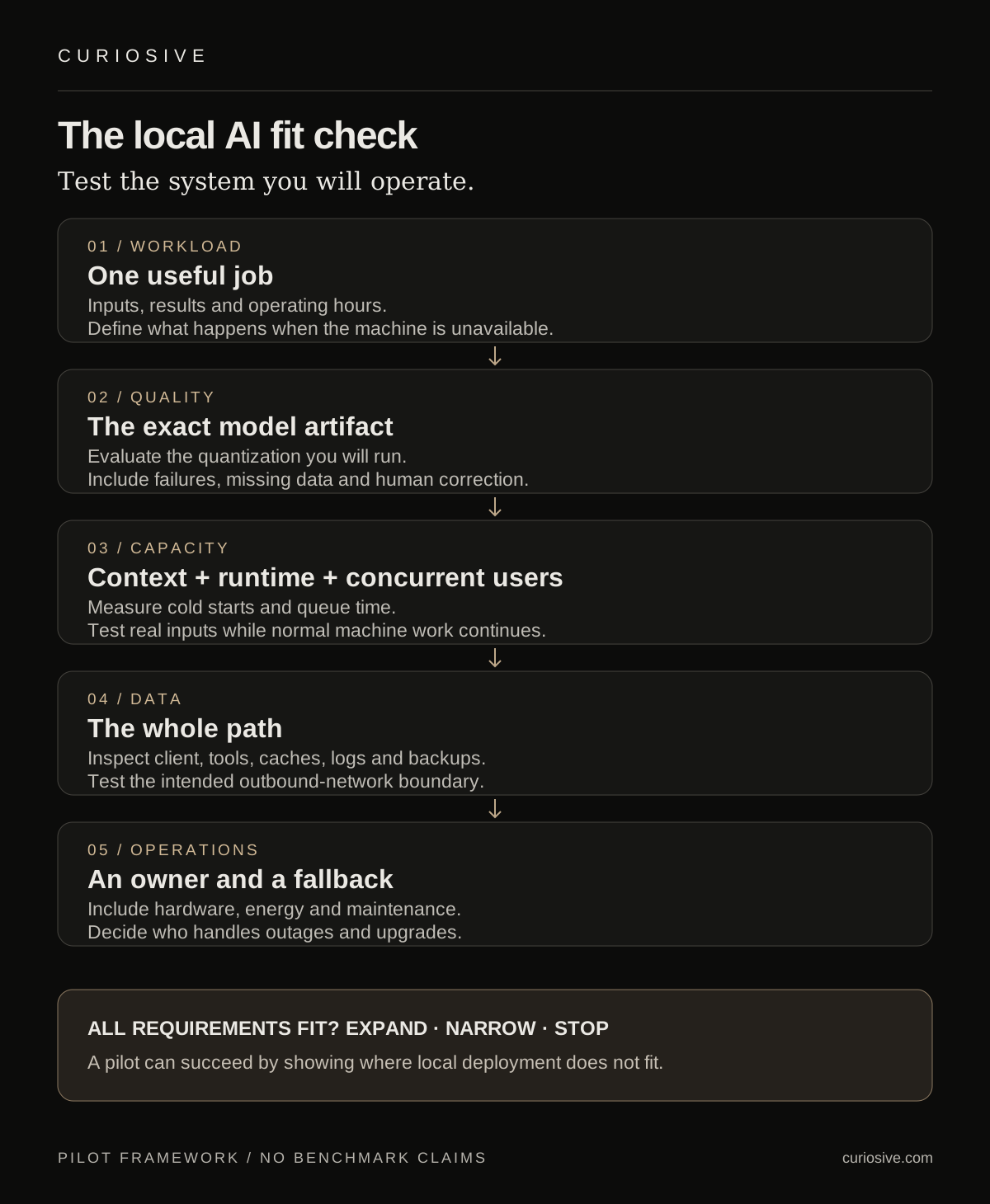
Use a pilot with clear stop and go criteria
- Select one workload and a sanitized evaluation set that represents its real inputs.
- Test a supported configuration with the expected context sizes and concurrency.
- Inspect outbound traffic, retained cache data and the client’s API behavior.
- Measure accepted results, latency, memory and the human work required to correct failures.
- Document ownership and fallback, then decide whether to expand, keep the pilot narrow or stop.
Set the criteria before tuning the system. A pilot can be successful by showing that the hardware is a poor fit before the team spends more. It can also uncover a useful local batch workflow even when interactive multi-user serving does not meet expectations.
Avoid turning a local experiment into an organization-wide mandate. Some workflows benefit from direct control of inference and retained data; others benefit from different capacity and support arrangements. The architecture should follow the evidence from the intended workload.
Scope local AI around a product need
Considering local inference for an internal tool or an existing product? Explore Curiosive’s AI integration work, read our guide to production AI routing and controls, or tell us which workflow you want to keep local.
Bring sample input shapes, expected users, the hardware you already have and the reason local processing matters. Those constraints are a better starting point than a model leaderboard or a new workstation specification.
Sources and scope
Sources read on 2 October 2026: the Hacker News discussion, the DwarfStar community site, and the upstream README, Metal guide and serving guide. These are evolving project documents; recheck the supported configuration before implementation. Curiosive has not benchmarked the project or audited it. Examples, decision criteria and operating recommendations are our original analysis.
Frequently asked questions
Does running an LLM locally make an application fully private?
It can keep inference prompts off a remote inference endpoint if the application uses the local path. Clients, external tools, telemetry, logs, caches and backups still need to be checked as part of the full data boundary.
How much memory does a local LLM need?
It depends on the exact model representation, context size, runtime buffers and active sessions. Start from the runtime’s supported configuration, leave headroom and measure the actual workload rather than relying only on model-file size.
Is local AI cheaper than a hosted API?
There is no universal break-even point. Compare the measured workload against hardware, electricity, storage, maintenance, idle capacity and human correction costs over a realistic period.
What should a local LLM pilot measure?
Measure accepted-result quality, time to useful output, completion and queue time, peak memory, concurrency, retained data and operator effort. Test cold starts, real input sizes, failure recovery and the application’s API behavior.
Put this into practice
Explore the services related to this article.
A short note about the product, the timeline and who it is for is enough to start. You will hear back from the engineer who would do the work, not a sales team.
Start a partnership