Multilingual AI agents: fluent answers still need verified sources
- AI integration
- AI agents
- Multilingual products

A multilingual AI agent can write a convincing answer while failing to retrieve the sources needed to support it. That matters when a product searches documents, prepares research or helps customers act across languages. Translation quality is one part of the experience; source access, dates and evidence determine whether the result is useful.
A recent report comparing agents on English and Farsi research tasks puts that distinction into view. For clients buying AI-accelerated development, the lesson is specific: test the whole retrieval-to-answer workflow in the target languages before treating a fluent demo as a finished feature.
What the recent agent study reports
Roya Pakzad’s 2 October 2026 article describes a test of three web-based agents completing public procurement research for the US and Iran. The author reports differences in source access, source selection and visible action records, while noting that fluent Farsi output did not establish strong retrieval. It also describes an access workaround that changed the baseline data year.
The HN submission, posted that day, had no substantive discussion when we read it. The evidence here is the author’s reported experiment, not an HN consensus or an independently replicated benchmark. We have not reproduced the runs or audited the linked spreadsheets and recordings.
We are not ranking the named agents from this account. Its useful question for product teams is whether an answer preserves the authority, meaning and date of its supporting sources when retrieval becomes difficult. The recommendations below are our own illustrative design and evaluation approach.
Define the language task precisely
“Support several languages” can mean different things. A product may translate an answer grounded in one shared document set, search a separate corpus for each language, or retrieve material from the open web. Those are different retrieval problems even when the final interface looks similar.
Name the task, the intended audience and the authoritative source set. For a customer-support assistant, approved product documentation may be the relevant boundary. For an internal research tool, the brief may require primary-source material in the original language. A general search result is not automatically an acceptable substitute.
Distinguish the language of the request, source and response. A Turkish question about an English product guide may legitimately produce a Turkish answer with an English citation. A question requiring a local-language official source should not silently receive a different-language secondary account instead.
Record terms that must keep their meaning: product names, organization names, dates, units and domain-specific labels. Treat unresolved translation choices as part of the brief. If the workflow touches a specialist area, involve an appropriate reviewer rather than using fluent output as evidence of domain accuracy.
Make source coverage visible
An agent should know which approved sources were actually retrieved. A search result showing a page title is different from reading the document. A failed request is different from a page with no relevant information. Preserve those distinctions in the retrieval record.
For each candidate source, record the URL or document identifier, retrieval status, relevant version or date, and the passage used for the answer. Show a source-access gap when it affects the result. A plausible answer should not conceal that the authoritative page was unavailable.
Use approved alternate access paths where they exist, such as a documented feed, API or authorized file import. A fallback should retain the source’s identity and applicable date. If it changes either, the answer needs to show that limitation and the reviewer needs to decide whether the substitution is acceptable.
Keep a failure localized. An inaccessible source in one language should not imply that the entire workflow has no useful evidence, or that another language’s evidence automatically applies. Report what was checked and what remains unresolved.
Preserve dates through retrieval and translation
A source can be authentic and still answer the wrong time-specific question. Distinguish when a page was retrieved, when it was published, and when its information applies. Those dates can differ.
For an illustrative internal research tool, an older dataset should not be treated as the current baseline merely because it is easier for the agent to access. Store the selected version explicitly and compare it with the task’s required period before generating the answer.
Watch for translated date formats, calendar conventions and ambiguous numeric order. Keep machine-readable values alongside the original text where the workflow needs structured dates. Ask for review when the source does not make the intended date clear rather than letting the model choose a convenient interpretation.
The same care applies to numbers and units. A multilingual answer should preserve the relevant quantity and qualification, not only produce a natural sentence. Validate critical structured fields separately from the final prose so a translation change does not quietly alter the underlying record.
Keep evidence attached to the claim
Build the answer from retrieved evidence rather than asking the model to fill gaps from memory. A claim should point to the passage that supports it, and the cited source should be the source actually used. A more authoritative-looking URL does not compensate for reading a different document.
Separate extraction from explanation. First record the relevant fact, its source language and any uncertainty. Then produce the audience’s requested language while retaining the connection to that record. This creates a reviewable boundary between what the source says and how the answer presents it.
Use useful uncertainty labels. “The required source could not be retrieved” and “the source does not state a date” tell a reviewer what to resolve. A generic confidence percentage can obscure the distinction between missing evidence and an uncertain interpretation.
If sources disagree, show the conflict and its scope. Do not smooth competing versions into one confident statement simply to make the output read well. The agent’s job may be to prepare a question for a reviewer rather than produce a final answer.
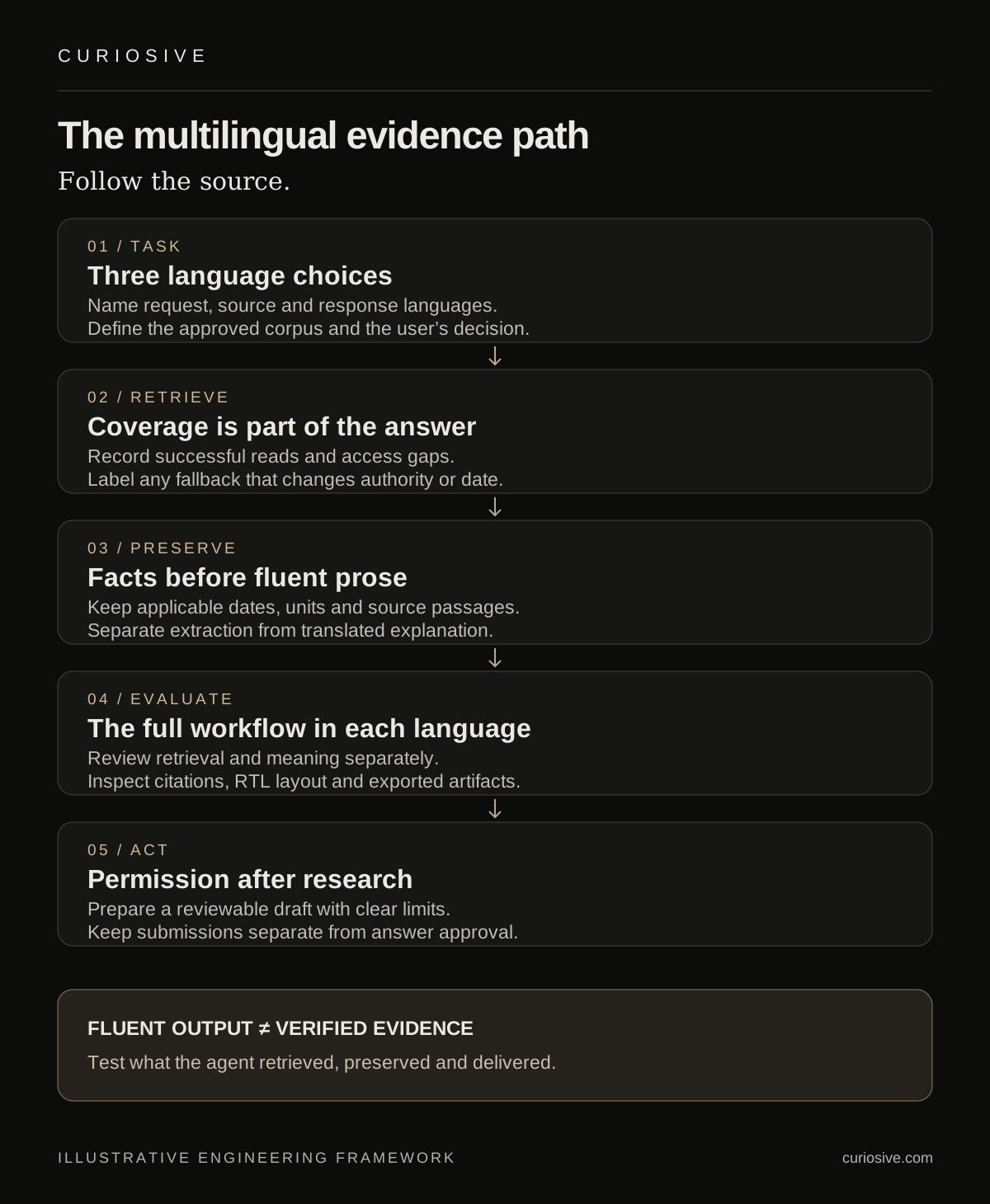
Evaluate each language on the real workflow
Create representative tasks in every supported language and context. Include ordinary cases, ambiguous terms, incomplete sources and access failures. A translated English test set can be useful, but it does not alone cover the source ecosystem or user expectations of another language.
Evaluate retrieval separately from answer presentation. Did the workflow select the approved source? Could it read the relevant passage? Did it preserve the applicable date? Did the final answer accurately reflect the evidence? Those checks can identify a weak retrieval path even when the prose is excellent.
Use reviewers able to assess the source and response languages, especially where domain terminology matters. Record disagreement rather than forcing every case into a binary score. Some tasks may need a clearer brief before a reviewer can decide whether the answer is acceptable.
Keep withheld cases for evaluating changes to the model, prompts or retrieval configuration. Compare equivalent tasks where the evidence is comparable, and report where the sources differ. Do not describe a language as generally “better” or “worse” based on a small, uneven set of pages.
Measure reviewer corrections and unresolved evidence, not only answer completion. A system that always returns something can look successful while creating more verification work for its users. Expansion should follow observed task quality under the intended source and access conditions.
Review the interface, including right-to-left output
The answer is delivered through an interface or artifact. Check that citations, dates and numbers remain readable after translation and export. Directionality can affect the presentation of mixed-script text, URLs and identifiers.
For a product supporting a right-to-left language, inspect real examples in the target display and generated files. A fluent answer can become hard to follow when punctuation, column order or source links are presented poorly. Language evaluation should include the final destination, not just a text response copied from a model.
Let users inspect the original passage when appropriate. A reviewer may need to compare a translated explanation with the source terminology. Keep that relationship clear without overwhelming the everyday interface with every retrieval event.
Use accessibility checks and audience feedback alongside language review. Neither translation quality nor a successful retrieval establishes that the product’s navigation and output work for the people using it.
Bound what the agent can do next
Research and action are different stages. An agent that prepares a multilingual record should not automatically register accounts, send messages or upload its findings to an external service. Give those actions explicit permissions and a visible proposed result.
The approval should let a person inspect the destination, material being submitted and any unresolved source limitations. A reviewer approving a translated summary is not necessarily authorizing a later operational change.
Keep factual action records: which source was accessed, which tool ran and whether a submission succeeded. Do not depend on a model’s retrospective narrative as the only record of its behavior. The application can provide useful evidence of actions without exposing private internal reasoning.
This is particularly relevant to a client integration that combines retrieval with workflow automation. Start with a reviewable draft and add authorized actions when the data path and review responsibility are clear.
What this means for AI-accelerated development
AI can help a team build and iterate on a multilingual search or research feature. It can also help draft interface copy and evaluation cases. The release decision still depends on the retrieved evidence, the final presentation and the product’s permission boundaries.
Curiosive’s AI integration work describes Appster’s use of precomputed embeddings and YouNet’s emphasis on bounded agent actions. Those are separate product concerns that become especially visible in multilingual workflows: how information reaches the model, and what the system is allowed to do afterward. They are not claims that this reported study tested Curiosive products.
For a useful first integration, choose one language pair and a defined source set. Demonstrate the evidence path, inspect failures and identify who reviews uncertain results. That provides a concrete basis for expansion rather than promising equal capability across every language from a single demo.
Scope a multilingual AI feature with evidence
Adding multilingual search, support or research to an existing product? Explore Curiosive’s AI integration services, see our shipped work, or tell us the languages, sources and decisions the feature needs to support.
Bring representative questions, approved source documents and examples that require human judgment. A focused evaluation can reveal whether the main work belongs in retrieval, translation, interface behavior or action controls before the team broadens the feature.
Sources and scope
Read on 3 October 2026: Roya Pakzad’s study report dated 2 October and the HN submission. The opening observations are attributed to the author and have not been reproduced by Curiosive. The proposed workflow, examples and client implications are original analysis, with no universal language ranking or measured customer outcome claimed.
Frequently asked questions
Does fluent output show that a multilingual AI agent retrieved reliable sources?
No. Evaluate source selection, successful access, supporting passages and applicable dates separately from the language quality of the final answer.
How should an agent handle an inaccessible authoritative source?
Record the access gap and use only an appropriate approved alternate path. If the fallback changes the source identity or applicable date, show the limitation and require review where it affects the answer.
Can translated English tests cover a multilingual product?
They can help, but each supported context also needs representative tasks, source-access failures, terminology review and final-interface checks, including right-to-left presentation where relevant.
Put this into practice
Explore the services related to this article.
A short note about the product, the timeline and who it is for is enough to start. You will hear back from the engineer who would do the work, not a sales team.
Start a partnership