Pi 1.0: connect AI coding agents to client tools with clear boundaries
- AI integration
- AI development
- MCP

Pi 1.0 makes a practical question more concrete for product teams: how should an AI coding agent work with the tools around a codebase? Issue tracking, repository history and design references can improve its context. Access to production systems also gives it consequences.
The client value is a workflow that carries an approved task through implementation and review with fewer missing handoffs. That needs an integration contract: what the agent can discover, which records it can read, which actions it may request and what evidence a reviewer receives.
Earendil’s October 1, 2026 Pi 1.0 announcement adds native MCP through Codemode, deferred tool loading and virtual-model extensions to its minimal harness. We separate those reported capabilities from Curiosive’s recommendations below. We have not benchmarked Pi or deployed this release for a client.
What ships in Pi 1.0
Earendil lists Codemode, native support for MCP and non-LLM models, deferred tool loading, virtual-model extensions, Anthropic cache warming and transcript-aware mid-conversation system messages. These are release-reported features, not measured improvements for a particular project.
The announcement demonstrates a script summarizing repository commits and an extension switching between planning and implementation models. These illustrate possibilities; they do not establish a reliable routing policy for your codebase.
Pi Durable is a separate experimental package, announced alongside Pi 1.0 for longer-running applications. Do not assume the stable terminal harness includes Durable’s application behavior. A coding session and a background workflow that must survive interruptions have different operating requirements.
The Hacker News discussion includes debate about minimal harnesses, customization, plugin ecosystems and dependable tooling. These community perspectives are not comparative tests. For a buyer, they raise an ownership question: who maintains the integration when connectors, schemas and models change?
Start with a real development handoff
Consider an illustrative task: update a subscription settings screen to match an approved requirement. The implementation may depend on an issue description, linked design revision, backwards-compatibility constraints and existing tests. An agent with repository access alone can produce plausible code while missing a constraint held elsewhere.
A connected workflow could retrieve the approved task, identify the design revision, read relevant code and propose a patch with its assumptions. The useful output is a reviewable change grounded in the right context. Installed connector counts do not measure that outcome.
Start with one task type and its actual handoff failures. If reviewers repeatedly chase missing acceptance criteria, supply that information. If a maintained script already produces a report, expose the script rather than asking a model to reconstruct its calculation.
For an AI integration, this creates a focused first delivery: one task pathway, a small tool set and a visible review artifact. Expand after representative tasks demonstrate that the pathway works.
Native MCP still needs a permission policy
MCP exposes tools and resources; your application determines what a task may do with them. Discovering a tool does not authorize changing a customer record or publishing a release.
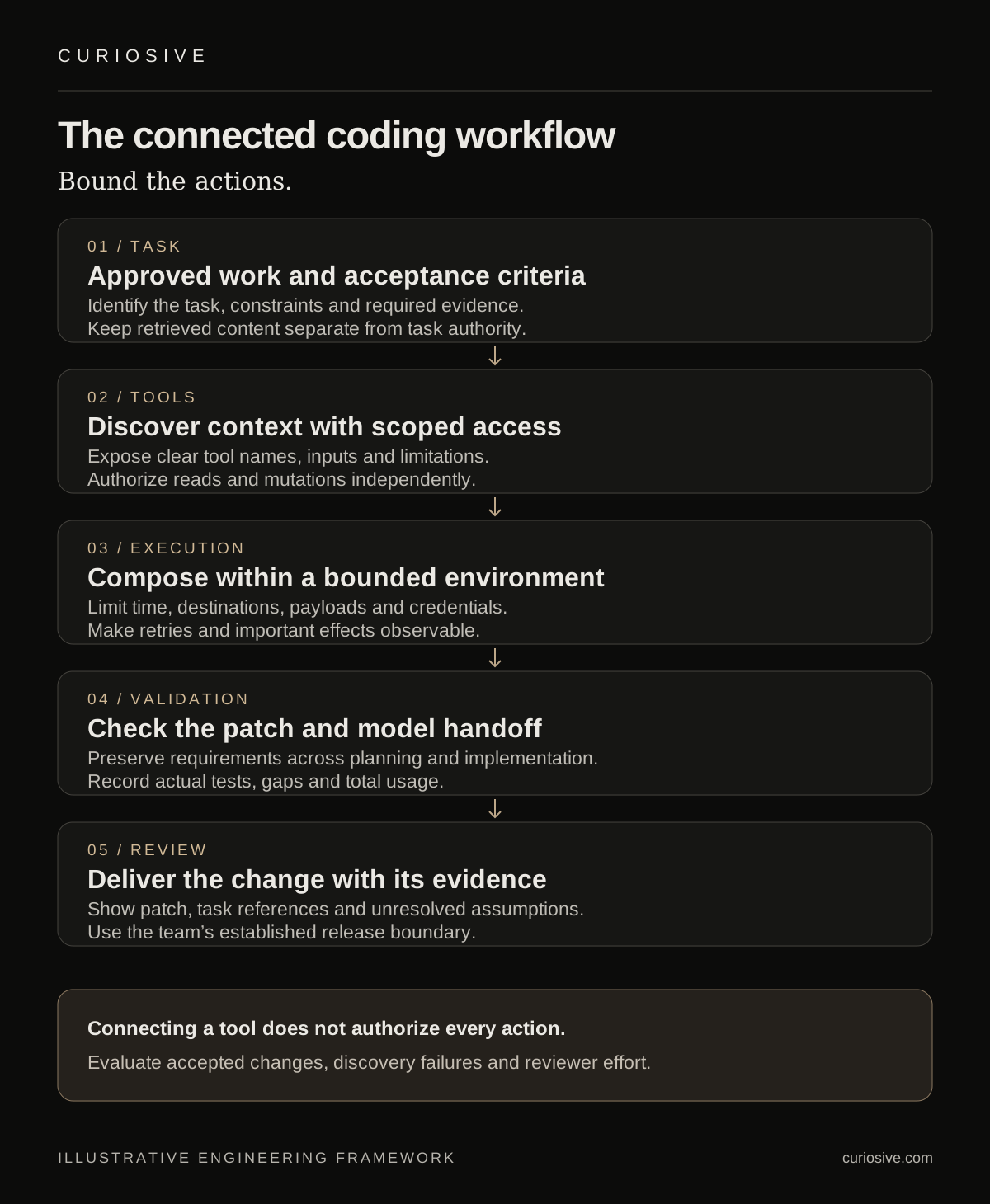
Separate discovery, reads and mutations. Credentials and server-side authorization should constrain the actual operations. Reading and editing an issue should not automatically share the same scope. A tool description asking the agent to be careful is weaker than a server rejecting an unauthorized action.
For an initial coding workflow, task-context reads and an isolated patch workspace may be sufficient. Use the team’s established review boundary for changes to shared systems. Keep retrieved material separate from governing instructions: an issue comment or external document can contain instructions that conflict with the approved task.
Codemode needs bounded execution
Pi’s release places native MCP support within Codemode and shows script-based composition across repository history. The attraction is combining tool results and producing a useful artifact without manually carrying each intermediate result between systems.
A script can also repeat an operation, combine records incorrectly or fail after partial completion. Our recommendation is to bound destinations, execution time, result sizes and credentials. Give mutations operation identifiers when retries must not duplicate effects.
Keep deterministic behavior in maintained tools. Let the agent compose those tools within the task policy. Record enough provenance for review without putting secrets or unnecessary customer content into broad logs.
Deferred loading depends on a usable catalog
Deferred tool loading is a release feature, not a guarantee of lower cost or better completion. Its value depends on finding the right tool and receiving enough information to use it.
Treat tool names and descriptions as an interface. Distinguish searching from updating; explain inputs, returned fields and limitations. Similar tools need clear boundaries so discovery does not select a broad mutation where a narrow read would suffice.
Test missing-tool behavior. An unavailable design revision should produce an identified gap, not an invented design. Conflicting record identifiers need resolution before an action. Track discovery errors separately from expired credentials, stale schemas and model failures. Otherwise, switching models can become an expensive distraction.
Evaluate model handoffs and accepted changes
Pi’s virtual-model demonstration combines planning and implementation models. That handoff is itself part of the system to evaluate. Define the state passed between stages: requirements, constraints, files examined, unresolved questions and planned checks.
Compare a routing policy with a baseline on the same representative tasks. Record accepted changes, failed checks, unsupported assumptions, reviewer effort and total usage across retries. A cheaper call does not establish a cheaper accepted change.
Our production AI architecture guide covers routing and reliability in more detail. In a tool-connected workflow, also verify that task state and permissions remain consistent when the active model changes.
Give reviewers a clear acceptance surface
A useful handoff contains the task reference, actual patch, assumptions and checks run. Distinguish passed checks from unavailable checks. Include the external evidence behind consequential implementation choices, with its revision where relevant.
Reviewers should be able to open the same requirement or design. If a connector failed, identify what remains uncertain. Preserve the evidence needed to assess the change without dumping an unfiltered transcript.
Before expansion, define the recurring task, authorized actions, script limits, acceptance evidence and owner of connector updates. Evaluate absent requirements, unavailable tools and ambiguous requests. Keep the existing engineering release process as the acceptance boundary.
Connect the workflow around your client task
Pi 1.0 makes tool composition worth investigating. The client benefit depends on approved context, bounded actions and reviewable results.
If your development process loses time between requirements and implementation, tell Curiosive about the handoff. We can discuss an AI integration around its access boundaries and acceptance criteria. Explore our work for product context.
Sources and scope
Reviewed October 3, 2026: Earendil’s Pi 1.0 release, October 1 and the associated Hacker News discussion. Capabilities and demonstrations are attributed to Earendil. Task design, permissions, execution controls and evaluation guidance are Curiosive recommendations. No independent benchmark or client deployment result is claimed.
Frequently asked questions
Is Pi Durable part of stable Pi 1.0?
Pi Durable was announced alongside Pi 1.0 as a separate experimental package for longer-running applications.
What does native MCP change for AI coding workflows?
Pi adds native MCP through Codemode. Teams can investigate tool composition while defining connector permissions, execution limits and review evidence.
Put this into practice
Explore the services related to this article.
A short note about the product, the timeline and who it is for is enough to start. You will hear back from the engineer who would do the work, not a sales team.
Start a partnership