Turning Code Review Into a Self-Improving Feedback Loop
- AI Code Review
- Software Engineering Practices
- Continuous Delivery
- AI Assisted Development
Most teams that adopt AI coding agents hit the same wall within a few weeks. The agents produce code faster than any reviewer can read it carefully, so review either becomes a rubber stamp or a bottleneck. Neither outcome is acceptable for software that has to run in production. The way out is not to review less, it is to change what a developer's attention is spent on: instead of inspecting every generated line, the job becomes defining the constraints and success criteria that generated code has to satisfy, then building automation that checks those constraints continuously.
Building A Review Skill From A Team's Own History
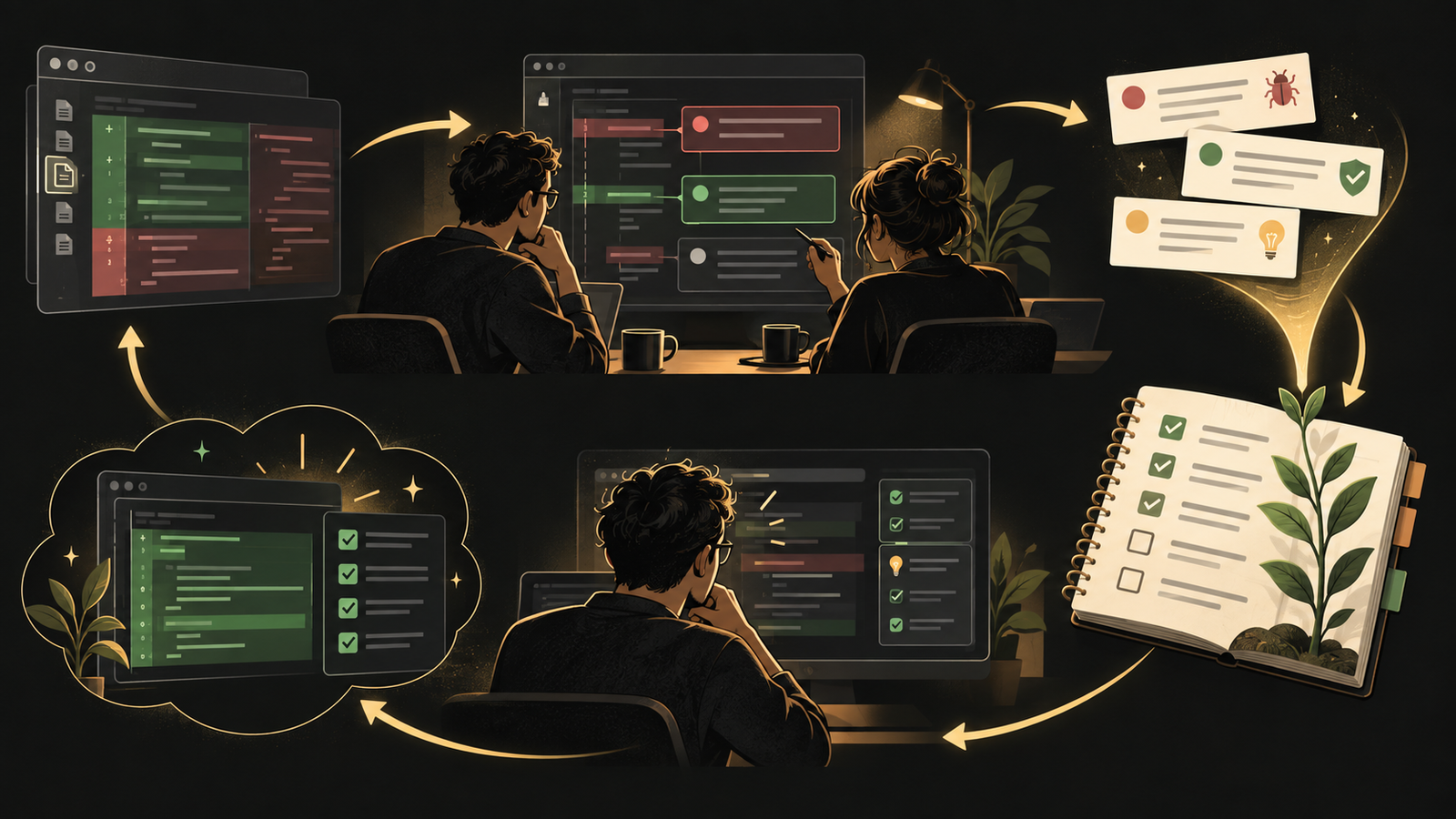
A useful starting point is a team's own pull request history. It already contains a record of what good and bad changes looked like: the comments reviewers left, the corrections they asked for, the patterns that kept recurring. That history can be turned into an automated review pass that runs on every new pull request, flagging the kinds of issues the team has actually cared about in the past, rather than a generic linter's idea of code quality.
This kind of automation will get things wrong at first, and that is fine as long as it ships anyway. The important part is what happens next: when a developer overrides or corrects the automated review, that correction becomes new training signal. A second process, running on a schedule, can look at the day's corrections and adjust the review logic accordingly. The result is a review system that keeps tightening itself against real feedback instead of sitting static once it is written.
Evaluation Scenarios Keep Automation From Regressing
The obvious risk with a review system that keeps changing itself is that a change meant to fix one case quietly breaks another. Software engineering already solved this problem for hand-written code: tests. The equivalent for AI-driven automation is a set of evaluation scenarios, concrete tasks paired with clear judgment criteria, pulled from the same historical examples used to build the review logic in the first place.
Running those scenarios against every proposed change to the review automation serves the same purpose a regression suite serves for application code. It also unlocks something teams would otherwise be nervous about: swapping which underlying model does the work. Once there is a scenario suite to check quality against, a team can move a routine check from an expensive, highly capable model to a cheaper one, or the reverse when a task turns out to need more reasoning, and know quickly whether the change held up.
Small Verifiable Steps Are Still The Discipline That Matters
None of this replaces the practice that has always separated strong engineering teams from weak ones: making progress in small, safe, verifiable steps and checking constantly that the system still behaves as expected. What changes with AI agents is the speed mismatch. Agents can produce changes far faster than a team can review them in detail, which makes the old model of exhaustive up-front review before release even less workable than it already was. The answer looks a lot like what continuous delivery already teaches: ship in small increments, observe what happens, and iterate, rather than trying to catch every problem before anything goes out the door.
None of this works without the supporting infrastructure that gets built alongside it: logging what each automated check actually decided, aggregating that history so it can be inspected, and treating the accumulated review logic as a project artefact that evolves rather than a one-off script. For a web team shipping features weekly, that infrastructure is the real deliverable. The AI coding tool is replaceable. The evaluation harness and the review history it was trained on are not, and they are what let a team trust faster iteration instead of just hoping it holds up in production.
Frequently asked questions
How can a team automate code review for AI-generated code?
A team can extract patterns from its own pull request history, the comments and corrections reviewers have made in the past, and turn those patterns into an automated check that runs on every new pull request.
What are evaluation scenarios in AI-assisted development?
Evaluation scenarios are concrete tasks paired with clear judgment criteria, drawn from real past examples, used to check whether a change to an automated process still performs correctly, similar to how tests check application code.
Why does line-by-line code review stop working with AI coding agents?
AI agents can produce changes far faster than a team can read and verify them individually, so exhaustive manual review before release becomes a bottleneck or gets skipped altogether.
Can a team change which AI model handles a coding task without losing quality?
Yes, once a suite of evaluation scenarios exists to check output quality, a team can move a task to a cheaper or more capable model and quickly confirm whether the change held up.
What software engineering practice still matters most when using AI coding agents?
Making changes in small, safe, verifiable steps and continuously checking that the system still behaves correctly remains the core discipline, the same one that underpins continuous delivery.
Put this into practice
Explore the services related to this article.
A short note about the product, the timeline and who it is for is enough to start. You will hear back from the engineer who would do the work, not a sales team.
Start a partnership