Vibe Coding Risks: How Senior Developers Use AI Strategically
- Vibe Coding
- AI Strategy
- Code Review
- Senior Developers
- Production Failures
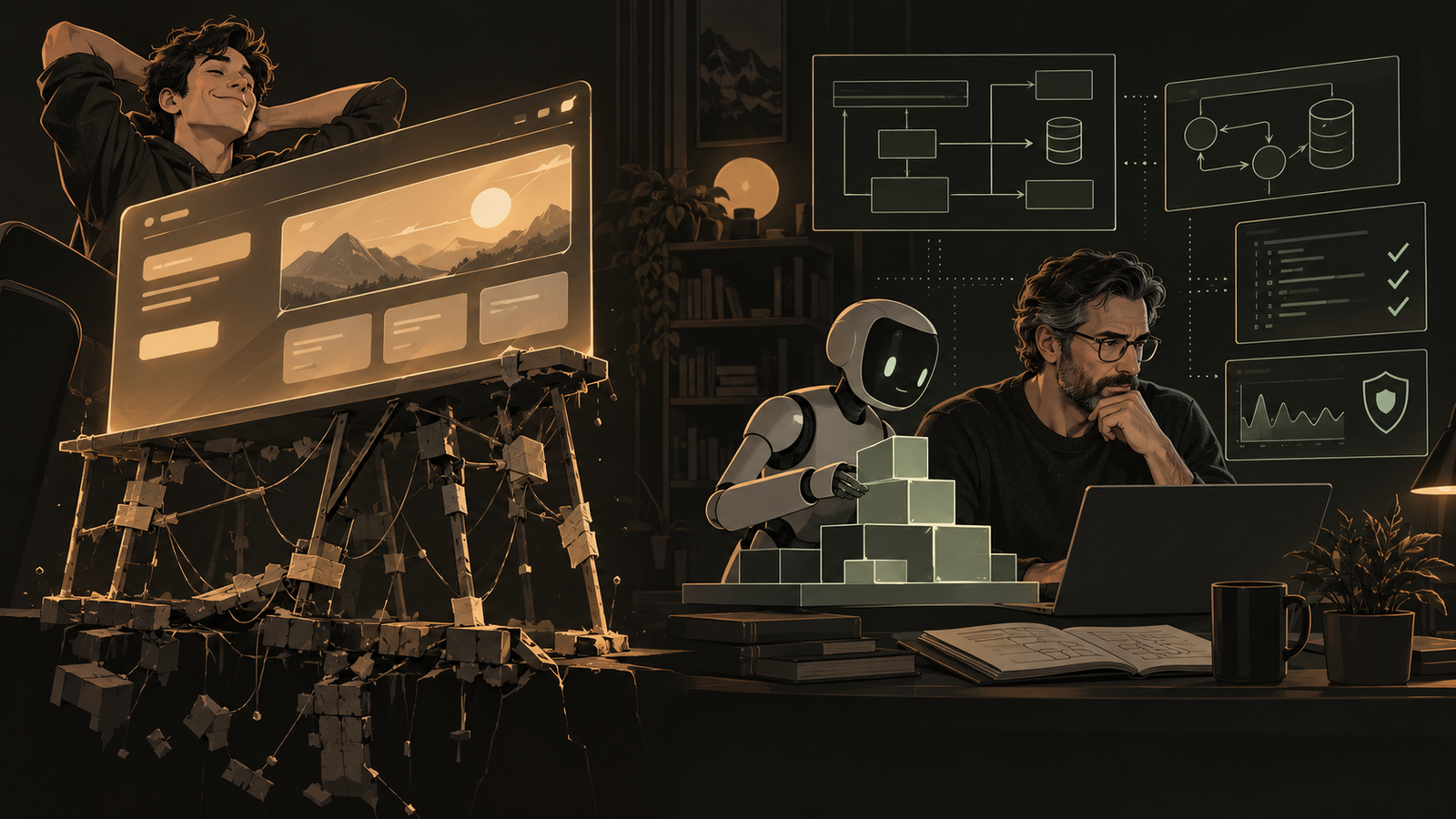
A feature ships in a day. The tests pass. The demo impresses. Then the real users arrive and the system buckles under load that no one anticipated, because no one fully understood the code that put it there. This is the trap of vibe coding.
Vibe coding is the act of accepting AI-generated code that runs and passes basic tests without demanding a thorough understanding of how it works. The name captures the feeling of going with what feels right, but in production, feelings are not enough. The result is software that holds together in gentle conditions and breaks apart the moment real traffic, edge cases, or failure modes appear.
The Fragility Trap of Vibe Coding
Vibe coding feels productive. A developer describes a feature, an AI generates an implementation, and the loop repeats. The danger is that the developer never forms a mental model of the system they are building. When every line is a plausible answer from a model with no understanding of the larger context, the output can hide subtle, catastrophic flaws.
A common example is a search-as-you-type feature. An AI happily writes a component that fires a database query on every keystroke. The code runs fine with a handful of local test records. In production, with thousands of concurrent users, those unfiltered queries overwhelm the database. There is no debouncing to batch or delay calls, no caching layer with a TTL to absorb repeated reads, no rate limiting to protect the backend. The database connection pool saturates, the application becomes unresponsive, and the failure cascades into other services. A developer who understood the requirements would have designed those guards from the start; a vibe coder discovers them only through a production outage.
Speed That Slows You Down
Measuring development speed by how fast code is committed is a misleading metric. A team that ships a feature in two days but then spends the next two weeks debugging mysterious timeouts, patching overlooked race conditions, and refactoring tangled logic has not been fast. The total time from idea to maintainable, production-hardened code is often longer with vibe coding than with a deliberate process.
Brian Kernighan observed that debugging is twice as hard as writing the code. If AI writes code at the limit of, or beyond, a developer’s comprehension, then that code is, by definition, undebuggable. When an obscure state mutation causes a data corruption bug at scale, the developer without a mental model cannot reason backwards from the stack trace. They do not recognise which invariants were violated or where. The only option is to ask the AI again, hoping for a fix that does not introduce a new hazard, a cycle that erodes confidence and extends recovery time.
Strategic AI Use: Boilerplate, Not Business Logic
Senior developers do use AI. They use it differently. The line they draw is clear: AI assists with the parts of the codebase that are tedious and well-understood, never with the parts that must be correct.
This means leaning on AI for boilerplate, test fixtures, configuration files, and straightforward scaffolding. It also means asking an AI to explore alternative approaches when the developer already understands the problem space well enough to evaluate the suggestions. But for core domain logic, critical paths such as payment processing, or any code that handles authentication, authorisation, or personally identifiable data, the senior developer holds the design. Every line generated for those areas is reviewed as if it were written by an unfamiliar colleague. Before code is merged, the developer can explain not just what it does, but why it was written that way, what assumptions it makes about inputs, and how it might fail.
This standard of review extends to subtle issues that AI routinely misses. For example, a generated React component might use a useEffect that subscribes to a data source without a corresponding cleanup, creating a memory leak that grows under navigation. Or a suggested caching strategy might never invalidate stale records because the AI was not prompted to consider cache invalidation, one of the two hard problems in computer science. A senior engineer spots these gaps during review.
The Atrophy of Mental Models
The most persistent cost of vibe coding is not a single outage. It is the slow erosion of the ability to build and maintain mental models of complex systems. When a developer repeatedly asks an AI for a solution before trying to reason through the problem themselves, they train themselves to outsource understanding. The feedback loop of struggling with a problem, forming a hypothesis, and testing it against the system is what builds deep knowledge.
During a production incident, this atrophy becomes painfully visible. A senior developer with years of hands-on debugging experience sees a spike in latency and immediately suspects connection pool exhaustion because the database thread pool chart looks flat. They scan the stack traces, recognise the familiar signature of a thread blocked on a connection acquisition, and narrow the investigation to a recent change that opened long-running transactions. A developer who has always leaned on AI to write and explain code sees the same stack traces and struggles to interpret them. The patterns are there, but the mental machinery to decode them was never built.
Building Intuition Through Deliberate Practice
AI tools cannot teach the intuition required to debug distributed systems under pressure. Recognising a race condition from an intermittent log pattern, understanding when a cache-aside strategy will amplify load instead of reducing it, or sensing that a queue’s back-pressure is about to cascade across services are skills that come only from building systems and observing their real-world failures. There is no shortcut.
The discipline that preserves and sharpens these skills while still using AI productively is straightforward. First, understand the problem and design the solution yourself. Sketch the data flow, list the failure modes, identify the critical sections. Only then use AI to assist with implementation, if it helps. After the code is written, review every line critically. If the AI introduced a library you do not know, read its documentation. If a generated function handles a specific edge case, verify that the edge case actually matches the production reality. The goal is not to reject AI; it is to ensure that the person responsible for the system remains smarter than the tools they use.
Teams that adopt this approach get the velocity benefit of AI on the routine work while keeping the deep understanding that prevents catastrophic failure. They ship features quickly without shipping technical debt they cannot later service. In the long run, that is the only kind of speed that matters.
Frequently asked questions
What is vibe coding?
Vibe coding is the practice of accepting AI-generated code that runs and passes basic tests without demanding a thorough understanding of how it works. It creates software that holds together in gentle conditions but breaks under real traffic, edge cases, or failure modes.
What are the dangers of vibe coding in production?
Vibe coding introduces hidden flaws that can cause catastrophic production outages, like a search-as-you-type feature firing unfiltered database queries on every keystroke. It also leads to code that is undebuggable because the developer lacks a mental model of how it works.
How do senior developers use AI without risking code quality?
Senior developers use AI for boilerplate, test fixtures, and scaffolding, never for core business logic or critical paths. They review every generated line as if it came from an unfamiliar colleague, ensuring they can explain why each decision was made.
Does using AI for coding make you a worse developer?
Over-reliance on AI can atrophy your ability to build and maintain mental models of complex systems. Without deliberate practice, developers lose the debugging intuition needed to recognise patterns like connection pool exhaustion or race conditions during incidents.
How can I use AI tools without losing my debugging skills?
Understand the problem and design the solution yourself first, then use AI to assist with implementation. After code is written, review every line critically, verify edge cases, and learn any unfamiliar libraries to ensure you remain smarter than your tools.
Put this into practice
Explore the services related to this article.
A short note about the product, the timeline and who it is for is enough to start. You will hear back from the engineer who would do the work, not a sales team.
Start a partnership