What Makes AI Coding Agents Production Ready
- AI Coding Agents
- Software Architecture
- Code Review
- AI Assisted Development
Every few months another headline claims that anyone can now build software by describing what they want in plain English. The demos are real. So is the gap between a demo and something a team can safely run in production. That gap is not closed by a better model. It is closed by everything around the model: the software managing its actions, the boundaries stopping it from doing damage, and the process used to review what it produces. For a founder or product team deciding how to build with these tools, that surrounding structure matters more than picking a favourite model.
The Model Is the Smallest Part of an AI Coding System
A language model alone is a function: text goes in, text comes out. It cannot search the web, read a file or run a command by itself. An agent is what results once a model sits inside a loop, picking an action, having it executed for real, and feeding the result back in to decide what comes next. The software managing this loop is usually called a harness: it sends prompts, carries out requested actions, manages the context window, and preserves state so a long task can survive an interruption. Around it sit a standard protocol for reaching external tools, reusable instructions for specific tasks, and a disposable, isolated environment where code can run without touching a real machine. This is the same discipline any reliable backend needs: clear interfaces, contained side effects, a record of what happened.
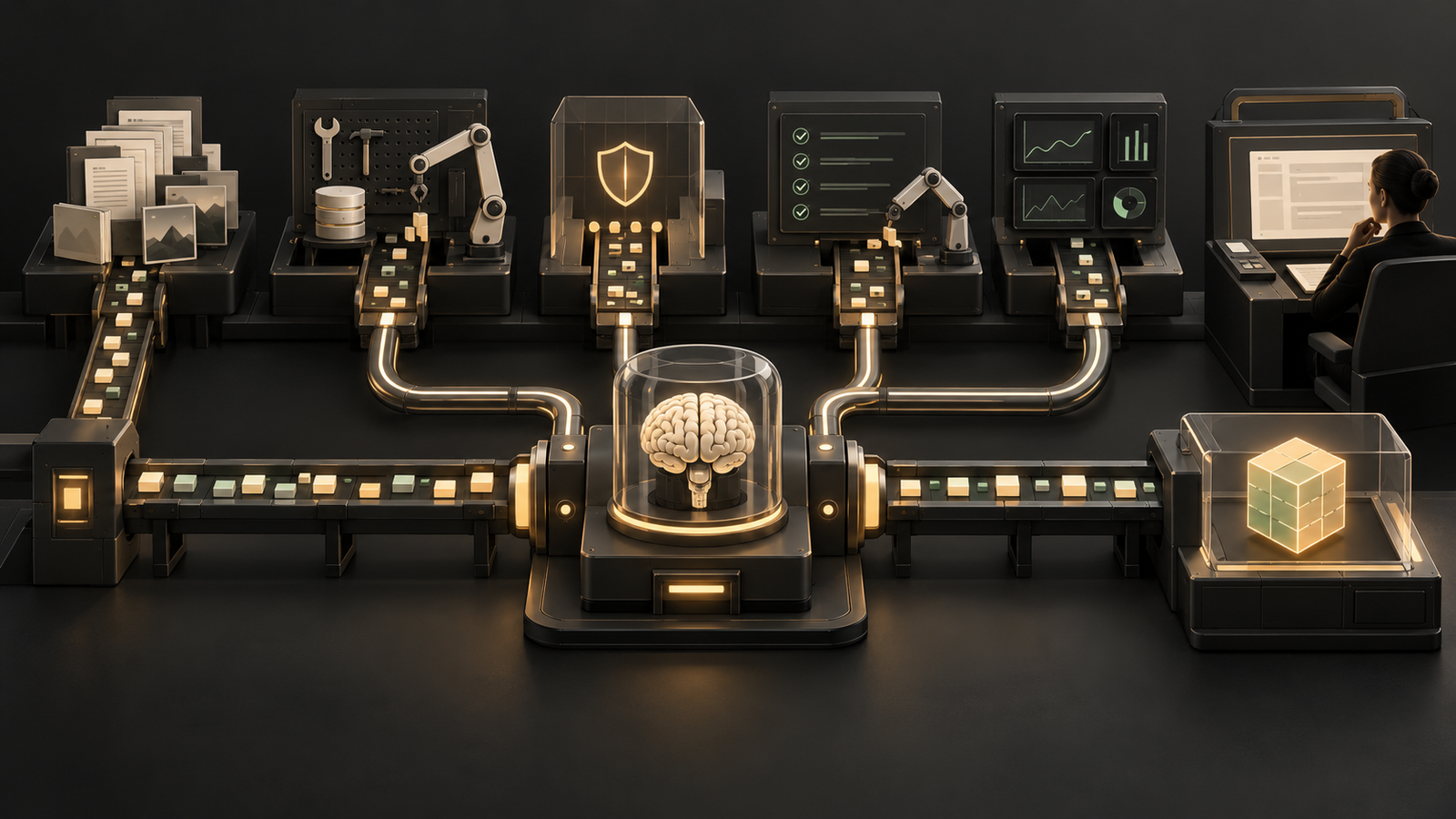
Treat It as a Factory With Layers, Not One Purchase
Teams getting durable value from AI assisted development think in layers rather than committing to one vendor's whole stack: a development environment layer for tooling, a harness layer for the agent loop, an infrastructure layer for compute, and an orchestration layer that dispatches and tracks work. Each layer can be bought or built, and the strongest setups mix the two.
This also shows where the real problems sit. Development environments hold up best when disposable and quickly reprovisioned, not maintained by hand. Incoming bug reports are unreliable on their own and are worth turning into a verified reproduction before they become a ticket. A large AI generated change is easier to review when split into several small pull requests rather than shipped as one diff no reviewer will hold to a normal bar.
Multi Agent Work Needs a Budget Before a Prompt
Not every task needs a swarm of agents. A single session covers a quick question, a documented instruction set covers a repeated task. Splitting work across agents that run independently and report back earns its keep once a job genuinely breaks into pieces that do not depend on each other. A small group of agents that talk to one another and share a task list is worth the extra cost only when a problem benefits from a debate rather than a checklist.
Each step up this ladder adds capability and cost together, and a loosely scoped instruction to a large job can burn through a surprising amount of compute in minutes. The fix matches any distributed system: bound the scope, name the deliverable, and reserve the most capable model for the step that needs it.
None of this replaces engineering judgement, it gives that judgement somewhere to attach. A web team adopting AI assisted coding gets more value from a clearly defined harness, review process and cost boundary than from chasing whichever model benchmarks best this month. The architecture around the agent is what turns a promising demo into software a business can run.
Frequently asked questions
What is a harness in an AI coding agent?
A harness is the software that runs an AI agent's action loop: it sends prompts, executes the actions the model requests, manages the context window and preserves state so a long task can survive an interruption.
Why do AI coding agents need a sandbox?
AI coding agents need a sandbox because letting an agent execute code directly on a real machine is risky, so a disposable, isolated environment lets code run without touching production systems.
What are the layers of an AI coding software factory?
An AI coding software factory has four layers: a development environment layer for tooling, a harness layer for the agent loop, an infrastructure layer for compute, and an orchestration layer that dispatches and tracks work.
Should large AI generated pull requests be reviewed as one change?
No, a large AI generated change is easier to review, and more likely to receive a proper review, when it is split into several small pull requests rather than shipped as one large diff.
When does a task need multiple AI agents instead of one?
A task needs multiple agents only when it genuinely breaks into independent pieces that can run in parallel, since splitting work across agents adds both capability and cost together.
Put this into practice
Explore the services related to this article.
A short note about the product, the timeline and who it is for is enough to start. You will hear back from the engineer who would do the work, not a sales team.
Start a partnership