Why Multi-Agent Coding Needs Separate Builders and Verifiers
- AI Coding Agents
- Code Review
- Software Testing
- Engineering Workflow
Teams that adopt AI coding agents tend to hit the same wall. The models are capable enough to tackle a backlog of fifty features, yet every task still needs a brief, and every commit still needs a review. The result is that a handful of tasks move forward each day. The bottleneck is human attention, not machine intelligence. Multi-agent setups can spend that attention better, but only when they are structured with care.
Separate the agent that builds from the agent that checks
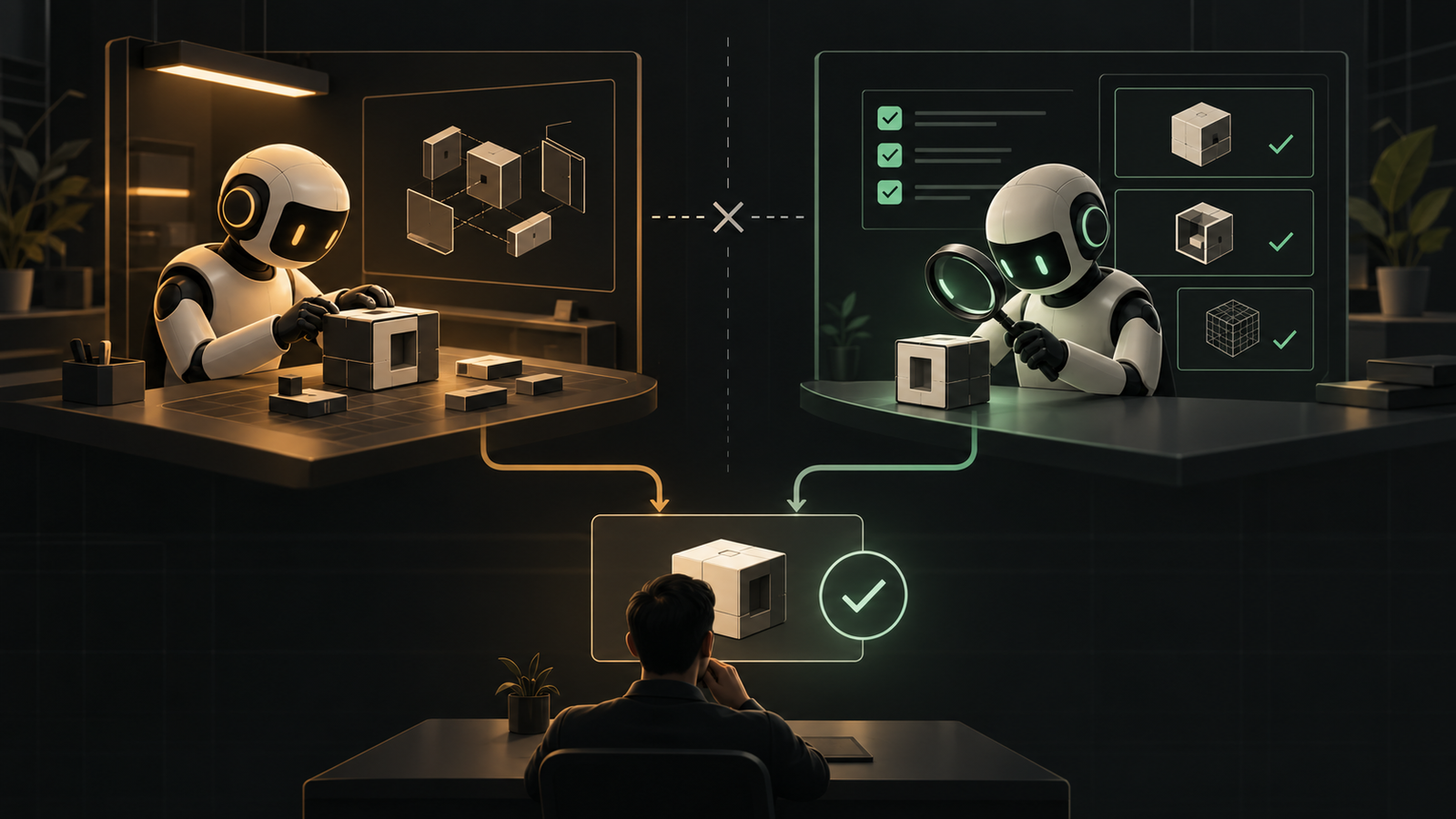
An agent that wrote a piece of code has a built-in bias: it wants that code to work. A fresh agent with clean context is far more likely to spot problems, for the same reason human teams do code review. This creator and verifier split is the most useful pattern to adopt first.
A workable layout has three roles. An orchestrator handles planning, asks clarifying questions and produces a plan with features and milestones. Workers each implement one feature from a clean context, then commit to Git so the next worker inherits a working codebase instead of accumulated baggage. Validators verify the result without having seen the implementation, which makes their review adversarial by design.
Define done before any code exists
Tests written after implementation tend to confirm decisions rather than catch bugs. They are shaped by the code, not by what the code was meant to do, so a system that relies on them will drift over time.
The fix is a validation contract written during planning. It is a list of assertions that defines correctness independently of any implementation. Each feature is assigned the assertions it must satisfy, and together the features must cover every assertion.
Validation then runs in two layers after each milestone:
- Conventional checks: the test suite, type checking, linting and dedicated review agents for each completed feature.
- Behavioural checks: a QA-style validator starts the application, fills in forms, clicks through pages and confirms that flows work end to end.
The second layer is slower, because it waits on a live application. It is also where many real defects turn up.
Run features serially and hand off in writing
Running ten agents at once sounds like ten times the throughput. In software work it rarely delivers, because agents overwrite each other's changes, duplicate effort and make inconsistent architectural decisions. Coordination overhead eats the gains while tokens are still burned.
A steadier approach runs one feature at a time and parallelises only read-only work such as searching the codebase, researching APIs and reviewing code. It looks slower on paper, but the error rate drops, and correctness compounds over long tasks.
Continuity comes from structured handoffs. When a worker finishes, it records what was completed, what was left undone, which commands ran with their exit codes, and what issues it found. The system does not hope that agents remember. It forces them to write things down.
Model choice matters per role too. Planning benefits from careful reasoning, implementation from fast code fluency, and validation from precise instruction following. Using a different model provider for validation can also reduce shared blind spots. Keeping orchestration logic in prompts and skills, rather than a rigid state machine, lets the setup improve as models improve.
What this means for web development practice
Few web products need multi-day agent runs, yet the principles scale down well. Write acceptance criteria before the build starts. Have someone, or something, with fresh context review the work. Check behaviour in a real browser, not just in unit tests. Keep short written handoff notes between sessions.
These habits protect the scarcest resource on any team, which is attention. At Curiosive, AI does the heavy lifting while senior engineers stay accountable for what ships. Separating builders from verifiers is what makes that accountability practical.
Frequently asked questions
Why should a different AI agent review code than the one that wrote it?
A fresh agent is less biased toward the code working. The agent that wrote the code wants it to succeed, while a reviewer with clean context is more likely to find issues, which is the same reason human teams do code review.
What is a validation contract in AI-assisted development?
A validation contract is a list of assertions written during planning, before any code exists. It defines correctness independently of the implementation, and each feature is assigned the assertions it must satisfy.
Should AI coding agents run in parallel or one at a time?
Running features one at a time is usually safer. Parallel agents tend to overwrite each other's changes, duplicate work and make inconsistent architectural decisions, so parallelism is best kept for read-only tasks such as code search and review.
Why do tests written after the code miss bugs?
Tests written after implementation are shaped by the code, not by its intended behaviour. They tend to confirm decisions already made rather than catch defects, which lets a system drift over time.
What should an AI agent record in a handoff?
A handoff should record what was completed, what was left undone, which commands ran with their exit codes, and what issues were found. Writing this down means the next agent does not rely on remembering context.
Put this into practice
Explore the services related to this article.
A short note about the product, the timeline and who it is for is enough to start. You will hear back from the engineer who would do the work, not a sales team.
Start a partnership