Define the directory's audience and authoritative sources
Start with the organizations using the directory and the sources its editors are authorized to publish. Grants.gov provides a public example with opportunity-number search and forecasted, posted, closed and archived filters. Its XML extract page describes a daily database export intended for import. These establish concrete source and discovery patterns, not an existing Curiosive integration. Decide whether your directory covers federal programs, other approved funders or a curated subset, and who maintains that coverage. Keep the original opportunity link available so readers can check the source information.
Decide whether official search or a curated links page is enough
If readers only need to search federal opportunities and the existing Grants.gov filters meet their tasks, begin with that official destination or a maintained links page. Importing the same records into another directory creates publication work without necessarily improving discovery. A custom product needs a specific additional task, such as combining approved funders under a publisher-owned subject taxonomy, reviewing source changes before release or maintaining useful editorial context across those sources. Name the editor who owns that work and test the task against representative records. Evaluate ordinary filters before adding semantic search. None of these choices establishes eligibility, application receipt or an award.
Delivered reference: Appster's maintained discovery platform
The published Appster case describes an OpenAI-embedded catalog of more than 2,700 apps, semantic vector search, a full administration panel and thousands of prerendered SEO pages. Next.js, Supabase, TypeScript and Tailwind CSS form the application stack. The project is recorded in Mexico. This establishes search, catalog administration and public-page delivery. It does not establish a grant database, a government-source connection, grant eligibility assessment or funding outcomes. A new directory's data model, publication process and retrieval checks must be agreed separately.
Give each opportunity a stable source identity
Use the source owner and opportunity identifier together; a title can change or occur in more than one program. Agree the fields editors need, such as agency, program description, source status, supplied deadline and official destination. Preserve the source value when a deadline is incomplete rather than inventing a time or time zone. Keep publisher-written summaries distinguishable from source text. Record when information was received and when the approved record became public. Repeating an import should update the intended opportunity without creating an unrelated duplicate.
Review a candidate import before replacing public content
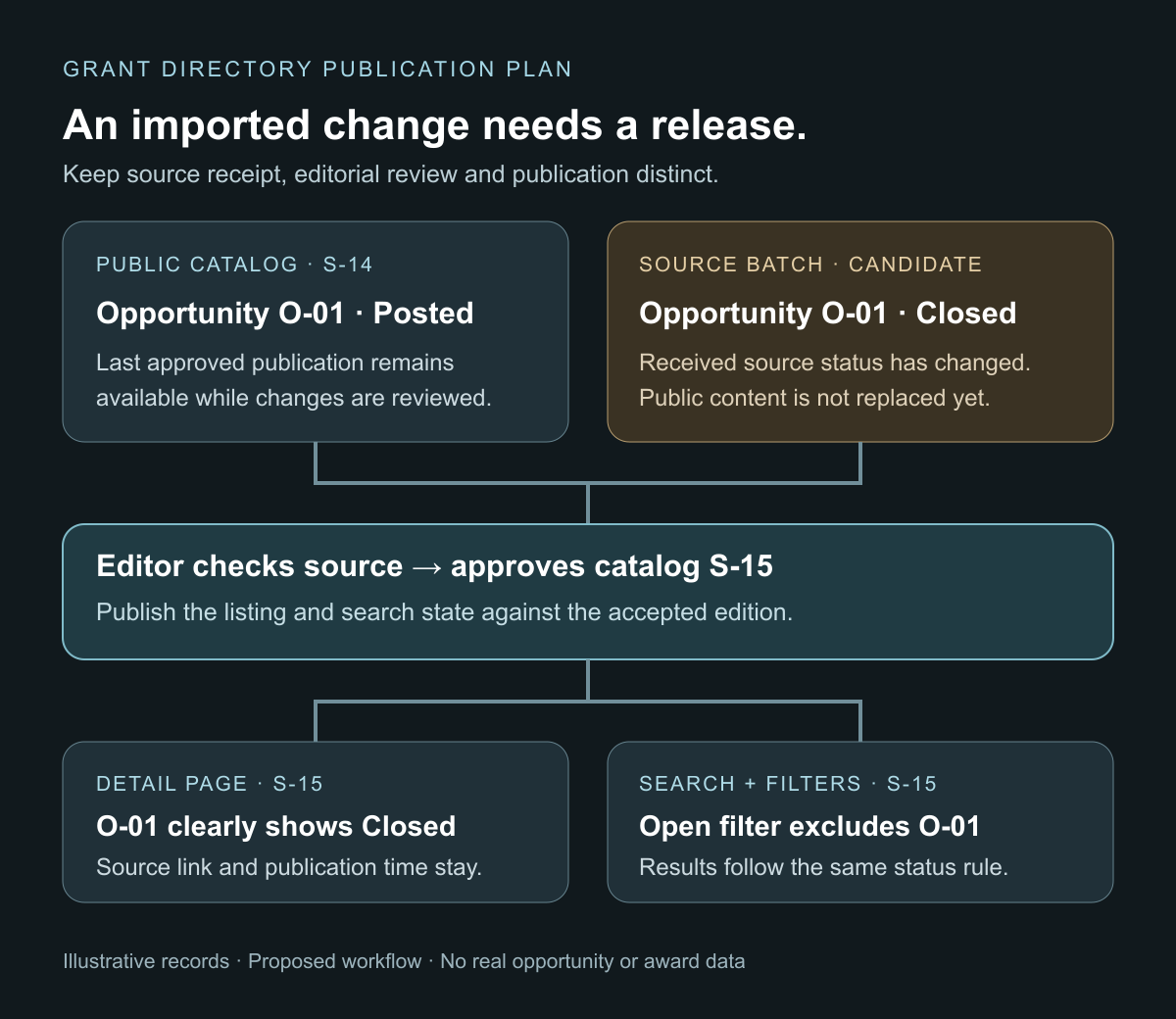
Treat receipt of a source file and publication as separate events. Compare changed records with the last approved catalog and show additions, corrected deadlines and status transitions to the responsible editor. An empty or incomplete file should follow an explicit recovery policy, not silently remove every listing. A record missing from one import does not by itself establish cancellation. Agree which evidence permits retirement and when staff investigates an exception. Source scheduling, validation and review happen in the controlled publishing process; they need not run whenever a visitor opens a public page.
Keep source status distinct from a reader's next action
Define how forecasted, posted, closed and archived records appear using the approved source semantics. A forecasted program should not silently look open for application. Decide whether a closed detail page remains useful as an archive and how its changed status appears in lists and filters. Readers may save a link or follow the official destination, but those actions do not submit an application or establish eligibility. A source deadline or program description needs its own publisher review; the directory should not manufacture funding recommendations or an award prediction.
Publish pages, filters and search against the same catalog
Agree which published edition supplies a detail page, category list and search index. If a program closes, test that the open-opportunity filter and any semantic search result follow the accepted rule together. Semantic search can help readers describe a subject, but a similarity score does not establish eligibility. Keep source status and approved filters explicit, and provide a useful path when the catalog has no matching opportunity. Review a broad request, an ambiguous phrase, a closed program and a missing record using examples chosen by the publisher.
Make freshness and failed updates understandable
Show the publication time or another approved freshness indicator without implying that a daily source export guarantees a daily directory release. Keep source receipt, editorial approval and publication timestamps distinguishable. If an import fails, preserve the last accepted catalog and tell editors what needs attention. Agree when a public stale-data notice is necessary and which person can resume publication. A failed update should not create apparently current empty results. Saved links and historical records should remain understandable during recovery.
Use public URLs that survive opportunity changes
Give approved opportunity records stable destinations and useful descriptions rather than generating duplicate pages for every combination of filters. Plan canonical URLs, navigation and sitemap inclusion around the public content. Decide how a corrected title, closed opportunity and withdrawn listing affect older links. Preview and editorial review records should remain outside the public catalog. Keep applicant information out of this discovery scope; if the organization also needs an intake tool, define its own record and staff handoff rather than combining the two products by assumption.
Review an import that closes one opportunity before publishing it
For a new engagement, bring approved source records, stable opportunity identifiers and an editorial publication policy. Proposed acceptance examples: a forecasted opportunity remains distinguishable from a posted one; a closing notice updates its listing and search state together; an unsuccessful import leaves the last approved catalog available with its publication timestamp; and an editor can explain which source revision supports a displayed deadline. Include a missing field, a repeated import and a source record absent from the next file. These are proposed directory checks, not claims about Appster's historical grant imports, funding decisions or source-refresh tests.
Work with a US company and an Ankara-led engineering team
Curiosive LLC is a US company, with engineering led from Ankara, Türkiye. Monthly AI-accelerated development starts from $2,000, with scope, capacity and operating responsibilities confirmed in writing. Bring approved source records, a representative status change, your current publication process and examples of useful search results. Agree US review windows and a bounded first release. Your team owns source selection, editorial wording and program interpretation; engineers implement the approved directory and publishing behavior through reviewed releases.