Skip to content
Employee-benefits assessment software

Workplace Financial Wellness Software Development for US Benefits Providers

Updated

A benefits provider may offer an assessment through an employer-sponsored program while the employee expects their answers and personal result to remain private. The software must explain who can enter the program, what is saved and what the sponsor can see. Those are different decisions from calculating a score or publishing a learning library.

Curiosive’s MoneyCare case, recorded in Mexico, demonstrates a Next.js and Supabase financial-health assessment with results, a roadmap and editable question and scoring administration. It does not establish a delivered US employee-benefits product. Sponsor eligibility, employer integrations and reporting policies described here would be separately agreed requirements, owned by your program team.

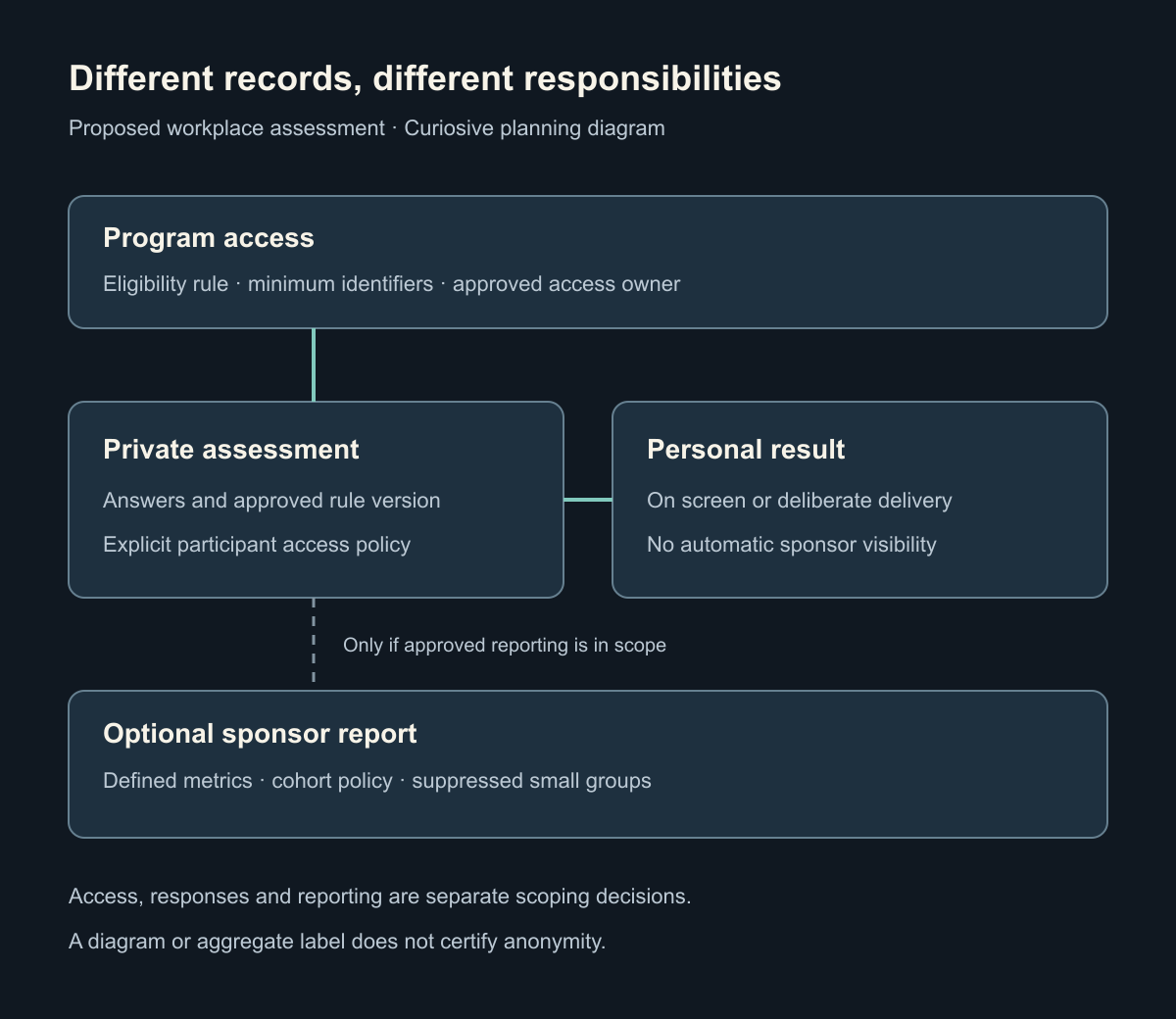
Planning diagram separating workplace-program eligibility from participant answers and personal results, with an optional bounded sponsor report
Curiosive planning diagram for a new workplace assessment; example data responsibilities, not a client system or anonymity certification.
5+
years building for production
12
countries the work runs in
100%
of code read by a senior engineer
1 day
to hear back, from the engineer
Browse industry workflows →

Choose the program boundary before adding integrations

Map how an employee reaches the assessment: an approved program link, an existing benefits account or a separately scoped sign-in integration. Decide whether the application needs to identify the participant at all. A public education resource may require less data than a program that saves personal history. Name the system that owns eligibility and the person who approves access changes. Payroll, single sign-on and benefits-platform connections are not assumed features; evaluate the supported interfaces and required data before including them.

Use MoneyCare’s assessment delivery as the engineering reference

The published MoneyCare case describes a multi-step Next.js assessment, a scored result with charts and a personalized roadmap. Supabase holds assessments and content; an admin area manages questions, scoring rules and blog content, with administrator writes restricted through role-aware row-level security. Plans can be delivered by email. The project is recorded in Mexico and uses questionnaire responses without bank linking or credit checks. That is relevant engineering evidence for assessment and administration software. Employer eligibility, payroll integrations and sponsor reports are new scope, not additional claims about that delivery.

Separate access records from private assessment responses

A sponsor may need to know whether someone can use a program without seeing what they answered. Agree the minimum access record and where it is stored. Define which roles may read raw answers, personal results and delivery destinations, then enforce those boundaries in backend queries and exports as well as the interface. Explain the treatment of a shared link and a departed employee’s saved result. Keeping tables separate alone is not an anonymity guarantee; the complete identifier, access and retention design needs review against your approved policy.

Approve the instrument and the scoring method together

Your designated subject-matter owner supplies the assessment questions, permitted changes, scoring method and result wording. The CFPB publishes its own financial-well-being questionnaire and scoring method; its consumer tool is an example that does not ask for personal financial account data. If your program chooses that instrument, use its documented method and agreed use conditions rather than treating an arbitrary weighted score as equivalent. A custom MoneyCare-style model is a different product decision. Curiosive implements approved calculation examples; it does not certify a financial model or provide regulated financial advice.

Give the employee a deliberate personal-results journey

Decide whether the result appears once, stays in a participant account or can be sent to a destination the employee supplies. Make saving and sending separate actions with clear outcomes. An email failure should not expose a score in a sponsor view or silently repeat delivery. Agree what happens on a shared device, an expired result link and a return after the rule set changes. Optional history, result downloads and deletion flows need their own approved retention and identity rules. Begin with the least complicated journey that meets the program’s stated purpose.

Scope sponsor reporting as a separate product

Start by asking what decision a sponsor report supports. Program entry counts, completed assessments and changes in a questionnaire score measure different things. Decide which metrics are necessary, how their denominators are defined and what is omitted. If group reports are included, agree a minimum cohort policy, suppression behavior and permitted filters before implementation; combinations of small groups can still reveal information. Do not promise that aggregate labeling automatically makes data anonymous. Sponsor reporting can be deferred while the first release concentrates on the participant journey.

Connect approved resources without promising a financial outcome

A result may offer program resources, educational material or a separately agreed professional-service handoff. Name the owner who approves those destinations and what information, if any, is transferred. Opening a resource is not evidence of improved financial well-being, and a completed questionnaire does not establish the effectiveness of the program. If the provider wants evaluation across time, agree comparable measurements and a review owner rather than adding a success percentage to the dashboard. Keep the software’s delivery checks separate from the program’s financial-content approval.

Review program access without exposing a participant’s answers

For a new engagement, bring approved assessment content, a program-access policy and separate participant, content-editor and sponsor roles. Proposed acceptance examples: program access does not expose individual responses to sponsor staff; a personal result reaches only the agreed participant destination; an editor change follows the approved rule-version policy; and a small cohort follows the configured report suppression rule. Include a shared result link, a withdrawn program account and a failed email handoff. These are proposed workplace checks, not claims about MoneyCare’s historical employer integrations, anonymity guarantees or financial outcomes.

Work with a US company and an Ankara-led engineering team

Curiosive LLC is a US company, with engineering led from Ankara, Türkiye. Monthly AI-accelerated development starts from $2,000, with scope, capacity and operating responsibilities confirmed in writing. Bring your approved instrument, representative expected results, program-access policy and the intended participant and sponsor views. Agree US review windows and a bounded first release. We maintain the approved software and integrations through reviewed releases; your team owns the program policy, financial content and required specialist review.

Questions

The things people ask before starting.

Have you already delivered a US employer financial-wellness program?

The cited MoneyCare project is recorded in Mexico and covers assessment, results and editable administration. Employer access, payroll or benefits integrations and sponsor reporting would be new requirements. It is not presented as a delivered US workplace program.

Does an assessment need bank access or a credit check?

MoneyCare’s published delivery uses questionnaire responses without bank linking or credit checks. Your program owner chooses the inputs needed for its purpose. Any account-data integration would have a separate access, data and operating scope.

Can a sponsor see an employee’s answers or personal score?

That is an explicit program-policy and authorization decision. A proposed first scope can keep personal results outside sponsor views and provide only agreed program metrics. Backend reads, exports and shared-link behavior must follow the same approved rule.

Does a group report guarantee anonymity?

No. Group size, filters, identifiers and other available information affect what can be inferred. If reports are in scope, agree cohort thresholds, suppression and permitted combinations with the responsible program owner; an aggregate label is not a certification.

What do you need to scope a first release?

An approved questionnaire and scoring method, representative expected results, program-access rules, participant and sponsor roles, and resource destinations. Include an interrupted result delivery, a shared device and a small reporting cohort. Financial-model and program-policy approval remain with your designated owners.

How it starts

What happens after you write to us.

  1. 01

    You describe the product

    One paragraph on what you are building, roughly when you need it, and who it is for. No brief, no form with fifteen fields.

  2. 02

    You get a reply within a day

    From the engineer who would do the work, not a sales team. If we are not the right fit we say so, and where possible we point you somewhere better.

  3. 03

    You get a scoped plan

    Scope, price and timeline in writing before anything is committed. You decide with the numbers in front of you.

No long contract to begin, no lock-in to our tooling, and the code is yours from the first commit.

Start a conversation
Contact

Looking for an engineering partner for the long haul?

A short note about the product, the timeline and who it is for is enough to start. You will hear back from the engineer who would do the work, not a sales team.

Ankara / Türkiye · Working across European and US time zones