AstaBrief: build AI research reports readers can verify
- AI integration
- Research synthesis
- Product development

A useful AI research report needs more than fluent paragraphs and a list of links. A reader must be able to check which evidence supports each claim, what the original source actually established and where the report is making an inference.
Ai2’s October 2, 2026 AstaBrief release is useful news for teams building research and knowledge features. It introduces an open model specialized for turning a question and retrieved scientific excerpts into a cited report. The larger lesson for client products is to design report generation as an evidence workflow with a reviewable output.
This article separates Ai2’s findings from Curiosive’s recommendations. We have not run AstaBrief, reproduced its evaluations or measured a client report pipeline.
What AstaBrief actually provides
Ai2 describes AstaBrief 8B as a report-generation model built from Qwen3-8B and trained with supervised fine-tuning and direct preference optimization. It is available in Asta’s Fast report mode, alongside a Claude-powered Thinking mode. Ai2 also releases weights, training data and an example workflow for reports from PDFs.
The model consumes a research question and retrieved literature excerpts. Retrieval, document processing and the interface around the report remain separate engineering work. Downloading a report model does not create a complete document-search product.
The model card lists Apache 2.0 licensing and intended research and educational use. It recommends the training prompt format because different formats can lead to inconsistent behavior. Treat that intended scope as part of an evaluation, not proof of suitability for arbitrary business documents.
The Hacker News discussion, submitted October 2, contains both enthusiasm and one reader’s negative anecdotal report. Neither is an independent comparison. The practical response is to evaluate representative questions and inspect their evidence.
Read the evaluation dates before the headline
Ai2 says most training and evaluation took place in 2025 and that it has not rerun the full evaluation against current frontier models. Its reported speed and quality comparisons belong to those conditions.
We do not use those numbers to promise faster client delivery or rank current providers. The useful engineering idea is to investigate whether a specialized generation stage can simplify a report pipeline without weakening the evidence a reader needs.
A client evaluation should time the whole job: document ingestion, retrieval, generation, citation validation and human review. A faster drafting stage can still be a poor trade if it increases correction effort. Compare accepted, checked reports rather than raw generation speed.
Start with a bounded research question
Consider an illustrative product-discovery workflow: a team wants to compare published approaches to a technical problem before planning a prototype. A report might organize the available methods, limitations and unresolved questions. It should distinguish research findings from recommendations about the team’s own product.
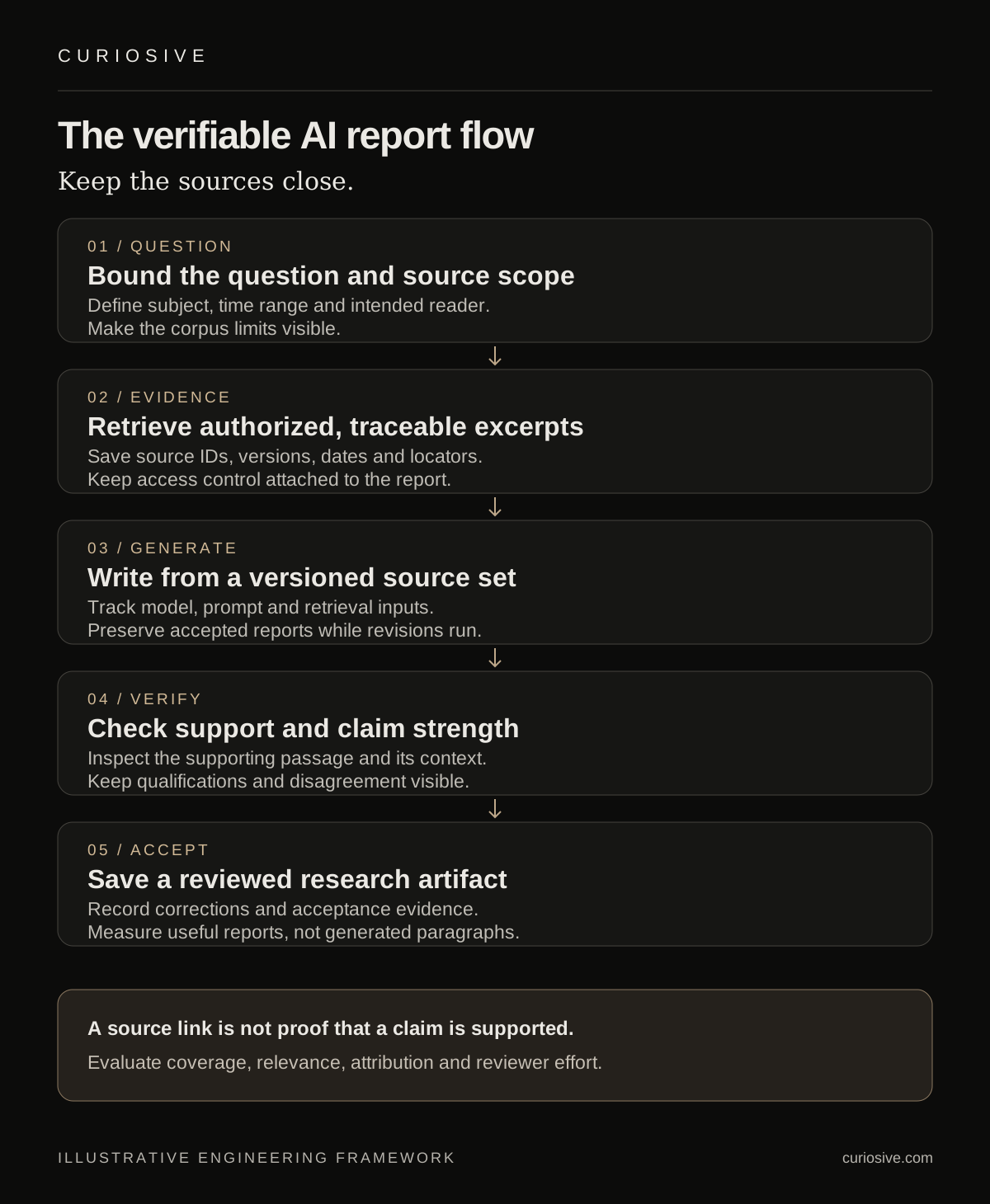
Define the question and scope before retrieval. Specify the relevant subject, time range, source types and intended reader. “Tell us everything about AI search” is difficult to evaluate. A question with defined constraints gives a reviewer a clearer way to identify omissions and irrelevant material.
Use AI to accelerate synthesis while preserving the discovery work’s decision boundary. A generated report can inform an engineering conversation; it should not silently become the approved product specification.
For teams discussing AI integration, that boundary helps define a deliverable: a cited draft and review interface, with explicit acceptance criteria for its evidence.
Retrieval determines what the writer can support
Give every retrieved excerpt a stable source identifier. Retain its document title, version, publication date and locator, such as a page or section. Keep the excerpt associated with the actual source, not just a search-result URL.
Track which sources were eligible for the question and which reached the writer. If only a selected corpus is searched, say so in the report. Absence from that corpus is not evidence that no research exists.
Version the retrieval input for each report. A user returning later should be able to inspect the evidence used for that version even if documents have since changed. A new question or refreshed source set can produce a new report rather than invisibly altering the old artifact.
For private documents, access control belongs before retrieval. A model must not receive an excerpt merely because its wording matches a query. Keep document permissions attached to both retrieval results and the stored report.
A citation can be related without supporting the claim
Reviewing citations needs more than checking that links open. Ask whether the cited passage supports the attached statement and whether the report preserves the source’s scope.
An experiment in a specific setting should not become a universal claim. A measured relationship should not become a causal explanation without evidence. A source describing a limitation should not be transformed into an unqualified product recommendation.
Design the review interface around those checks. Let readers open a claim’s supporting excerpt and its surrounding context. Distinguish quoted evidence, paraphrase and the report’s inference. If sources disagree, show the disagreement rather than smoothing it into a confident conclusion.
Automated checks can validate source IDs and detect missing references. They cannot, on their own, establish that a technically related citation justifies the strength of a claim. Keep substantive review in the acceptance workflow.
Evaluate coverage, relevance and attribution separately
A report may cover the subject while attaching weak citations. Another may cite accurately but fail to answer the actual question. Test these dimensions separately.
Build a reviewed set of representative questions with expected topics and source passages. Include sparse evidence, conflicting findings, incomplete documents and questions the corpus cannot answer. A useful system should make evidence gaps visible rather than fill them with generic knowledge.
Measure question coverage, relevant content, citation support and unsupported claims. Review whether important qualifications survive synthesis. Record reviewer time and the corrections required before acceptance.
Keep a baseline with the same retrieval inputs. Changing the retriever and writer simultaneously makes it harder to locate regressions. An apparent writing improvement may simply reflect a better excerpt set.
Our multilingual AI retrieval analysis addresses source-access differences across languages. Report generation adds another layer: preserving those sources faithfully in a long-form artifact.
Make report jobs observable and recoverable
Long-running report features need ordinary product infrastructure. Give each job an identifier, visible status and bounded retries. Separate retrieval failure from generation failure so the interface can explain what is unavailable.
Preserve accepted reports while a revision runs. Do not replace a verified artifact with a partial draft. Store the model identifier, prompt version and source set needed to investigate a result, while limiting private content in operational logs.
Bound document volume, output length and concurrent jobs. Measure cost per accepted report, including review and retries. The production AI architecture guide covers these surrounding cost and reliability controls.
Build the evidence workflow before expanding the report
AstaBrief makes specialized, open report generation worth studying. Whether this model fits a particular client feature requires a scoped evaluation. The broader opportunity is a report users can inspect, correct and revisit with its evidence intact.
If your product needs research synthesis or a cited knowledge feature, describe the report and its readers to Curiosive. We can discuss an AI integration around the corpus, review experience and acceptance criteria. See our approach for how we frame delivery.
Sources and scope
Reviewed October 3, 2026: Ai2’s AstaBrief announcement, October 2, model card and Hacker News discussion. Model descriptions and evaluation timing are Ai2-reported. The workflow, controls and evaluation plan above are Curiosive recommendations. No hands-on model result or client case study is claimed.
Frequently asked questions
Does AstaBrief retrieve documents by itself?
Ai2 describes a report model receiving a question and retrieved scientific excerpts. Retrieval, document processing and the surrounding product remain separate work.
Are its published comparisons current frontier benchmarks?
Ai2 says most training and evaluation occurred in 2025 and it has not rerun the full evaluation against current frontier models.
Put this into practice
Explore the services related to this article.
A short note about the product, the timeline and who it is for is enough to start. You will hear back from the engineer who would do the work, not a sales team.
Start a partnership