Database portability: prove the path out before a vendor change
- SaaS development
- Databases
- Architecture

When a database vendor is acquired, a product team needs a clear picture of its dependencies. The useful response is to check what can move, what would need rebuilding and whether the application has a tested recovery path. A downloadable database file or an open-source engine is a starting point; operating the same product elsewhere takes more work.
Supabase’s announcement that it is acquiring Turso makes this a timely question for founders and engineering leads. This guide explains how to assess database portability without starting an unnecessary migration or designing every feature around a hypothetical exit.
What the Supabase and Turso announcement says
In its 2 October 2026 announcement, Supabase says existing users’ experience will continue, with Supabase focused on Postgres and Turso continuing work on SQLite. It frames the acquisition around infrastructure for the many small databases created by agents, with a path toward larger workloads. These are the company’s stated plans, not independently verified future outcomes.
The Hacker News discussion includes optimism about investment and concerns about long-term product continuity and compatibility. It also contains conflicting performance anecdotes. We are not using those comments as benchmarks, or inferring an immediate service change from them.
Our recommendation is to use news like this as a trigger for a bounded dependency review. Verify current capabilities and requirements, document the product’s actual exposure, and make a decision from evidence. The rest of this article describes that review, with illustrative examples rather than customer migration results.
Define what portability means for your product
Portability can mean several different things: restoring data after an outage, moving between hosts running the same engine, replacing a managed platform, or changing database engines. Those goals have different costs. Decide which one matters before asking whether the stack is portable.
A SaaS product may need a tested restore on the same platform without needing immediate support for a second engine. A product with specific deployment requirements may need to run in a different environment. An embedded application may depend on a local database file in a way that a shared web service does not. The portability requirement should follow a business constraint, not a generic preference for interchangeable infrastructure.
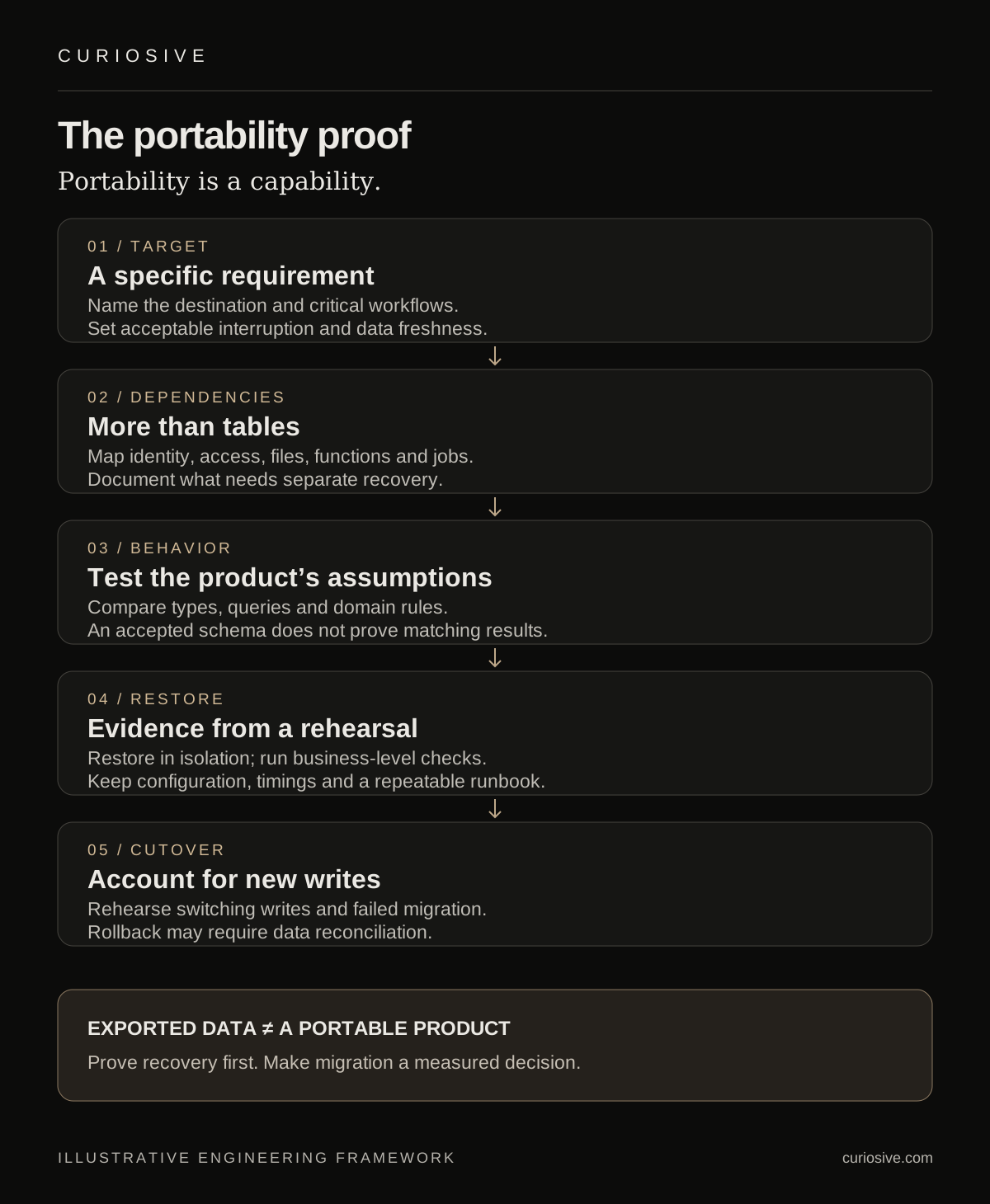
Write the requirement in observable terms. Can the team restore a usable product in an agreed environment? How much interruption is acceptable? How recent must the recovered data be? Who performs the procedure, and which features must work before users return? These questions turn an abstract exit strategy into something an engineering team can rehearse.
Inventory the system around the database
Start with the application’s critical workflows and trace their dependencies. Tables and queries are only part of the map. Include identity, authorization rules, uploaded files, background work, functions, webhooks, environment settings and any external callbacks tied to the platform.
For an illustrative customer portal, a successful restore means more than seeing the customer rows. A user must be able to sign in, see only their organization’s records, open uploaded documents and trigger the right background jobs. If the database moves but those behaviors fail, the data export has succeeded while the product migration has not.
Supabase’s own CLI backup and restore guide separates database work from additional configuration, function migration and storage-object migration. That is a useful reminder even when moving between projects on the same platform. Read the documentation for the exact features your application uses; do not assume a database dump includes every connected service.
Maintain a short dependency register rather than a sprawling hypothetical plan. For each important feature, record the data it needs, the service it calls and how it would be recovered or replaced. A clear owner and a known procedure are more useful than an untested claim that everything is standard SQL.
SQL compatibility does not prove behavior matches
A familiar SQL interface can reduce integration work, but it does not establish that two engines interpret every schema, value or query in the same way. Driver behavior, data types, constraints, query syntax and transaction patterns can all affect application results.
SQLite’s quirks documentation explicitly discusses differences that matter when porting applications, including flexible typing, date representation and some query behavior. It also documents stricter table options. The practical lesson is to inspect the source configuration and stored values rather than assuming an engine label or ORM makes the data portable.
Use concrete cases from your application. Check empty and missing values, unexpected input types, timezone boundaries, decimal values, ordering, uniqueness and relationships between records. Compare what the application returns after conversion, not only whether the destination accepts the schema.
An ORM can help isolate access patterns, but it cannot erase database semantics. Keep domain rules explicit at the application boundary and test the operations the product relies on. If a query uses a useful engine-specific capability, document that choice and its replacement cost. Portability does not require refusing features that materially improve the product.
Prove export and restore before planning a cutover
The first useful exercise is a restore into an isolated destination. Use a sanitized dataset when possible, or an environment with controls appropriate to the real data. Record the source version, required extensions, export procedure, destination configuration and validation results.
PostgreSQL’s pg_dump documentation describes a consistent export of one database. It distinguishes that from cluster-wide objects such as roles, and notes that production backup planning involves more than choosing this export utility. Treat a logical export as one part of a recovery or migration procedure, not a complete availability strategy.
After restoring, verify record counts and relationships, then run business-level checks. Counts alone cannot show that a timestamp changed meaning or an access policy disappeared. Include sign-in, authorization, representative reads and writes, file access and background tasks where those features are in scope.
Measure the time the exercise actually takes, including setup and validation. Keep the evidence: which configuration worked, which manual steps were needed and what did not transfer. The rehearsal should produce a short runbook another authorized engineer can follow without relying on the original author’s memory.
Plan the write boundary and rollback
A migration changes where new data is written. That boundary is often more consequential than copying the initial dataset. Decide how writes are paused, transferred or synchronized during the transition, and how the destination is checked before normal traffic resumes.
For a small application, an agreed maintenance window may be simpler than building a complicated synchronization system. A product with tighter availability requirements may need a different plan. Choose from the measured workload and interruption allowance; do not promise zero downtime before designing and testing the transition.
Define rollback in terms of data, not only routing. If users have written new records at the destination, pointing traffic back to an older source can lose those changes or create conflicting histories. Identify the point at which rollback needs reconciliation, and make that decision visible to the people operating the release.
Rehearse the failure cases that are plausible for the chosen plan: incomplete copy, incompatible schema, missing credentials, delayed jobs and callbacks that still point at the old environment. Keep destructive steps separate from the proof that the replacement works. Retiring the old system belongs after the validation and retention decisions have been made.
Keep the architecture proportionate to the risk
There is a real cost to maintaining multiple database backends. Every supported path adds combinations to test, configuration to manage and features that may need different implementations. A small product can lose focus if it tries to avoid every possible dependency from the outset.
Prefer a few useful boundaries. Keep core domain logic from depending directly on platform response shapes. Isolate critical external service calls. Maintain reproducible schema changes and a practical export/restore procedure. Document engine-specific decisions where they appear, so a future team can evaluate them deliberately.
These measures help a team change direction without making infrastructure interchangeability the product’s main feature. The right goal may be a recoverable managed deployment with a documented path out, rather than immediate support for several engines.
Review the plan when a concrete requirement changes: a new deployment constraint, unacceptable service behavior, a pricing change that affects the business, or a feature the current system cannot support. An acquisition announcement is a reason to verify facts; it is not sufficient evidence that a working product should migrate now.
What a founder should ask for
Ask for a portability assessment that distinguishes current evidence from estimates. It should identify the product’s critical dependencies, name the intended destination or recovery environment and state which parts have actually been rehearsed.
- What moves with the database, and what requires separate migration or configuration?
- Which schema, query and authorization assumptions are tied to the current platform?
- When was a usable restore last tested, and what did the business-level checks cover?
- How would new writes be handled during cutover and a failed migration?
- What is the smallest useful improvement to recovery or portability right now?
A good assessment can conclude that no migration is warranted. It can also reveal a missing restore test, a storage dependency or an undocumented access rule that deserves attention immediately. Those findings are useful whether the vendor’s ownership changes or not.
Build a tested path for your data
Need to understand the dependencies behind an existing SaaS product or plan a move between environments? Explore Curiosive’s SaaS development services and our engineering approach, or tell us about your current stack and portability requirement.
Bring the product’s important workflows, the intended destination and the reason a move may be necessary. A focused restore rehearsal and dependency review can make the next decision concrete before a team commits to a larger migration.
Sources and scope
Read on 2 October 2026: Supabase’s acquisition announcement, the HN discussion, SQLite’s portability caveats, PostgreSQL’s pg_dump documentation and Supabase’s CLI restore guide. Vendor plans are attributed as plans. Migration examples and recommendations are Curiosive’s analysis; no comparative database benchmark or customer outcome is claimed.
Frequently asked questions
Does an open-source database guarantee portability?
It can help with access to the engine and data, but the application may also depend on platform identity, authorization, files, functions and jobs. Portability needs a tested path for those workflows.
Should a vendor acquisition trigger an immediate migration?
An announcement is a reason to review dependencies and requirements. It does not alone establish that a working product should migrate. Evaluate current behavior, business constraints and rehearsal evidence.
Put this into practice
Explore the services related to this article.
A short note about the product, the timeline and who it is for is enough to start. You will hear back from the engineer who would do the work, not a sales team.
Start a partnership