Gemini 4 Argon: evaluate long-running AI engineering tasks
- AI development
- AI integration
- Engineering workflows

Longer AI engineering tasks need clearer progress and acceptance evidence. A model that can work through many steps may produce a larger change, but the client still needs to know what was authorized, what was checked and whether the result can safely enter the release process.
Google’s September 30, 2026 Gemini 4 Argon announcement makes that question timely. It describes a model aimed at complex, long-horizon work and a phased rollout. The useful client response is an evaluation plan for extended engineering tasks, rather than a promise based on the launch benchmarks.
This article separates Google’s claims from Curiosive’s recommended workflow. We have not accessed Argon, run its benchmarks or used it on a client codebase.
What Google announced, and who can access it
Google says Argon is rolling out to trusted cyber defenders through its Fairwind Program, with broader developer, enterprise and consumer access planned later. The announcement should not be treated as proof of general API availability.
The post describes internal use in debugging, optimization and codebase migrations. Those are Google-reported experiences in Google’s environment. They do not establish how the model will perform on another repository or reduce a client’s delivery cost.
One technical detail matters: Google describes an expanded output token limit of one million, not a one-million-token input context claim in that passage. More room for a trajectory does not guarantee correct work or efficient use of that room.
The Hacker News discussion, submitted September 30, contains user anecdotes and debate about models and harnesses. Several accounts concern earlier models. They should not be presented as hands-on evidence about Argon.
Define the long-running task before choosing the model
Consider an illustrative client task: replace an internal library while preserving the public behavior of a product. The work may involve dependency mapping, compatibility decisions, many file changes and multiple rounds of tests. An agent can help carry the task across those steps, but its mandate must remain explicit.
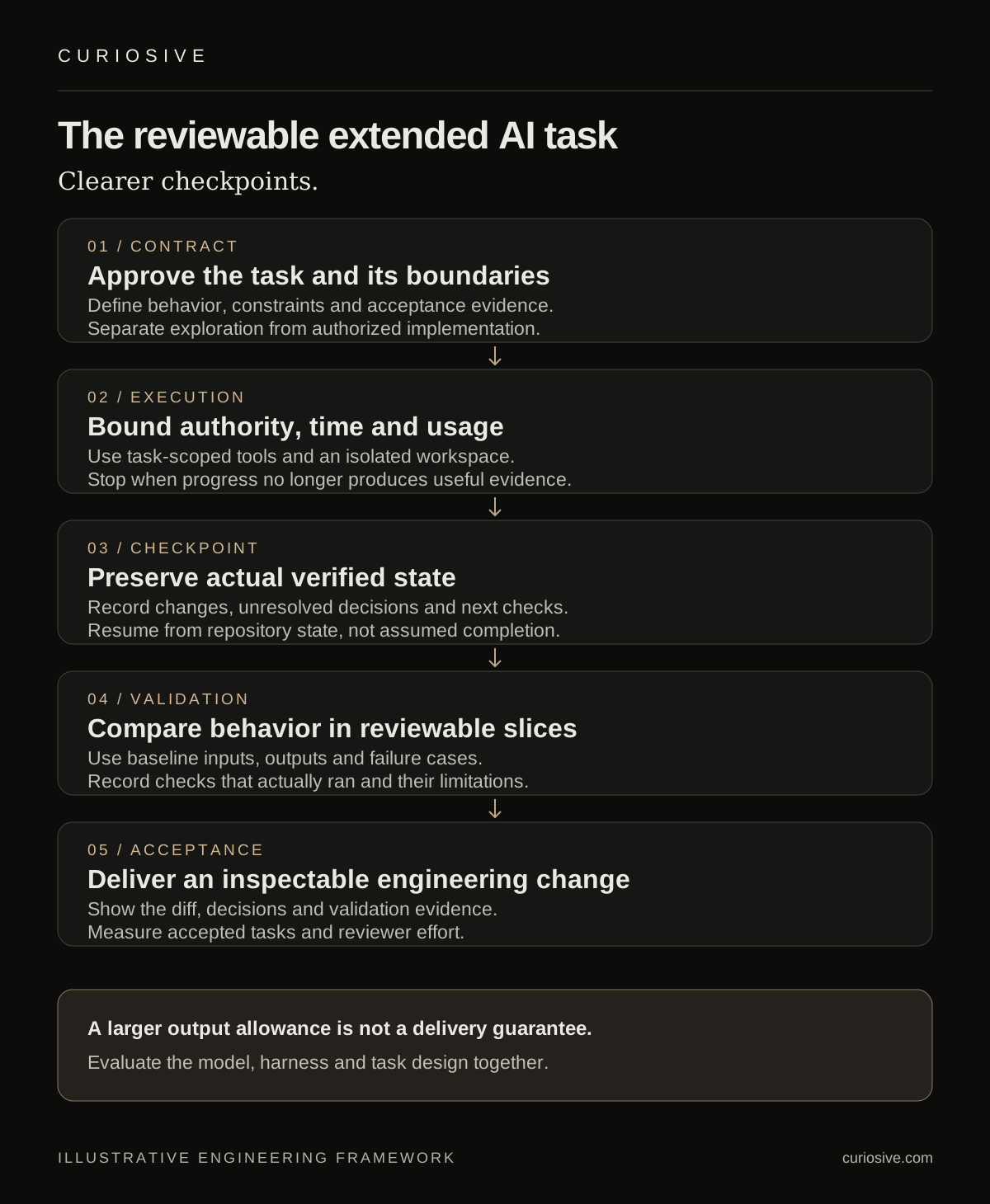
Write down the desired behavior, scope boundaries and evidence required for acceptance. Name the files or modules that may change and the interfaces that must remain compatible. Identify decisions requiring a product owner or engineer rather than leaving them to emerge from a long model run.
Separate exploration from approved implementation. A proposed dependency replacement can reveal a constraint that changes the plan. The agent should surface that constraint and its implications instead of treating completion of the initial request as authority for a broader rewrite.
For an AI integration, the useful delivery unit is an accepted engineering change with traceable decisions. A long transcript or large patch is not the same outcome.
Use checkpoints that preserve task state
Extended tasks can lose important constraints between stages or after an interruption. Keep a compact, durable task record outside the transient conversation.
It should contain the approved requirements, current branch or workspace reference, completed changes, unresolved decisions and next validation step. Record what changed since the previous checkpoint. Distinguish completed work from a plan the agent has merely proposed.
Choose checkpoints around meaningful evidence: dependency analysis complete, one module migrated, behavior comparison reviewed or regression suite passed. A time interval alone is less informative than a verified stage.
Resume from actual repository state. The agent should inspect the patch and check results rather than assume a previous operation completed. This matters when execution stops between writing files, running tests and recording the outcome.
More output needs an explicit execution budget
A larger output allowance is a ceiling, not a requirement. Bound the run by the task’s acceptable cost, elapsed time and number of retries. Define a stopping condition when progress is not producing useful evidence.
Separate model usage from tool costs and reviewer effort. A run that produces a patch quickly can still be expensive if review must untangle unnecessary changes. Measure cost per accepted task and include failed attempts.
For performance work, avoid letting the agent optimize an easy metric while changing the intended behavior. Specify representative inputs and correctness checks before tuning. Improvements that only appear on a narrowed test set should be identified as such.
Our production AI architecture guide covers routing and usage controls. Extended engineering adds a practical question: when should a run stop, preserve its state and ask for a decision?
Keep execution authority separate from model capability
A more capable model does not need unrestricted access to accomplish a bounded engineering task. Give its execution environment the permissions required for the approved scope.
Use isolated workspaces for changes and credentials suited to the task. Keep publishing, production data access and destructive operations behind the project’s actual authorization rules. Retrieved documents and issue comments are context, not new authority to widen the task.
Google’s announcement discusses defenses against prompt injection and misalignment. These are source-reported safeguards, not a replacement for application-level limits. Your harness must still control the operations it exposes and the credentials behind them.
For tool-connected development, our Pi 1.0 analysis explains connector discovery and bounded actions. The long-horizon question is how those boundaries remain intact across a lengthy sequence of operations.
Validate behavior in smaller reviewable slices
For a migration, establish a baseline before changing the implementation. Preserve representative inputs and outputs, interface expectations and failure cases. Add meaningful checks for behavior that could be lost during the change.
Review increments rather than allowing every task to become one large final patch. A small accepted slice can expose a faulty assumption early. It also makes rollback and comparison easier to reason about.
Google reports that its large rewrites undergo automated and manual auditing, emulation testing and review before production rollout. That distinction is important: model-generated engineering work and accepted production software are separate stages.
A reviewer should receive the actual diff, decisions made, checks executed and limitations. Do not label a check as passed because it was planned or because the model describes confidence in the result.
Evaluate the task outcome, not the launch ranking
When access is actually available and permitted, compare candidate workflows on the same representative tasks and repository snapshots. Keep the test environment and acceptance criteria consistent.
Include difficult cases: incomplete requirements, a failing baseline, conflicting constraints and unavailable tools. Measure accepted changes, regressions, unsupported assumptions, interruptions and reviewer effort. Track whether checkpoints permit a reliable resume.
A stronger benchmark score can justify investigation. It cannot settle whether a model, harness and task design fit your team. That requires evidence from the workflow you intend to use.
Prepare the workflow while availability develops
Gemini 4 Argon’s announcement signals continued attention to extended AI work. Client teams can prepare the task contract, review stages and evaluation set without assuming access or promising a particular productivity gain.
If your project has a migration or engineering task that crosses many steps, describe its acceptance boundary to Curiosive. We can discuss an AI integration around the scope, checkpoints and evidence. See our approach for how we frame product delivery.
Sources and scope
Reviewed October 3, 2026: Google’s Gemini 4 Argon announcement, September 30 and the associated HN discussion. Availability, model limits, internal experiences and safeguards are Google-reported. Workflow and evaluation guidance are Curiosive recommendations. No independent benchmark or client outcome is claimed.
Frequently asked questions
Was Gemini 4 Argon generally available at launch?
Google’s September 30 announcement describes rollout to trusted cyber defenders and plans for broader access. It does not establish general API availability.
Does the announcement describe a one-million-token context window?
The cited passage describes an expanded output token limit of one million. It should not be relabeled as an input context limit.
Put this into practice
Explore the services related to this article.
A short note about the product, the timeline and who it is for is enough to start. You will hear back from the engineer who would do the work, not a sales team.
Start a partnership