AI-assisted agency delivery: how Curiosive published a complete website content package
- Agency workflow
- AI development
- Website delivery

AI can help an agency draft content, generate artwork and implement changes. The client-facing work is deciding what belongs in the product, checking that it fits and delivering a version that can be reviewed and maintained.
This walkthrough uses a real, limited example: the AI-assisted editorial packages published on Curiosive’s own website in October 2026. It covers the content, visual assets, integration and release checks performed for those packages. It is not a client case study or a claim about a measured productivity gain.
The practical lesson is to connect AI output to the project’s existing delivery system instead of treating the generated files as a finished website feature.
Start with the destination and acceptance criteria
The requested result was more than a blog draft. It included an original article, infographic, social artwork, Open Graph image, search metadata and a relevant call to action, followed by commit, push and deployment verification.
That gave the work a concrete acceptance surface. The article needed to use the existing English content conventions. Assets needed to match Curiosive’s black marble visual language. The published page needed canonical and social metadata, discoverability and working links.
For a client project, the equivalent first step is to turn a broad request into observable outputs. “Use AI for the website” does not define a release. A named page, audience, content source, destination and review owner make the work easier to assess.
Use AI to prepare candidates, then verify their basis
We read primary sources and the associated Hacker News discussions before drafting the news analysis. The articles distinguish source-reported capabilities from Curiosive recommendations and avoid invented benchmarks or client outcomes.
That separation matters in agency work. A vendor announcement may justify explaining a new development, but it cannot establish a performance promise for another project. A confident draft still needs its dates, capabilities and limitations checked.
The published Gemini 4 Argon article, for example, distinguishes phased access from general availability. The hybrid AI search article distinguishes a planned storage redesign from shipped performance results.
For content delivery, review the source-dependent statements separately from the original analysis. Keep citations close to the claims they support. Then check whether the article answers a useful reader question rather than simply repeating a launch announcement.
Build the visual package around the brand and destination
The social artwork was generated around Curiosive’s established near-black background, warm-white typography and black marble sculpture language. We inspected the generated images before using them.
The portrait social image and landscape Open Graph card are separate compositions. A portrait was adapted for the wide destination rather than stretched into it. Final files were prepared at 1200×1500 for social and 1200×630 for Open Graph.
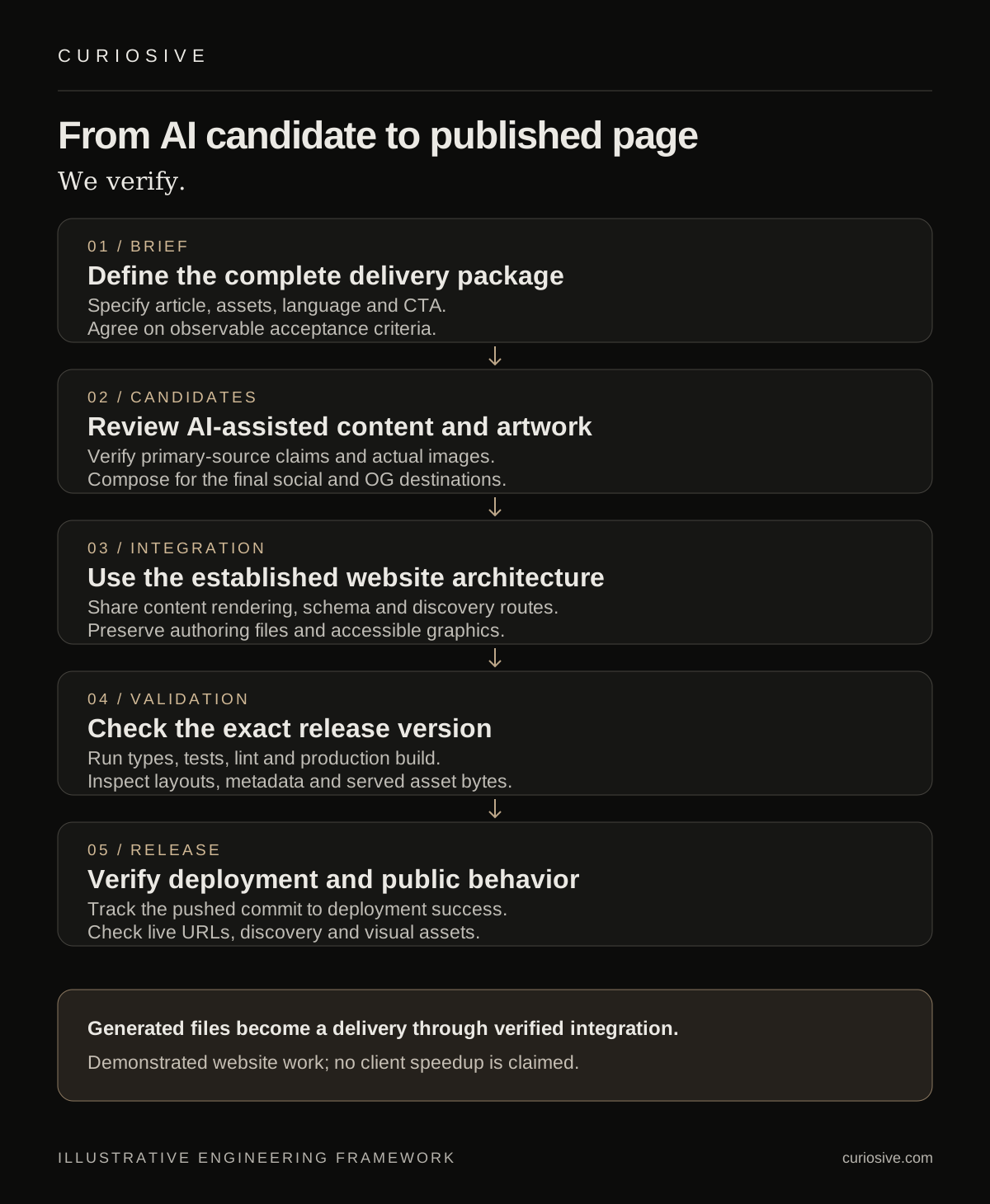
The infographic is an original SVG with readable labels, an accessible text alternative and a caption stating its scope. The article links to the full-size asset so a smaller screen can access the detail.
For a client brief, define those destinations early. A strong image at one aspect ratio can lose its message in a different crop. Typography, contrast and safe margins need review at the actual delivery size.
Integrate with the website’s existing content system
The repo-owned articles use the same rendering and discovery architecture as the site’s CMS articles. The Portable Text JSON is the rendered source; an adjacent Markdown file preserves the authoring copy.
The new content is registered in the editorial collection and reaches the article page, blog index, API, Markdown representation, feed and sitemap through existing code. The English originals do not claim a Turkish translation that was never produced.
That is the implementation decision worth carrying into agency work: extend the established content path where it serves the requirement. Creating a separate page with copied metadata logic can make a small feature harder to maintain.
AI-assisted implementation still needs a person or review process to check those architectural choices. A generated component is only one part of the result; its behavior in the application matters more than whether it runs in isolation.
Review the page and its machine-readable outputs
We checked mobile and desktop rendering, image loading and horizontal overflow. The infographic checks inspected text bounds, and the visuals were reviewed as rendered artifacts.
The release checks also verified canonical URLs, descriptions, Open Graph and Twitter image routes, article schema, sitemap discovery and Markdown output. Served infographic and OG bytes were compared with the intended files.
These checks cover the editorial feature. They do not turn into a general security certification or a test of every website behavior. A client release needs checks suited to its own changed functionality and risks.
A useful review packet makes that scope visible: the actual change, the checks run, their results and what remains outside them. “AI says it is done” is not an acceptance criterion.
Validate the exact version that will be released
For these packages, only the article files, registry update and their visual/social assets were staged. Unrelated working files were preserved.
We validated an isolated snapshot of the content commit with type checks, unit tests, lint and the production build. Browser checks then ran against that production build before push. This distinction mattered because a development-server hydration warning did not reproduce in the production and live checks.
The commit was pushed through the established branch workflow. We waited for Vercel’s deployment result and verified the public URLs afterward. A successful push was not treated as proof that the pages were live.
For a client project, the transferable principle is version alignment: review, build and release the same intended change. Keep the deployment result and live verification attached to that version.
A useful AI workflow has explicit review boundaries
A recent essay on coding agents and data flow, shared on Hacker News, argues for explicit specifications and observable behavior. That is a useful prompt for thinking about handoffs, not evidence that specifications alone make code review unnecessary.
Our demonstrated content workflow kept several boundaries: source review, visual review, integration checks, exact-version validation and live verification. AI helped produce the candidates; the delivery process established which candidates became the published result.
For clients, this provides inspectable outputs at each stage. Whether it reduces total delivery time must be measured on the actual project rather than assumed from the amount of generated content or code.
Bring the deliverable, not just the AI idea
If your website needs a new content flow or feature, tell Curiosive what users should receive. We can discuss the scope, implementation path and review evidence around an AI integration or website project. Explore our work for product context.
Evidence and scope
This article describes the editorial packages published on Curiosive’s own site and their repository-backed delivery workflow, verified October 3, 2026. The linked Argon and hybrid-search pages are public outputs. The coding-agent essay is dated October 3 and had no substantive HN discussion when reviewed. It is supporting opinion, not a benchmark. No client result, time saving or universal agency process is claimed.
Frequently asked questions
Is this a Curiosive client case study?
No. The walkthrough describes AI-assisted editorial delivery completed on Curiosive’s own website in October 2026.
Were the social and Open Graph images the same composition?
No. The portrait artwork was adapted into a separate landscape composition and prepared at the required delivery size, rather than stretched.
Put this into practice
Explore the services related to this article.
A short note about the product, the timeline and who it is for is enough to start. You will hear back from the engineer who would do the work, not a sales team.
Start a partnership