turbopuffer v3: why AI search needs more than vector similarity
- AI search
- AI integration
- Retrieval

AI search needs to understand intent, but it also needs to respect exact words and access boundaries. A support engineer looking for an error code, or a buyer searching for a product identifier, may need a precise match that semantic similarity alone does not rank reliably.
turbopuffer’s September 30, 2026 storage redesign announcement is useful news for teams building AI retrieval features. The company is moving away from making its approximate-nearest-neighbor index the organizing center of every query. That is a storage-engine change in progress, not a declaration that vector search has stopped being useful.
The client lesson is to design retrieval around the questions users ask. This article separates the announced work from Curiosive’s recommendations for hybrid AI search. We have not benchmarked turbopuffer or deployed its proposed v3 architecture.
What the redesign actually changes
turbopuffer describes a current layout where document data and other indexes are organized around the vector’s ANN address. It says this creates constraints for non-vector queries, updates and multi-vector document representations.
The proposed v3 design makes ANN a secondary index rather than the primary organizing structure. The post describes correctness work and upcoming performance evaluation before production rollout. Do not describe its planned gains as generally available behavior.
The title’s point is about storage design, not the end of embeddings. The HN discussion, submitted October 1, includes comparisons with database indexing designs and debate about terminology. Those comments help frame the engineering tradeoffs; they are not an independent performance study.
Why this matters to an AI feature
Consider an illustrative knowledge assistant for a software product. Users may ask “how do I recover an interrupted import?” or search for the literal error identifier shown in a log. These are different retrieval needs within the same interface.
Semantic search can help connect a natural-language question with differently worded documentation. Lexical search can preserve important exact terms. Metadata filters can narrow results to a product version or an authorized workspace.
Treat these as complementary signals. An answer writer receiving the wrong evidence cannot repair the retrieval reliably by sounding more confident. The first product responsibility is to find relevant, permitted, current material.
For an AI integration, define the retrieval contract before selecting how an answer is written: which corpus is searched, how permissions apply and what happens when no suitable evidence is found.
Hybrid search is a pipeline, not one similarity score
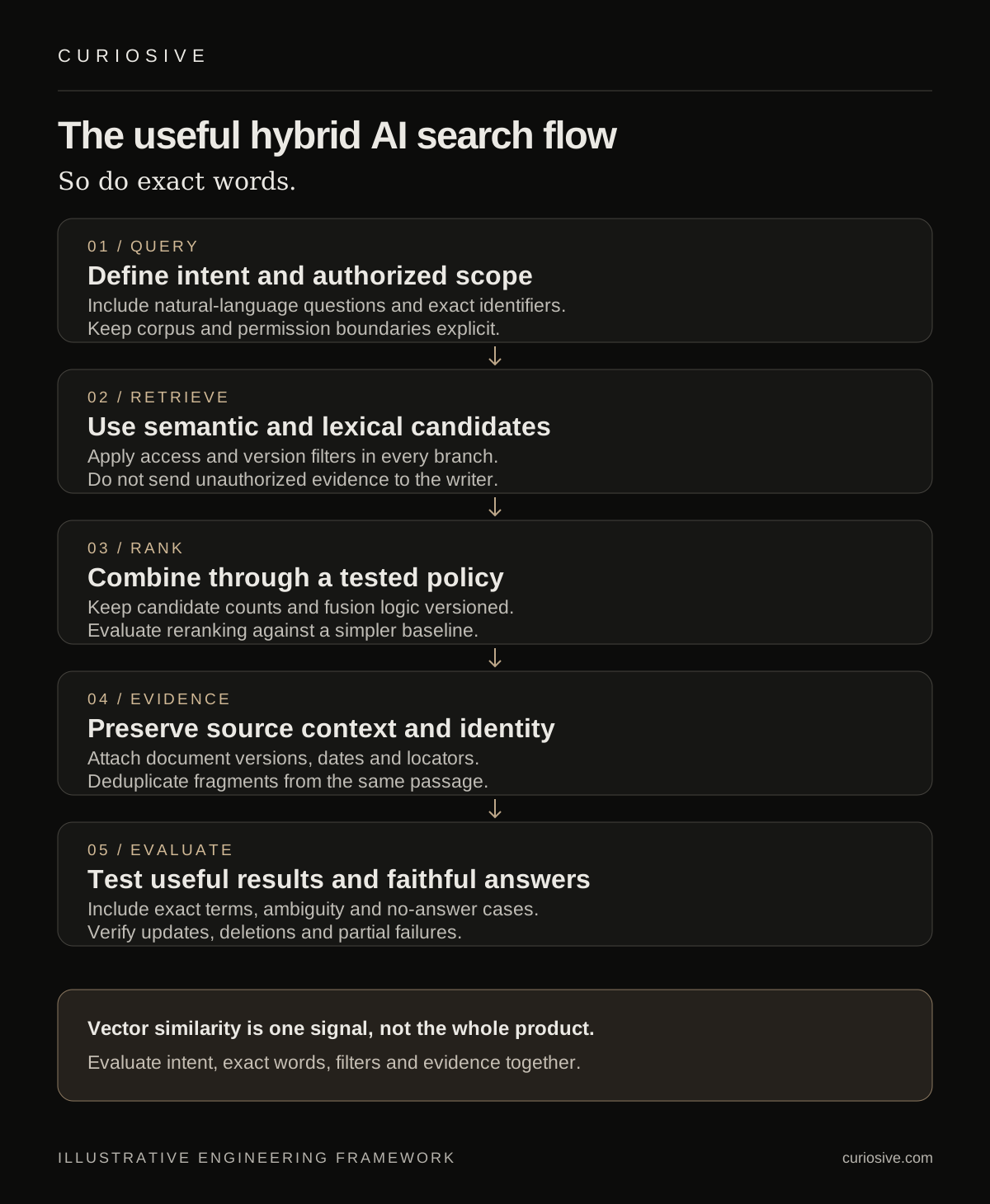
turbopuffer’s hybrid search documentation describes combining vector retrieval and BM25 full-text search, followed by rank fusion and optional reranking. The docs distinguish semantic relevance from matches to specific words or strings.
In a client architecture, preserve both candidate sets long enough to understand what contributed to the final ranking. Do not assume raw scores from separate retrieval methods have the same meaning or can be added without a defined policy.
Use a tested fusion strategy and evaluate it on real query types. Reranking may help select among candidates, but it adds another stage with its own latency, cost and failure behavior. A simpler baseline is useful for deciding whether that stage earns its place.
Make the application’s search logic explicit and versioned. A change to candidate counts, filtering or ranking can alter the evidence passed to an AI answer even when the generation model remains unchanged.
Filters must preserve authorization and context
Apply document permissions before evidence reaches the answer writer. A relevant excerpt is still unsuitable if the user cannot access it. Keep workspace, document and product-version boundaries attached to candidates and returned sources.
Do not rely on the language model to remove private evidence after receiving it. That places the boundary too late. The retrieval layer should enforce the caller’s authorized scope, and the source links in the response should respect the same scope.
Version filters also matter. Documentation for an older API can be semantically similar to the current question while giving the wrong instruction. Show the source version and date where those affect interpretation.
Test filters in combination with ranking, not only as isolated database predicates. A ranking change must not bypass an access or version constraint in a different retrieval branch.
Give chunks stable identities and useful context
A chunk should retain a source identifier and a locator back to its document. Keep enough surrounding context to interpret its claims. Very small excerpts may match a query while omitting the qualification that changes the answer.
Choose chunking around document structure and test it. Headings, tables and procedural steps have different context needs. Treat overlapping chunks as candidates from the same source, not independent confirmation of a claim.
Deduplicate results before presentation where appropriate. A search page filled with adjacent fragments of one document can hide useful alternatives. An AI answer with several citations to the same underlying passage can look better supported than it is.
Our AstaBrief report analysis discusses how retrieved excerpts become a verifiable report. Hybrid retrieval is the earlier stage that determines which evidence the writer receives.
Evaluate exact-match and semantic queries separately
Build a reviewed set of queries with expected useful documents. Include natural-language questions, exact identifiers, misspellings, ambiguous terms and queries that should return no answer. Add permission and product-version cases.
Compare lexical-only, vector-only and hybrid baselines on the same corpus. Measure whether useful results appear near the top, not just whether the search returns something. Examine categories where adding a retrieval method makes the result worse.
Ranking metrics can help track changes, but read the failures. A result that scores well overall may miss a critical error-code query. Also inspect whether the final answer cites the retrieved evidence faithfully.
Our multilingual retrieval analysis covers another source of variation: the language and source path used by the query. Include the languages your product actually supports rather than assuming one query set represents all users.
Freshness, deletion and failure are product behavior
Define how an update reaches the searchable corpus and how stale versions are removed. A changed document and its old embedding can coexist unintentionally unless the ingestion process tracks versions consistently.
Deletion deserves its own verification. An obsolete or access-revoked document should not remain available through another retrieval branch or a stored answer artifact. Test the entire path from source change to search result.
Make partial retrieval failure visible. If the lexical branch times out, do not silently label the remaining semantic candidates as the full hybrid result. Decide whether the feature can present a degraded search or should pause answer generation.
Bound candidate counts, payload sizes, retries and reranking work. Measure cost and latency across the whole request. The production AI architecture guide covers these surrounding controls.
Build AI search around the user’s question
turbopuffer’s redesign highlights how search workloads outgrow one organizing assumption. Its v3 performance work and rollout remain in progress in the cited announcement. Client teams can still act on the broader product lesson now: evaluate intent, exact terms, filters and evidence together.
If your AI feature retrieves the wrong documents or misses precise identifiers, bring the query examples to Curiosive. We can discuss an AI integration around the corpus, access policy and acceptance tests. Explore our work for product context.
Sources and scope
Reviewed October 3, 2026: turbopuffer’s redesign announcement, September 30, hybrid search documentation and HN discussion. Storage plans and documented capabilities are vendor-reported. Workflow, evaluation and client examples are Curiosive recommendations. No v3 benchmark or production deployment result is claimed.
Frequently asked questions
Does the redesign mean vector search is obsolete?
No. turbopuffer describes changing ANN from the primary organizing index to a secondary index. Vector retrieval remains part of the search architecture.
Was turbopuffer v3 already rolled out in the announcement?
The post describes correctness work, upcoming performance evaluation and a future production rollout. Planned gains should not be stated as available results.
Put this into practice
Explore the services related to this article.
A short note about the product, the timeline and who it is for is enough to start. You will hear back from the engineer who would do the work, not a sales team.
Start a partnership