Membership platform access: a checklist for Nordic teams
- SaaS
- Authentication
- CMS
- Membership platforms

A member can sign in successfully and still be unable to open a resource. A subscription can be active while a lesson remains an editorial draft. A saved link can outlive the permission that originally made it useful. These are different states, and a membership platform brief needs to describe each one.
This checklist is for English-working product, learning and community teams in Sweden, Norway, Denmark and Finland. Use one shared access policy and a concrete rehearsal across the team. The regional audience does not create a special technical requirement: agree working language, review ownership and how scheduled times are displayed. The examples below are proposed acceptance criteria for a new product, not reports of Nordic client deliveries.
Start with published evidence and its limits
Curiosive's Release Coach AI case describes a React and TypeScript platform on Supabase with authentication, a members dashboard, progress tracking, Stripe subscriptions and an admin panel for curriculum and memberships. That establishes delivered member and subscription workflows. It does not establish the cancellation timing, event reconciliation or session-revocation rules proposed in this checklist.
The This is HCD case, recorded in Ireland, describes free courses, member bookmarks and course progress. Sanity holds curated editorial content; Supabase holds accounts and member activity. It supports separating publication from member records. Its free-course scope does not establish a paid-course entitlement implementation. Neither case is evidence of a Nordic office, regulatory certification or measured commercial result.
Define four independent decisions
- Identity: which account is making this request, and is its current session valid? An email address in a support message or possession of a saved URL is not sufficient proof of account ownership. Define supported sign-in, recovery and session-expiry behavior.
- Subscription state: what does the authoritative billing record say, including any scheduled change and its effective instant? Agree the meaning of trial, active, past due, cancellation requested and ended for your product. A cancellation request need not mean access ends immediately.
- Content permissions: which resources and actions may this account use now? Translate approved plans, roles and any separate grants into explicit permissions. Check overlapping grants before removing shared access. Being authenticated is not a permission to read every member's records.
- Editorial publication: which content edition has an editor approved for this audience? A paid member should not automatically see drafts. Publishing a lesson should not automatically grant every signed-in account access to it. Define withdrawal separately from subscription expiry.
Give each decision an owner and source of truth. The full stack development service scopes the account and permission boundary; Sanity CMS development scopes content modelling and editorial ownership. The connection between those systems needs an agreed contract.
Use an access matrix before designing the screens
For this fictional product, the premium library requires a current grant, the public archive is open, and only an authorized editor can preview a draft. The matrix assumes no other grant unless a row says otherwise. Apply its rules to the resource request, including media or download endpoints, rather than relying on a hidden navigation item.
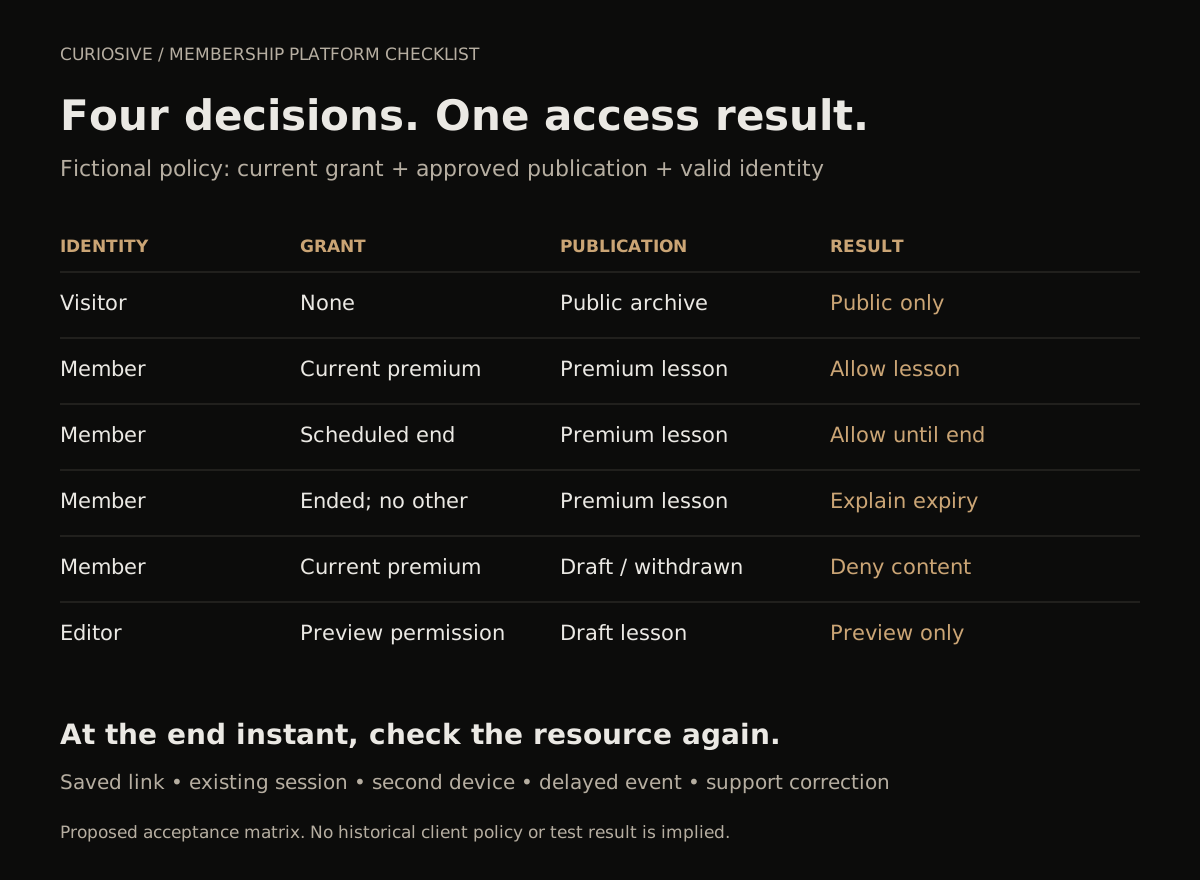
Read the matrix as identity / grant / publication → expected result:
- Visitor / none / published public archive → public content only. A member bookmark URL may lead to sign-in, without exposing another account's saved list.
- Signed-in member / current premium / published premium lesson → allow that lesson. The grant covers this resource and action; it does not expose another member's progress.
- Signed-in member / scheduled end still in the future / published premium lesson → allow until the agreed end instant. Show the scheduled change without labelling access already ended.
- Signed-in member / ended, with no other grant / published premium lesson → explain unavailable access. Keep permitted account history and bookmark references under the agreed retention policy; the bookmark itself grants nothing.
- Signed-in member / current premium / draft or withdrawn lesson → deny the member content request. Explain unavailability without returning the unpublished body or private media URL.
- Authorized editor / preview permission / draft lesson → allow the approved preview route only. This staff permission does not create a paid membership or permission to inspect arbitrary member records.
Write a matching rule for past-due subscriptions, trials and manual grants if the product uses them. Do not copy a vendor's state label into the interface without deciding what access it means. The SaaS development service can turn these rules into a scoped member and support workflow.
Rehearse a scheduled change with a fictional member
Use fictional member M-27, account A-27, subscription S-8 and published premium lesson L-12. A-27 has saved L-12 and completed an earlier lesson. Cancellation is requested now, with premium access ending at the explicitly agreed test instant 2026-11-01T10:00:00Z. For this exercise, the end boundary is exclusive: requests at or after that instant require another current grant. Choose the product's display time zone and show the equivalent time clearly to members and support; avoid an ambiguous label such as midnight.
M-27 remains a valid account after premium access ends. This exercise retains their saved references and progress under the agreed policy. It does not delete the account or assume indefinite retention. Run the following against a controlled clock or test fixture, not by changing a real member's subscription.
- Before the boundary: sign in, open L-12 and follow its saved link. All use the current premium grant. The account screen shows the scheduled end. The billing record and visible access explanation agree.
- At and after the boundary: repeat the protected request in the existing session. The server evaluates the current grant and returns the agreed unavailable state. Repeat in a second device session and a newly signed-in session. An old login or cached navigation must not keep authorizing fresh protected requests.
- Already displayed content: document what remains visible in an open tab and when the interface refreshes. Previously delivered bytes or downloaded files cannot be promised to disappear. If media uses signed URLs, agree their lifetime and test that boundary separately from the next application request.
- Saved links and history: open the bookmarked lesson directly after expiry. Show a useful destination and access explanation without the protected lesson. The bookmark and permitted progress remain attached to A-27. A different account must not inherit them by opening the same URL.
- Overlapping access: repeat with a separate, approved grant for L-12. Ending S-8 removes only its contribution. Verify both the shared lesson that remains available and a premium-only lesson that becomes unavailable.
- Publication change: restore a valid test grant, then withdraw L-12 through the editorial workflow. The direct lesson URL and media requests follow the withdrawal rule despite active membership. Restoring publication still requires a current grant on a later request.
Record expected and observed results for every step, including the resource, account, session, policy version and effective instant. A screenshot of the account badge alone is not evidence of the protected endpoint's decision.
Treat delayed and repeated events as reconciliation cases
A membership brief should say how access becomes current when billing notifications are delayed, repeated or received out of order. Define how the system authenticates an incoming notification, records its identity and reconciles the authoritative subscription state. A repeated event should not create another grant or extend its end date. An older arrival should not undo a later confirmed change merely because it was processed last.
For S-8, delay the cancellation notification beyond the test boundary, deliver it twice, then deliver an earlier active-state notification. Verify the chosen reconciliation process and the resulting grant. If notification delivery is the only expiry mechanism, a delay may leave access open too long. Specify how the effective end instant is enforced at protected requests and how unresolved state is handled. Choose a recovery time target the team can test; do not promise instant synchronization without evidence.
Keep any shared content cache separate from the account's access decision. Verify that cached HTML, resource responses and media delivery do not reuse another account's private result. Define the outage behavior as well: an unavailable permission source needs an explicit outcome rather than a cached assumption that access is still valid.
Give support a bounded correction path
If M-27 reports a wrong access result, support first verifies the account through the approved process and inspects the subscription reference, effective time and current grants. Avoid requesting passwords, session tokens or private lesson content in an ordinary ticket. Distinguish a stale screen, an unresolved billing update, a wrong grant and an unpublished resource before changing anything.
For a confirmed error, an authorized operator follows a recorded correction procedure: review the current authoritative state, apply the smallest approved adjustment, record who changed what and why, then rerun the existing-session, second-device and saved-link checks. Repeating the same correction must not create duplicate access. If a temporary grant is approved, give it an explicit scope, expiry and review owner; do not silently convert a support workaround into a permanent entitlement or edit billing history to match a screen.
Bring a small acceptance packet to discovery
Prepare the four-state definitions, the access matrix, fictional accounts and resources, exact timing rules, event rehearsal results and the authorized support procedure. Include what happens during a source-system outage and who reviews unresolved access. Product design can make the member's explanation, editor preview and support correction understandable before implementation.
For adjacent planning, the Sweden sign-in return guide covers returning from authentication, the Denmark SaaS import guide covers reviewing account-data changes, and the Finland workspace export guide covers controlled customer exports. Those are separate scopes, not additional membership case studies. English-working teams across Sweden, Norway, Denmark and Finland can use this single membership checklist without creating different access rules solely from a country label.
Sources and scope
The two published Curiosive case studies linked above were checked on 16 October 2026. The matrix, M-27 scenario, event handling questions and support procedure are proposed requirements for a new engagement. They are not claims that either referenced project shipped these exact policies or passed these tests. Access policy and retention decisions belong in the agreed product scope.
Frequently asked questions
Does signing in prove that a member may open a lesson?
No. A valid identity, a current resource permission and an approved content edition are separate requirements. Evaluate protected requests against the agreed policy rather than treating a successful login or saved link as an entitlement.
When should a scheduled cancellation remove access?
At the effective instant defined by the product policy. The fictional exercise allows access before 2026-11-01T10:00:00Z and requires another current grant at or after that instant. Cancellation requested, access ended and account deletion are separate states.
What should happen to saved links and existing sessions after access ends?
A saved reference can remain under the retention policy while the protected resource becomes unavailable. Test direct links, existing sessions and a second device. Fresh protected requests must use the current permission; previously delivered content cannot be promised to disappear.
How should a team test delayed or repeated billing events?
Delay the scheduled-change notification, deliver it twice and then deliver an older active-state notification. Verify authenticated event handling, reconciliation with authoritative subscription state, enforcement of the effective end instant and correction without duplicate grants. These are proposed acceptance checks.
Which delivered work supports this checklist?
Release Coach AI demonstrates authentication, member workflows, subscriptions and administration. This is HCD, recorded in Ireland, demonstrates free courses, bookmarks, progress and separate editorial and member data. The matrix and fictional M-27 rehearsal are proposed new scope, not historical test results from either project.
Put this into practice
Explore the services related to this article.
A short note about the product, the timeline and who it is for is enough to start. You will hear back from the engineer who would do the work, not a sales team.
Start a partnership