MedGuide: AI clinical summaries from patient records
A Next.js application and document pipeline that turn patient records in any format or language into structured clinical summaries, using Gemini for extraction.
The product problem
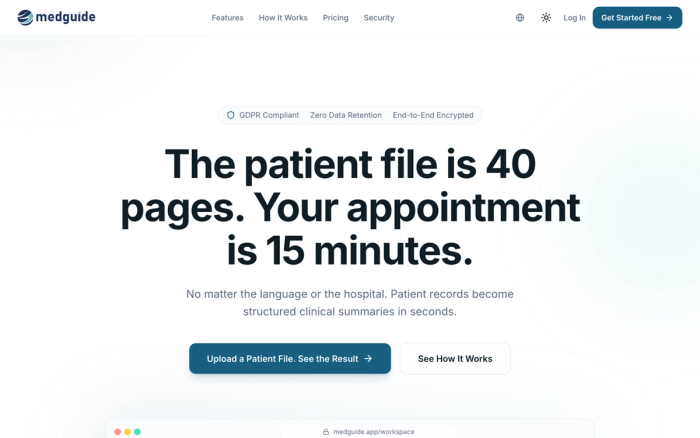
Clinics, hospitals and healthcare teams receive patient records as PDFs, scans and photographs, in whatever language and format the originating hospital used. A clinician may have only a fifteen-minute appointment to understand a long and unfamiliar file. The product has to turn that material into a structured summary a clinician can read quickly, while respecting the handling constraints that medical data carries.
The delivered scope
The web application is built in Next.js and TypeScript with Supabase. It covers upload, a document viewer, structured report dashboards, translations, follow-up chat, PDF export and subscription billing. A NestJS backend runs the document pipeline as queued jobs: extraction, validation, translation with layout preservation and report building. Gemini on Google Cloud performs the extraction. The product is built around end-to-end encryption, zero retention and GDPR compliance.
Treating extraction as a pipeline, not a prompt
Medical documents vary in layout, quality and language, so a single model call is not enough. Separating upload, extraction, validation, translation and report building gives each step its own checks and failure handling. For a similar AI integration, scope should cover the documents the system will actually receive, how output is validated before a professional reads it, and how sensitive data is handled at every step.
What shipped
A clinical document intelligence product that turns mixed-format patient records into structured summaries through a Next.js application and a Gemini-backed processing pipeline.
Visit the project ↗Industry scopes for a new US project
Roswell, New Mexico · Exhibitor-document intake portals
For Roswell event teams collecting exhibitor documents with event-edition identity, source-linked draft extraction and staff review.
Roswell, New Mexico · Exhibitor-document intake portals: scope and discovery questions →Hattiesburg, Mississippi · Equipment-manual translation portals
For Hattiesburg equipment-software teams connecting source-manual editions, translated sections and explicit reviewer approval before publication.
Hattiesburg, Mississippi · Equipment-manual translation portals: scope and discovery questions →Akron, Ohio · Supplier-document review software
For Akron industrial-software teams connecting supplier document versions, extracted fields and source references to a reviewed internal record.
Akron, Ohio · Supplier-document review software: scope and discovery questions →Iowa City, Iowa · Research document review tools
For Iowa City research-software teams connecting document processing to source-aware review, explicit job states and deliberate output export.
Iowa City, Iowa · Research document review tools: scope and discovery questions →Cleveland, Ohio · Multilingual clinical-document review tools
For Cleveland healthcare product teams connecting a translated document and structured report to the source a professional needs to review.
Cleveland, Ohio · Multilingual clinical-document review tools: scope and discovery questions →Jackson, Mississippi · Clinical document processing operations
For Jackson healthcare product teams giving operators a clear recovery path when document extraction or report processing stops.
Jackson, Mississippi · Clinical document processing operations: scope and discovery questions →Sacramento, California · Clinical document processing products
For Sacramento healthcare product teams connecting mixed-format document intake, processing status and professional review in one application.
Sacramento, California · Clinical document processing products: scope and discovery questions →