Choosing an outsourcing company

How to Choose a Software Development Company to Outsource To

Outsourcing software development has a reputation, and parts of it are earned. Account managers sitting between you and the engineers. Developers swapped without notice. Code that arrives as a zip file with no explanation attached. It is worth naming that before making any case for it.

This page is the set of questions we would ask if we were on your side of the table, with our own answers written next to them. Curiosive is a studio of senior engineers in Ankara, Türkiye, with 25 products in production across 13 countries and more than five years of shipping software that has to stay up.

25
products shipped and running
5+
years building for production
13
countries the work runs in
100%
of code read by a senior engineer
1 day
to hear back, from the engineer
01

Ask who actually writes the code

The person you meet in the sales call is often not the person who writes your software. Ask to speak with the engineer who would do the work, and ask whether they will still be on the project in three months. With us there is no sales layer: the first reply comes from the engineer who would build it.
02

Ask how many hours you genuinely share

Overlap decides how a week feels. Four shared hours means a question gets answered the same day. Zero shared hours means every question costs a day. Türkiye gives European teams nearly a full working day of overlap and US East Coast teams a real afternoon window. Ask any prospective partner for the number, not the reassurance.

03

Ask who reads the code before it merges

Volume of code is no longer the constraint, AI produces plenty of it. The constraint is judgement about what should not ship. Every change we make is read by a senior engineer before it merges, and the boundaries that matter, authorization, payment paths, anything touching user data, are designed by a person rather than generated.

04

Ask what the exit looks like

The question that separates a partner from a vendor is what happens when you leave. Where does the code live, whose name is on the hosting account, is there a document that explains the deployment. Ask it in the first conversation rather than the last, because the answer shapes everything in between.

05

Ask for products you can open right now

Case study PDFs are easy to write. Live URLs are not. Every project on this site is a link you can click and use: Zing Coach with more than a million users, RateItAll carrying 12 million reviews, the Detailed SEO Extension with 600,000 installs, later acquired by Ahrefs.

Proof

Products we shipped with exactly this.

Questions

The things people ask before starting.

How big is the team?

Small on purpose. You work with senior engineers directly rather than through an account manager, and the person who scopes the work is the person who builds it. When a project needs more hands we say so before committing rather than quietly adding juniors.

Is outsourcing cheaper than hiring?

Usually, but that is the wrong first question. Hiring gives you permanent capacity and takes months. Outsourcing gives you capacity this month with no long term commitment. The cost that decides the outcome is the one you cannot see on the invoice: how much of your own team's time goes into supervision.

What if we already have developers?

Then we work inside your process rather than beside it: your repository, your branching strategy, your review rules. Several of our engagements are additional capacity for an existing team rather than a replacement for one.

How do you handle sensitive data?

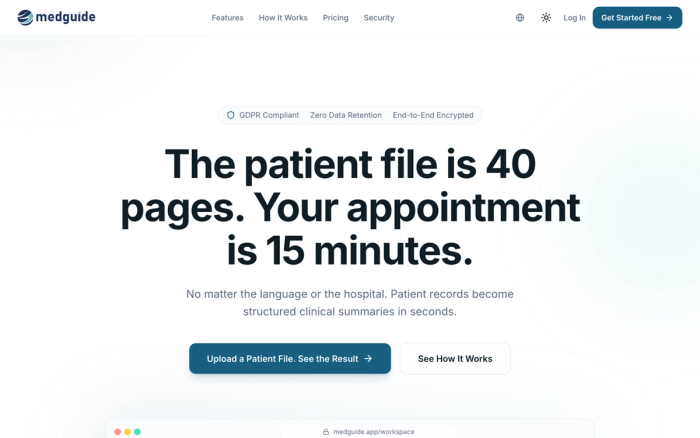
By treating it as a design constraint rather than a checklist. MedGuide processes medical records under GDPR with zero data retention and end to end encryption, which shaped its architecture from the first sketch rather than being added at the end.

How quickly can you start?

You get a reply within a working day, from the engineer who would do the work. A scoped plan with price and timeline follows before anything is committed.

How it starts

What happens after you write to us.

  1. 01

    You describe the product

    One paragraph on what you are building, roughly when you need it, and who it is for. No brief, no form with fifteen fields.

  2. 02

    You get a reply within a day

    From the engineer who would do the work, not a sales team. If we are not the right fit we say so, and where possible we point you somewhere better.

  3. 03

    You get a scoped plan

    Scope, price and timeline in writing before anything is committed. You decide with the numbers in front of you.

No long contract to begin, no lock-in to our tooling, and the code is yours from the first commit.

Start a conversation
Contact

Looking for an engineering partner for the long haul?

A short note about the product, the timeline and who it is for is enough to start. You will hear back from the engineer who would do the work, not a sales team.

Ankara / Türkiye · Working across European and US time zones